
The short answer
Klaviyo is an email and SMS marketing platform built for ecommerce. It connects to your online store, records what every customer browses and buys, and uses that data to send automated flows, such as abandoned cart and post-purchase emails, and targeted campaigns to precise segments. It works by turning store activity into triggers and audiences. Its strengths are deep store integration, flexible segmentation, built-in SMS and revenue reporting. It costs more than basic email tools as lists grow, so it pays off when email is a real revenue channel.
Most online stores reach the same point sooner or later. The newsletter tool they started with can send emails, but it cannot easily tell who abandoned a checkout yesterday, who has bought three times, or who is about to run out of the product they ordered six weeks ago. That is the gap Klaviyo was built to fill.
Klaviyo has become the default email platform for a large share of growing ecommerce brands, especially on Shopify. We build and manage Klaviyo accounts for clients in the UK, US, Gulf and elsewhere, including Fit Kit Bodycare, where rebuilt flows lifted revenue from flows by 29% with a 41% average flow open rate.
This guide explains what Klaviyo actually is, how it connects to your store, the flows and segments that matter, how SMS fits in, what it costs, the mistakes new users make and a realistic plan for the first 30 days.
What Klaviyo actually is, in plain terms
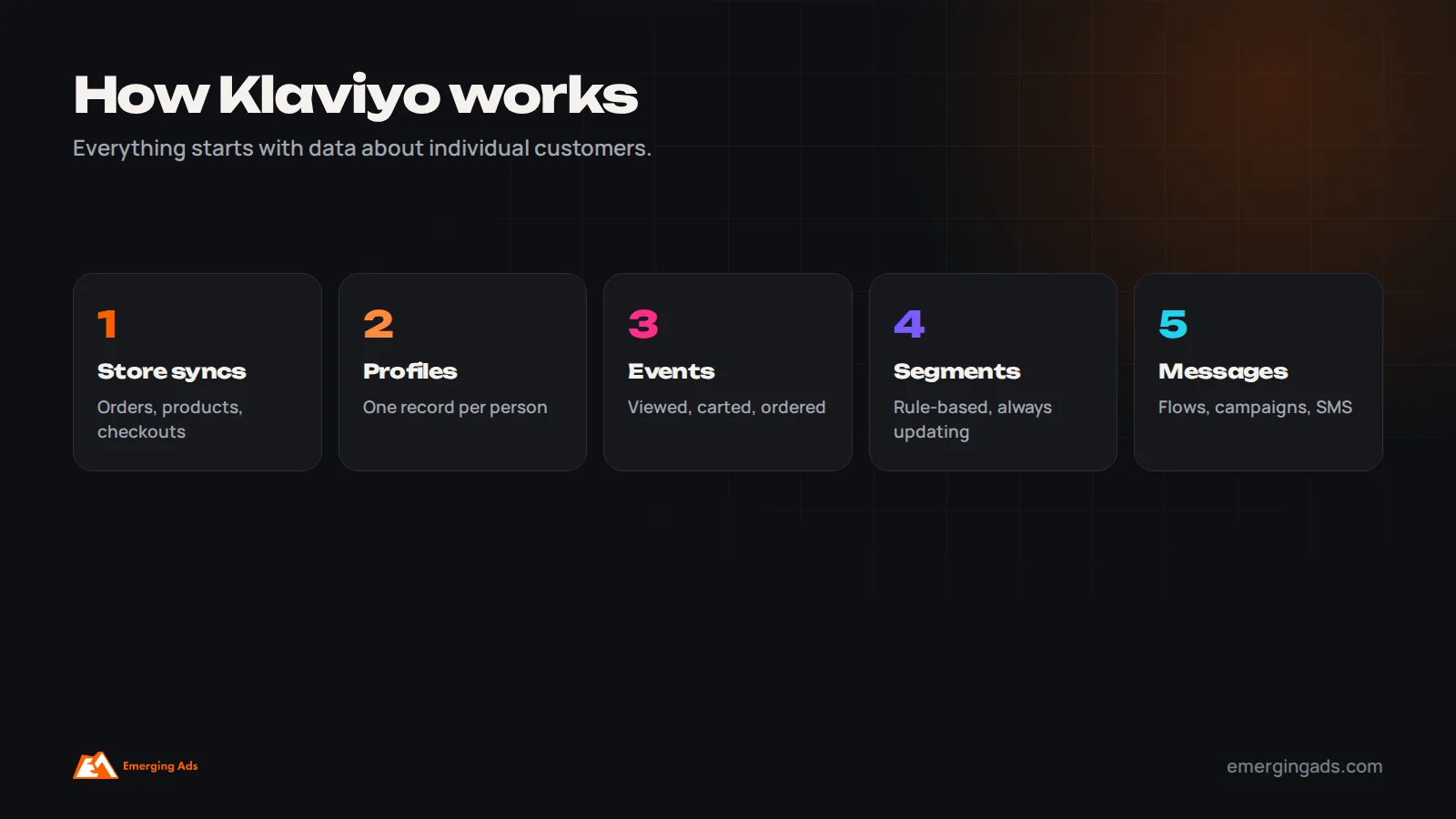
At its core, Klaviyo is a customer database connected to messaging tools. Every person who subscribes, browses your store while identified, or buys becomes a profile. Each profile holds properties, such as name, location and preferences, and a timeline of events, such as viewed product, added to cart, started checkout, placed order and opened or clicked an email.
On top of that database, Klaviyo provides email and SMS sending, signup forms, automated flows, one-off campaigns, segmentation, reporting and, depending on the plan, predictive analytics, product reviews and customer service tools.
The important idea is that everything is driven by data about individual customers. Instead of “send this email to everyone on Tuesday”, you can say “send this email to people who bought a moisturizer between 40 and 50 days ago and have not reordered”.
Lists, segments, profiles and events
Four concepts explain most of how Klaviyo works:
- Profiles: one record per person, with their properties, consent status and activity history.
- Events (metrics): things that happen, such as Viewed Product, Added to Cart, Placed Order, Opened Email or Clicked SMS. Events trigger flows and power segments and reports.
- Lists: static groups that people join, usually by subscribing through a form. A list is a record of who signed up.
- Segments: dynamic groups defined by rules, such as “placed an order at least twice and engaged in the last 90 days”. People move in and out automatically as their behavior changes.
Most beginners send everything to lists. Most experienced users send almost everything to segments, because segments target people by what they actually do.

How Klaviyo connects to your store
Klaviyo integrates natively with Shopify, WooCommerce, BigCommerce, Magento and other platforms. Once connected, it imports historical customers and orders, then syncs new activity in near real time: products, collections, orders, refunds, checkouts and, through Klaviyo’s onsite tracking, product views and other browsing activity from identified visitors.
For Shopify, setup typically involves installing the app, enabling onsite tracking, syncing historical data, connecting your sending domain and choosing how email and SMS consent from Shopify checkout syncs to Klaviyo. Getting consent sync right matters: you should only market to people who agreed to it.
Other integrations add more data: reviews platforms, loyalty programs, subscription apps, helpdesks and quizzes all send events that can trigger flows or define segments.
What a customer journey looks like in Klaviyo
It helps to follow one customer through the system. Imagine Sara visits a skincare store from an Instagram ad and signs up through a popup for a first-order discount. Klaviyo creates her profile, adds her to the newsletter list and starts the welcome series, which sends her code immediately.
Two days later she browses a vitamin C serum and a moisturizer but does not add either to cart. Because she is identified, Klaviyo records the product views, and the browse abandonment flow sends a gentle reminder featuring those products. The next week she adds the serum to her cart and starts checkout, then leaves. The abandoned checkout flow sends a reminder an hour later, then an email answering common questions about the serum the next day. She buys.
Her order triggers the post-purchase flow: a thank-you, then tips for using the serum when it arrives, then a review request, then a suggestion for the moisturizer she looked at earlier. Klaviyo’s prediction suggests she will need more serum in about seven weeks, so a replenishment email arrives shortly before then. Meanwhile, she is added to segments such as first-time buyers and skincare buyers, so campaigns about new skincare launches reach her, while haircare promotions do not.
Every step was triggered by something she did, and none of it needed anyone to press send.
Now imagine the same store without Klaviyo. Sara gets the discount code, then a weekly newsletter about whatever the store is promoting that week, regardless of what she looked at, what she bought or whether she is likely to need more. Some of those emails will be relevant by chance. Most will not. The difference between those two experiences, multiplied across thousands of customers, is the difference Klaviyo makes to email revenue.
The automated flows every store should have
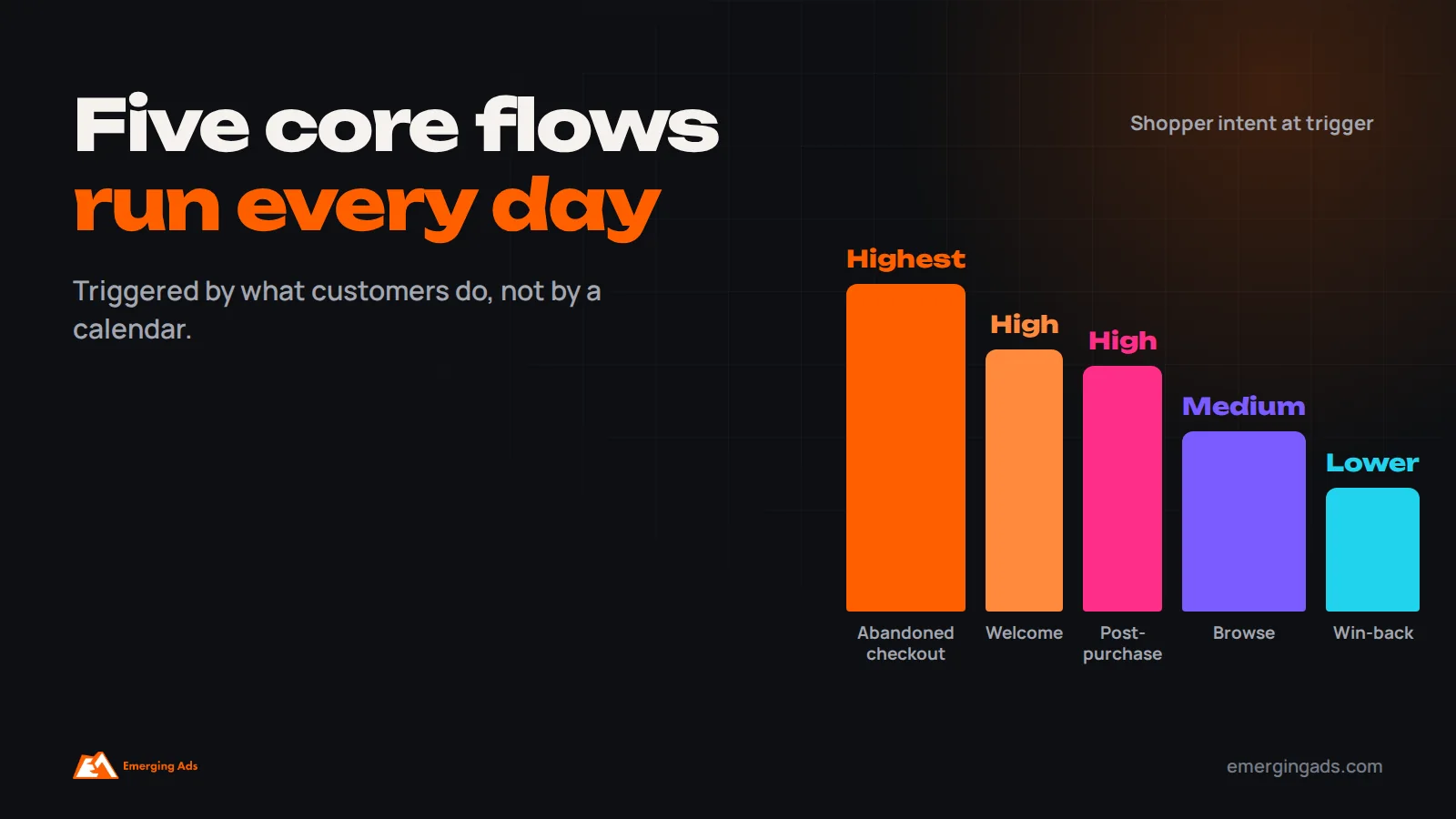
Flows are automated sequences triggered by an event, a list or segment entry, or a date. They run continuously and usually produce a large share of Klaviyo revenue for most stores. The core five are:
- Welcome series, triggered when someone joins your list.
- Abandoned checkout and abandoned cart, triggered when someone starts checkout or adds to cart without buying.
- Browse abandonment, triggered when an identified visitor views products without adding any.
- Post-purchase, triggered by an order, covering thanks, education, reviews and cross-sells.
- Win-back, triggered when a customer has not ordered for longer than usual.
Klaviyo includes pre-built templates for all of them, which are a reasonable starting point but rarely the finished article. Each flow should use conditional splits and filters so the message fits the person, for example skipping the brand story for returning customers, and stopping as soon as someone buys. We cover timing and content for each in our guide to the five essential ecommerce email flows.
Segmentation: Klaviyo’s real strength
Segmentation is where Klaviyo most clearly outperforms basic email tools. Segments can combine almost any data Klaviyo holds: purchase history, products and categories bought, order value, number of orders, browsing behavior, email and SMS engagement, location, predicted customer value and custom properties.
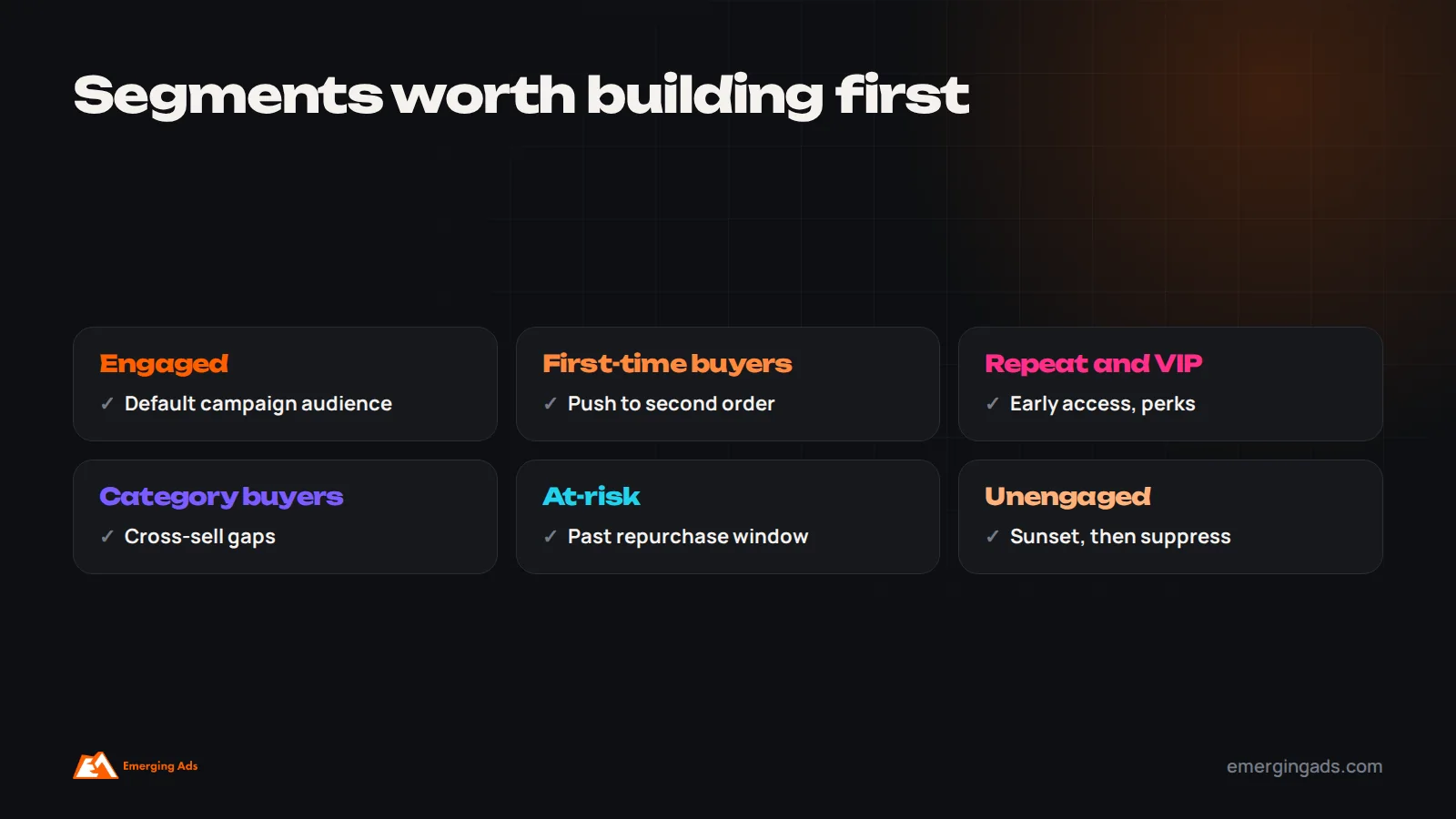
The segments we build for nearly every client include:
- Engaged subscribers, people who opened, clicked or bought recently, used as the default audience for most campaigns to protect deliverability.
- First-time buyers who have not yet made a second purchase.
- Repeat and VIP customers, by number of orders or total spend.
- Category buyers, such as people who bought skincare but never haircare.
- At-risk customers whose usual repurchase window has passed.
- Unengaged subscribers, excluded from most sends and targeted by a sunset flow.
Sending each campaign to the right segment rather than the whole list usually raises revenue per recipient and protects sender reputation at the same time.
Campaigns: one-off sends done properly
Campaigns are one-time emails or texts, such as product launches, sales, newsletters and announcements. In Klaviyo, the best practice is to send most campaigns to engaged segments, use smart send time or test send times, A/B test subject lines on larger lists, and use dynamic content blocks so different segments see different products or messages within the same email.
A sensible campaign calendar for many stores is one to three emails a week to engaged subscribers, more around major sales, and fewer to less engaged people. Watch unsubscribe and spam complaint rates, which tell you if frequency is too high.
SMS and email working together
Klaviyo includes SMS in the same platform, sharing profiles, flows and reporting. That lets you coordinate channels, for example sending an abandoned checkout text only to people who did not open the email, or using SMS for time-sensitive launches and email for richer content.
SMS requires separate, explicit consent, and rules vary by country. It also costs more per message than email and is more intrusive, so use it for high-value moments rather than every campaign. In markets where WhatsApp is the preferred channel, such as much of the Gulf and India, a WhatsApp tool alongside Klaviyo often makes more sense than SMS. Our WhatsApp marketing team often runs this combination.
Signup forms and list growth
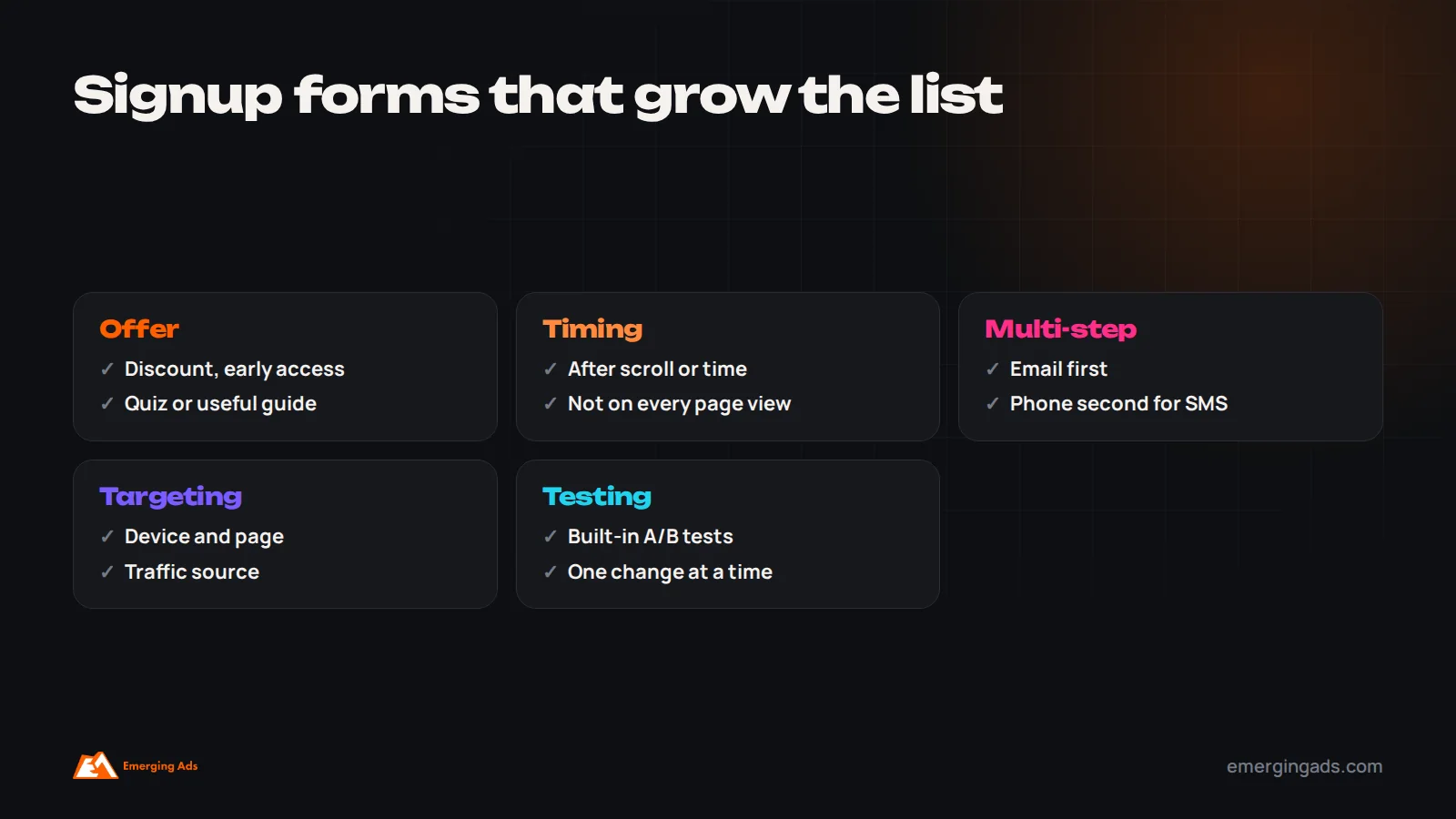
Klaviyo’s form builder creates popups, flyouts, embedded forms and full-page forms, with targeting by device, page, traffic source and visitor behavior, plus built-in A/B testing. Multi-step forms can collect an email first and a phone number second, which increases SMS signups without hurting email signups.
The offer matters most: a first-order discount, free shipping, early access, a quiz result or a useful guide. Time the popup sensibly, such as after some scrolling or time on page, and avoid showing it again immediately to people who closed it.
Predictive analytics and AI features
Once a store has enough order history, Klaviyo can predict values for each customer, such as expected lifetime value, likelihood of churn and expected date of next order. These predictions can define segments, for example “high predicted value customers who have not ordered in 60 days”, or time replenishment emails.
Klaviyo has also added AI features for subject lines, content and segment building. They speed up routine work, but the strategy, offer and brand voice still need human judgment.
How Klaviyo use differs by store type
Consumables and subscriptions, such as supplements, skincare, coffee and pet food, get the most from replenishment flows, predicted next order dates and subscription app integrations. The priority is getting the second and third order.
Fashion and apparel rely heavily on browse and cart abandonment, back-in-stock alerts, size-specific segments and frequent new-arrival campaigns. Visual, product-led emails work well.
High-ticket and considered purchases, such as furniture, electronics and equipment, need longer, more educational flows, comparison content and social proof, with fewer, more helpful emails rather than frequent promotions.
Gifting brands see strong seasonal peaks and benefit from date-based flows, such as reminders before birthdays or anniversaries a customer bought for last year.
Multi-market stores need segments and flows by country and language, with correct currency, shipping messages and local holidays.
Reviews, loyalty and other integrations
Much of Klaviyo’s value comes from connecting other tools. Reviews platforms can trigger review requests and feed star ratings into emails. Loyalty programs send points balances and tier changes, which make excellent triggers and personalization. Subscription apps send renewal, skip and cancellation events for retention flows. Helpdesk integrations let support teams see email history and pause marketing to customers with open complaints. Quizzes pass answers into profiles, which personalize product recommendations. Klaviyo also offers its own reviews and customer service products, which some brands use instead of separate tools.
Klaviyo vs Mailchimp and other email tools
Klaviyo goes deeper on ecommerce data and segmentation. Mailchimp and similar tools are often simpler and cheaper for small lists and basic needs. The right choice depends on how much revenue you expect email to drive and who will run it. We compare the two in detail in Klaviyo vs Mailchimp for ecommerce.
What Klaviyo costs, and how that scales
Klaviyo prices email plans mainly by the number of active profiles, meaning people you can market to, with SMS priced by message credits. There is a free tier for very small lists. Pricing has changed several times in recent years, so check Klaviyo’s current pricing page rather than relying on figures from older articles.
Three things keep costs under control:
- Suppress unengaged profiles regularly, so you do not pay to keep people who never open.
- Avoid importing old or purchased lists, which inflate profile counts and damage deliverability.
- Judge cost against revenue. If Klaviyo flows and campaigns drive a meaningful share of store revenue, the subscription is usually a small fraction of what it earns.
Deliverability basics in Klaviyo
Since 2024, Gmail and Yahoo require bulk senders to authenticate with SPF, DKIM and DMARC, offer one-click unsubscribe and keep spam complaint rates low. Klaviyo supports all of this, but you need to set up a dedicated branded sending domain rather than relying on a shared one.
Beyond setup, deliverability depends on behavior. Send mostly to engaged segments, run a sunset flow for people who have not engaged for a long time, warm up new sending domains gradually and watch Klaviyo’s deliverability reports for rising bounce or spam rates.
Reporting and attribution
Klaviyo reports revenue by flow, by message and by campaign, using an attribution window you can configure, typically counting purchases within a few days of an open or click. It also benchmarks your results against similar businesses.
Attributed revenue is generous by design, because some recipients would have bought anyway. Use it to compare flows and campaigns with each other, and compare Klaviyo’s total with actual store revenue to keep perspective. Click rate, conversion rate and revenue per recipient are more reliable than open rates, which Apple’s Mail Privacy Protection inflates.

Testing in Klaviyo
Klaviyo supports A/B testing in campaigns, flows and forms. In campaigns, subject lines, preview text, content and send times can be tested on a portion of the audience before the winner goes to the rest. In flows, you can split traffic between versions of an email or between different timing. In forms, you can test offers, designs and timing.
Test the things most likely to make a big difference first: the offer in the welcome flow, the timing of the first abandoned checkout email, whether the cart flow needs an incentive at all, and subject lines on the largest campaigns. Give each test enough recipients for a clear result and judge on revenue per recipient or placed order rate rather than opens.
Moving to Klaviyo from another platform
Most brands come to Klaviyo from Mailchimp, Shopify’s own email tool or another platform. A clean move involves exporting contacts with their consent status, connecting the store so historical orders sync, authenticating a sending domain and warming it up by sending to your most engaged subscribers first, rebuilding flows rather than copying them, replacing forms and switching off the old platform’s automations once the new ones are live, so nobody receives duplicates. Plan it for a quieter trading period, not the weeks before a major sale.
Running Klaviyo in-house or with an agency
Many brands run Klaviyo in-house successfully, especially once flows are built. The setup phase, including integration, flows, segments, forms and deliverability, is where specialist help most often pays for itself, because mistakes there affect every email afterwards. Ongoing campaigns are easier to manage internally if someone owns the calendar and has time to write and design. Brands with large lists, several markets or heavy SMS use often keep an agency for strategy, testing and new flow builds alongside an in-house team for day-to-day campaigns.
The Klaviyo numbers worth watching each month
A short monthly review keeps an account healthy. Look at revenue from flows and from campaigns separately, because flows should be steadily growing as traffic grows, while campaign revenue depends on your calendar. Check revenue per recipient for each major flow, which shows which flows need attention. Track list growth from forms, and the share of new subscribers who go on to buy. Watch deliverability signals: bounce rate, spam complaint rate and unsubscribe rate. And compare Klaviyo-attributed revenue with total store revenue, so the share email takes credit for stays believable.
If flow revenue is flat while store traffic grows, forms or flows are not keeping up. If campaign revenue rises but unsubscribes and spam complaints rise faster, frequency or targeting is too aggressive. If the share of revenue attributed to email keeps climbing without store revenue moving, attribution settings may be too generous.
For broader ideas on improving results once the basics are in place, read how to improve results with ecommerce email marketing.
Common mistakes new Klaviyo users make
- Sending every campaign to the whole list instead of engaged segments.
- Switching on template flows without editing timing, content or exit conditions.
- No sending domain authentication.
- Importing old or bought lists.
- Flows that overlap, so one person gets three emails in an afternoon.
- Discounts in every flow, training customers to wait.
- Judging success on open rates.
- Never suppressing unengaged profiles, raising cost and hurting deliverability.
A realistic first 30 days with Klaviyo
- Week 1: connect the store, enable onsite tracking, sync history, set up the branded sending domain and authentication, and configure consent sync.
- Week 2: build abandoned checkout and welcome flows, launch a signup form with a clear offer, and create core engagement segments.
- Week 3: build the post-purchase flow and browse abandonment, and send the first campaigns to engaged segments only.
- Week 4: add win-back and sunset flows, review flow performance, and set a campaign calendar for the next month.

How Klaviyo helps you scale paid ads
Email and SMS do not just earn revenue on their own. They change the economics of paid acquisition. When customers acquired through Meta or Google are worth more over time, you can afford to pay more to acquire them, which lets you scale ads further.
For The Simple Seed Baby, Klaviyo flows running alongside Meta ads helped raise the returning customer rate from 21.62% to 34.81% and average order value from $70.38 to $82.82. That retention is part of why the brand could keep scaling Meta at 5.30x ROAS. Our guide to scaling Meta ads explains the link.
Klaviyo beyond email
Klaviyo has expanded from an email tool into a broader customer platform. Alongside email and SMS, it now offers push notifications for brands with mobile apps, product reviews, customer service tools, audience syncing to ad platforms and customer data features that unify information from several sources. Audience syncing is particularly useful: segments such as recent purchasers or high-value customers can be sent to Meta and Google to exclude existing customers from acquisition campaigns or to build lookalike audiences from your best buyers. You do not need every feature, but it is worth knowing what is available before paying for separate tools that duplicate it.
Who should use Klaviyo?
Klaviyo is a strong fit for ecommerce brands on major platforms that want email and SMS to be a significant revenue channel, have enough traffic and customers to benefit from segmentation, and have someone, in-house or an agency, to build and maintain flows. It is less necessary for very small stores that only need a simple newsletter, and for businesses whose sales do not happen online.
If you want Klaviyo built properly, our Klaviyo email marketing team handles setup, flows, segmentation and campaigns, as part of our wider email marketing service.
Frequently asked questions
What is Klaviyo used for?
Klaviyo is used by ecommerce brands to send automated email and SMS flows, targeted campaigns and signup forms, based on detailed customer data synced from their online store.
How does Klaviyo work with Shopify?
Klaviyo’s Shopify integration syncs customers, orders, products and checkouts in near real time, and onsite tracking records browsing from identified visitors. That data triggers flows and builds segments.
What is the difference between a list and a segment in Klaviyo?
A list is a static group people join, usually by subscribing. A segment is a dynamic group defined by rules, such as purchase history or engagement, that updates automatically.
How much does Klaviyo cost?
Klaviyo prices email by the number of active profiles and SMS by message credits, with a free tier for small lists. Pricing changes periodically, so check Klaviyo’s current pricing page.
Is Klaviyo better than Mailchimp?
For most growing ecommerce stores, Klaviyo’s deeper store integration and segmentation make it the stronger choice. Mailchimp can be simpler and cheaper for small lists with basic needs.
Which Klaviyo flows should I set up first?
Abandoned checkout first, then the welcome series and post-purchase flow, followed by browse abandonment and win-back.
Does Klaviyo include SMS?
Yes. SMS shares profiles, flows and reporting with email, so you can coordinate both. SMS requires separate consent and is priced by message credits.
How long does it take to set up Klaviyo?
The core setup, including integration, sending domain, forms and the first two flows, can be done in a week or two. A full setup with five core flows and segments typically takes about a month.