
The short answer
The top SaaS SEO agency for your company understands how software buyers research, builds content around problems, use cases, comparisons and integrations rather than generic keywords, fixes technical issues common on SaaS sites such as JavaScript rendering and documentation sprawl, earns authority through genuinely useful assets, and measures success in signups, demos, pipeline and revenue rather than traffic. Location matters far less than SaaS experience and evidence of growing qualified pipeline for companies like yours.
SEO works differently for software companies. SaaS buyers research extensively, compare alternatives, read reviews, look for integrations, test free trials and often involve several people in the decision. The searches that bring valuable customers are rarely the obvious high-volume keywords. They are specific: “best scheduling software for clinics”, “Tool A vs Tool B”, “how to automate invoice approvals”, “Tool X alternatives”, “integrates with Salesforce”.
Many agencies apply generic SEO to SaaS sites and produce traffic that never converts: top-of-funnel articles that attract students and job seekers rather than buyers. A SaaS-experienced agency builds a program around the questions buyers actually ask on their way to a purchase. We work with software companies through our SaaS marketing and SEO teams. This guide explains what to look for.

Why SaaS SEO is different
SaaS products solve specific problems for specific people, often with long sales cycles and several decision-makers. Search intent ranges from early problem awareness to late-stage comparison and integration questions. Product pages, documentation, integrations pages, comparison pages and help content all carry search value. And conversion goals vary: free trial signups, demo requests, freemium activation or self-serve purchases. A good SaaS SEO strategy maps content to each stage and measures the right conversion.
Content that drives SaaS pipeline
- Use case and solution pages: how the product solves a specific problem for a specific team or industry.
- Comparison pages: honest “Your product vs Competitor” pages that help buyers choose.
- Alternatives pages: for buyers looking to replace a competitor.
- Integration pages: one page per major integration, explaining what it does and how it works.
- Problem-focused guides: practical how-to content for the jobs your product helps with.
- Templates, tools and calculators that attract links and capture leads.
- Original research and benchmarks that earn citations and authority.
- Customer stories with specific outcomes.
Mapping content to the SaaS buyer journey
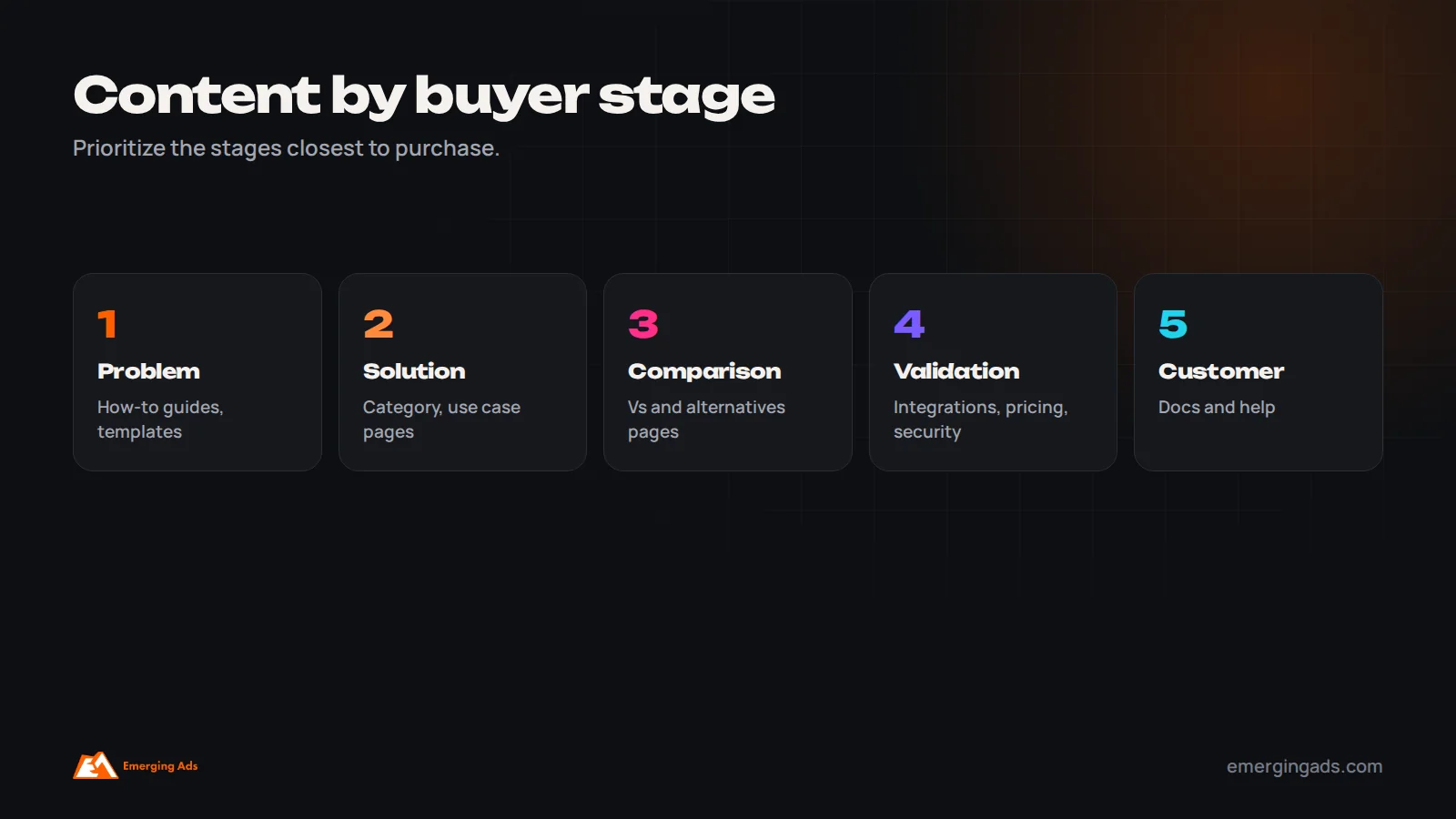
SaaS buyers move through recognizable stages, and each needs different content. In the problem-aware stage, people search for how to solve a challenge, such as reducing churn, managing shifts or automating reports; practical guides and templates meet them here. In the solution-aware stage, they look for types of tools, such as “employee scheduling software” or “customer onboarding platform”; category and use case pages answer them. In the comparison stage, they search for “best”, “vs” and “alternatives”; honest comparison pages and review content matter most. In the validation stage, they check integrations, pricing, security, implementation and reviews; integration pages, pricing explanations, security documentation and case studies close gaps. After purchase, help and documentation content supports activation and retention. A good agency builds a content map across these stages and prioritizes the stages closest to revenue first, rather than starting with broad top-of-funnel articles.
The common mistake is the reverse: a blog full of broad thought leadership that attracts readers who will never buy, while the product has no comparison pages, thin integration pages and outdated use case pages. Reversing the order, starting with high-intent content and expanding outward, usually produces pipeline far faster.
Writing comparison and alternatives pages well
Comparison and alternatives pages often produce some of the highest-converting organic traffic for SaaS companies, because the people searching are close to a decision. They only work when they are genuinely helpful. Strong pages explain who each product is best for, compare features, pricing models, integrations, support and ease of use honestly, acknowledge where competitors are stronger, include customer evidence, and make switching easy to understand. Pages that simply claim to be better at everything are rarely trusted by buyers and can attract legal complaints if they misrepresent competitors. Keep comparisons accurate and update them when products change.
Technical SEO issues common on SaaS sites
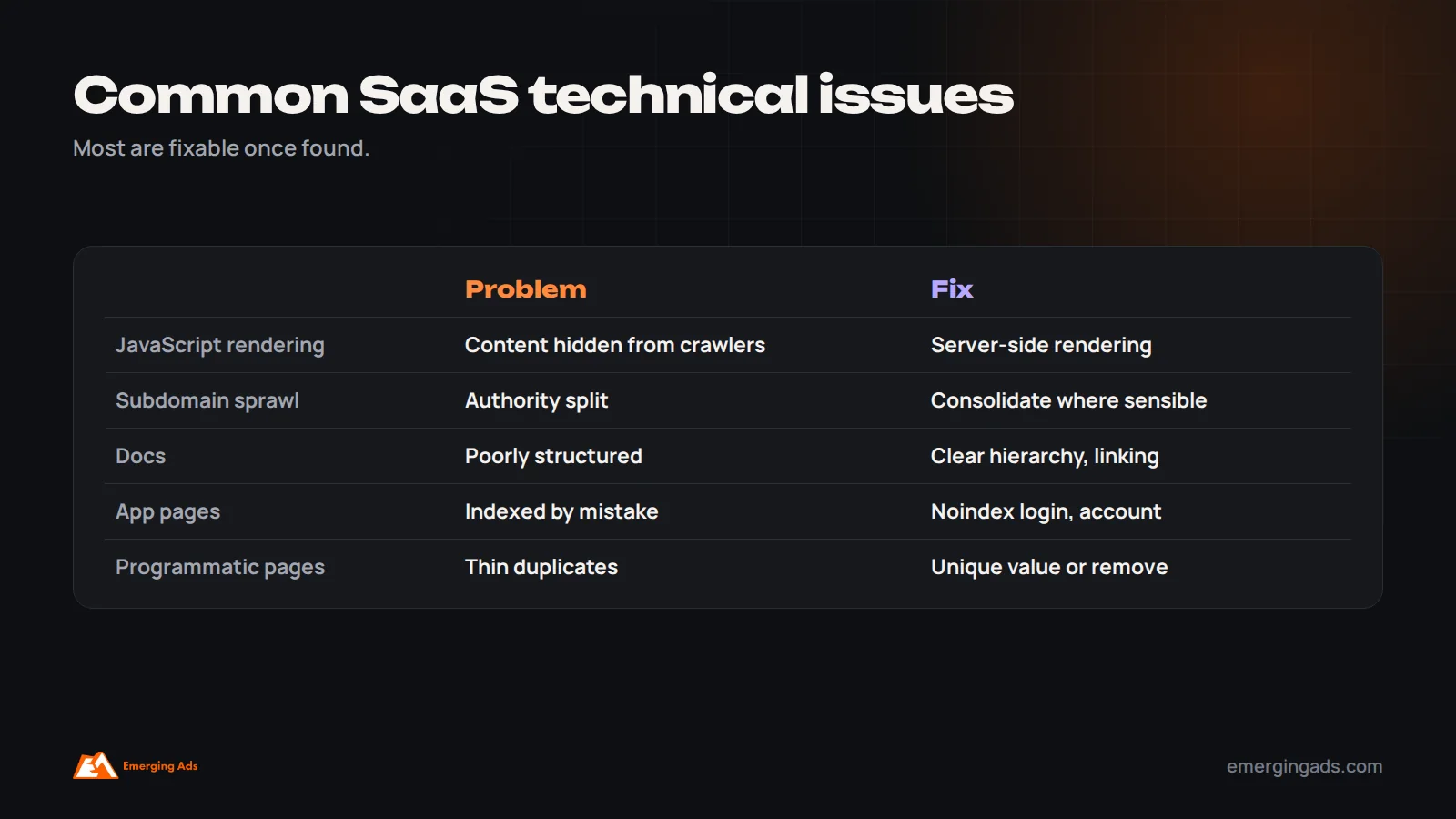
- JavaScript rendering: marketing sites built with single-page frameworks can hide content from crawlers if not rendered properly.
- Subdomain sprawl: blog, docs, help center and app on separate subdomains can split authority.
- Documentation and help content: large, valuable but often poorly structured or indexed inconsistently.
- App pages indexed by mistake: login, signup and account pages that should not appear in search.
- Thin programmatic pages: large numbers of auto-generated pages with little unique value.
- Site migrations and redesigns that lose redirects.
Our technical SEO checklist covers the essentials.

Building authority in a SaaS category
Links and mentions from respected sites still influence rankings, and in SaaS they also influence buyers and AI tools. The most reliable ways to earn them are assets other people genuinely want to reference: original research and benchmark reports from your product data, free tools and calculators, comprehensive templates, expert commentary on industry changes, integrations and partnerships with other software companies, and contributions to industry publications and podcasts. Listing and reviews on software review platforms also help, both for visibility and because AI assistants often draw on them when recommending tools. Avoid buying links or large link packages, which rarely help and can create risk.
SEO for product-led growth
For product-led SaaS companies, where users sign up and start using the product before talking to sales, SEO and product experience are tightly linked. Content should lead naturally into signup, such as a template that can be used directly in the product, a guide that ends with a free trial of the feature it describes, or a tool page that is itself a lightweight version of the product. Measure organic signups and activation rather than just traffic, and work with the product team to make sure new users from organic search reach their first value quickly. A great article that sends users into a confusing onboarding flow wastes much of its value.
AI search and SaaS buying
Software buyers increasingly ask AI assistants to shortlist tools, compare options and explain categories. These answers draw on review sites, comparison articles, documentation and company websites. Clear positioning, honest comparison content, complete integration and pricing information, strong reviews on software review platforms and consistent descriptions of your product across the web all improve the chances of being recommended. Our guide to ChatGPT SEO explains what helps.
Measuring SaaS SEO
Traffic is a means, not the goal. Measure SaaS SEO by what organic visitors do after they arrive, and follow them into the product and the sales pipeline.
- Signups, trials and demo requests from organic search.
- Activation and paid conversion of organic users.
- Pipeline and revenue influenced by organic content.
- Rankings and visibility for high-intent keywords: comparisons, alternatives, use cases and integrations.
- Organic traffic by intent stage, not just total traffic.
- Citations in AI answers for category questions.
Connect analytics to your product and CRM data so organic signups can be followed through to paying customers. Our guide on attribution modeling explains how.
How SEO works with paid acquisition
Many SaaS companies run paid search, LinkedIn and review site advertising alongside SEO. The channels inform each other: paid search shows which keywords convert to trials and demos, which helps prioritize SEO content, while strong organic rankings for expensive keywords reduce reliance on paid clicks over time. Organic content also makes good landing pages for paid campaigns aimed at buyers still researching. A good SEO agency works with whoever runs paid media so both use the same keyword insights and conversion data. Our guide to B2B leads with LinkedIn ads for SaaS covers the paid side.
SEO priorities by company stage
Early-stage startups should focus on a small number of high-intent pages: clear product and use case pages, a handful of comparison and alternatives pages, integration pages for the most important tools, and listings on review platforms. Founders’ expertise often makes the best content. Growth-stage companies can expand into broader problem-focused content, templates and tools, original research and systematic link earning, alongside a technical foundation that scales. Mature companies often get the most from technical optimization at scale, content updates and consolidation, international SEO and programmatic pages where each page adds unique value. An agency should recommend priorities for your stage rather than a one-size-fits-all package.

Red flags
Watch for these warning signs when you speak to agencies.
Be cautious of agencies that report mainly on traffic and rankings for broad keywords, propose large volumes of generic blog posts, have no experience with JavaScript sites or documentation, cannot explain how they would connect organic traffic to signups and pipeline, or offer bulk link building packages. Also be wary of guaranteed rankings and of writers who cannot understand your product well enough to explain it accurately.
Use case and industry pages in depth
Use case and industry pages are often the backbone of SaaS organic growth, because they match how buyers think about their problems. A scheduling tool might have pages for clinics, restaurants, retail stores and field service teams; a reporting tool might have pages for marketing teams, finance teams and agencies. Each page should describe the specific challenges that audience faces, show how the product solves them with screenshots or short videos, mention the integrations that audience uses, include a customer story from that segment, and invite a trial or demo with messaging tailored to them. Thin pages that swap the industry name into a template rarely rank or convert. Pages built from real customer conversations, with specific workflows and outcomes, do both.
Start with the segments that already produce your best customers, then expand into adjacent segments where you have proof. Sales and customer success teams are the best source of detail: ask them which problems each segment mentions most, which features matter and which objections come up. Turning those conversations into pages often creates the most persuasive content a SaaS company can publish.
Integration pages and partner ecosystems
Buyers often search for software that works with the tools they already use, such as a CRM, accounting system, ecommerce platform or communication app. A dedicated page for each important integration captures those searches and reassures buyers during evaluation. Strong integration pages explain what the integration does in practical terms, which data syncs and in which direction, common workflows it enables, how to set it up and any plan requirements. Partner companies may link to these pages from their own marketplaces and directories, which builds authority. Co-marketing with integration partners, such as joint webinars, shared guides and marketplace listings, extends reach to their customers. As your integration library grows, a well-organized directory page helps buyers browse and helps search engines understand the full ecosystem.
Pricing pages and SEO
Buyers search for pricing information constantly, both for your product and for categories in general. A clear pricing page that explains plans, what each includes, how pricing scales, and answers common questions about trials, billing and contracts converts better and ranks for valuable branded searches. Even companies with sales-led pricing can publish starting prices, pricing models or factors that affect cost, which reduces friction for buyers who want a rough idea before speaking to sales. Articles explaining typical costs in your category can also attract buyers early, provided they are honest and current.
Documentation and help content as SEO assets
Documentation and help centers often contain hundreds of pages answering specific how-to questions about your product. Well-structured, indexable documentation can capture searches from existing users, prospects evaluating capabilities and people searching for how to accomplish tasks your product supports. Make sure documentation is crawlable, logically organized, interlinked with marketing pages where relevant, and kept up to date. Avoid duplicating the same content across marketing pages and docs, and make sure outdated versions are removed or redirected. Good documentation also reduces support costs and helps activation, so the investment pays back in several ways.
Why writers need product understanding
SaaS content fails when writers do not understand the product or the buyer. Articles that describe features vaguely, misuse technical terms or offer generic advice are quickly recognized by experienced buyers and rarely earn links. The best SaaS SEO agencies either employ writers with experience in your category or run a disciplined process to capture expertise: product demos, interviews with product managers and customer success teams, access to customer calls and support tickets, and review by subject experts before publishing. Ask agencies to show examples of technical content they have written and to explain how they would learn your product.
International SEO for SaaS
Many SaaS companies sell globally, which raises questions about languages, regional sites and pricing. International SEO typically involves deciding which markets justify localized content, choosing a site structure such as subfolders by language or region, implementing hreflang correctly so search engines show the right version, localizing pricing, currency and examples, and building authority in each market. Machine translation of entire sites rarely performs well; prioritize localizing high-intent pages such as product, use case, pricing and comparison pages for your most important markets, with native review.
What good reporting looks like
SaaS SEO reports should connect organic activity to business outcomes. Useful reports show organic signups, trials and demo requests by page type and buyer stage, activation and conversion to paid for organic users, pipeline and revenue influenced by organic content, visibility for priority high-intent keywords, technical health and issues fixed, content published and updated, and next priorities. Reports focused only on total traffic and keyword counts make it hard to judge whether SEO is building revenue.
An example SaaS SEO program
Consider a growth-stage SaaS company selling a customer onboarding platform to B2B software companies. Its blog has many broad articles about customer success, but few rank and almost none produce demos. The agency starts with a technical audit and finds that the marketing site’s JavaScript framework hides key content from crawlers and that hundreds of thin tag pages are indexed. After fixing rendering and removing low-value pages, it builds a content map focused on buyers close to a decision: comparison pages against three main competitors, alternatives pages for buyers leaving a legacy tool, use case pages for onboarding enterprise customers, onboarding for self-serve products and implementation services, and integration pages for the CRM and support tools customers use most. Each page is built with input from sales and product teams, includes customer stories and screenshots, and invites a demo with tailored messaging. Older blog articles are consolidated and updated, and a free onboarding checklist template is published to earn links. Organic demos are tracked in the CRM through to pipeline and revenue. Within six months, comparison and use case pages produce a meaningful share of organic demo requests, and pipeline from organic search grows steadily.
Does a SaaS SEO agency need to be near you?
SaaS companies often search for an SEO agency near their headquarters, but SEO work is almost entirely remote. What matters is experience with SaaS companies, understanding of your buyers and category, technical skill for modern web frameworks and the ability to collaborate closely with your marketing, product and sales teams. Time zone overlap helps for regular collaboration, and local knowledge matters if you target a specific regional market, but location alone should not decide the choice.
What your team needs to provide
SaaS SEO succeeds when the agency has access to product knowledge and customer insight. Expect to provide product demos and access, time with product marketing, sales and customer success, customer stories and data, developer support for technical fixes, access to analytics, CRM and product data for measurement, and prompt review of content for accuracy. Agencies working without this input fall back on generic content that rarely converts.
Programmatic SEO done responsibly
Some SaaS companies grow organic traffic by generating many pages from structured data, such as one page per integration, template, location, job role or use case combination. Done well, each page answers a real search with genuinely useful, unique information, such as a working template, real integration details or data specific to that combination. Done badly, thousands of near-identical pages add little value, waste crawl budget and can drag down how search engines judge the whole site. Before building programmatic pages, confirm that people actually search for those combinations, that each page will contain information they cannot find elsewhere, and that the pages link naturally into your product. Start with a small set, measure engagement and conversions, and expand only if they perform.
Updating and consolidating existing content
Many SaaS blogs have grown over years into large libraries of overlapping, outdated articles. Refreshing and consolidating this content is often one of the fastest wins. Identify articles that target the same topics and merge them into stronger single pages with redirects; update articles with outdated screenshots, features or statistics; improve articles that rank on the second page with better structure, depth and internal links; and remove or noindex pages with no traffic, links or strategic value. Search engines and AI tools favor current, comprehensive content, and buyers notice when screenshots show an interface from years ago. Our guide on recovering from Google updates explains why content quality across the whole site matters.
How SaaS SEO agencies charge
Most SaaS SEO agencies charge monthly retainers covering strategy, content, technical work and reporting, sometimes with a setup or audit fee. Some charge per content piece, and a few offer performance-linked arrangements tied to signups or pipeline. Compare proposals on what is included, especially technical support, content depth and product research, rather than the monthly fee alone. Our guide on agency pricing explains common models.
Internal linking across marketing, blog and docs
SaaS sites often grow in separate pieces: a marketing site, a blog, documentation, a help center and sometimes a community forum, each managed by different teams. Without deliberate internal linking, valuable pages remain isolated and authority stays trapped in the blog. Link from educational articles to the relevant use case, comparison and integration pages; link from product pages to supporting guides and customer stories; and link from documentation to related marketing pages where it helps users understand capabilities. Use descriptive anchor text and keep navigation clear. A simple internal linking review each quarter often lifts rankings for commercial pages without any new content.
Realistic timelines
Technical fixes can improve visibility within weeks once search engines recrawl the site. High-intent pages such as comparisons, alternatives and integrations often start producing signups and demos within two to four months in moderately competitive categories. Broader authority, competitive category keywords and large content programs usually take six to twelve months or more. Set expectations accordingly, measure leading indicators monthly, and judge the program on pipeline over a meaningful period.
Making the decision
When comparing SaaS SEO agencies, ask which one understood your buyers and category best, which proposed starting with high-intent pages rather than broad blog content, which had the technical skill for your site, and which will measure success in signups, demos and pipeline. The agency that answers best on those questions is usually the one that turns organic search into a dependable revenue channel.
How to choose a SaaS SEO agency
Use these criteria to compare every agency on your shortlist side by side.
- SaaS experience with companies at your stage and in a similar market, with pipeline results.
- Buyer-focused strategy: content mapped to use cases, comparisons and integrations.
- Technical depth for JavaScript sites, docs and migrations.
- Writers who understand software or a process to capture product expertise.
- Reporting tied to signups, pipeline and revenue.
- Collaboration with product marketing, sales and product teams.

Frequently asked questions
What makes SaaS SEO different?
SaaS buyers research use cases, comparisons, alternatives and integrations over long cycles, and conversion goals include trials, demos and activation, so strategy and measurement must reflect that.
What content works best for SaaS SEO?
Use case pages, honest comparison and alternatives pages, integration pages, problem-focused guides, templates and tools, original research and customer stories.
How should SaaS SEO be measured?
By organic signups, demos, activation, pipeline and revenue, plus visibility for high-intent keywords, not just traffic.
Does a SaaS SEO agency need to be local?
No. SaaS experience and evidence of pipeline growth matter far more than location.
Should our blog be on a subdomain?
Many SaaS companies keep the blog in a subfolder of the main domain to consolidate authority, but the right choice depends on your setup. A good agency will assess it.
Are comparison pages worth creating?
Yes, when honest and helpful. Buyers actively search for comparisons late in their decision.
How long does SaaS SEO take?
High-intent pages can show results within a few months; broader authority builds over six to twelve months or more.
Can programmatic SEO work for SaaS?
It can, when each page offers unique value, such as integration or template pages. Thin auto-generated pages rarely perform and can harm quality.