The short answer
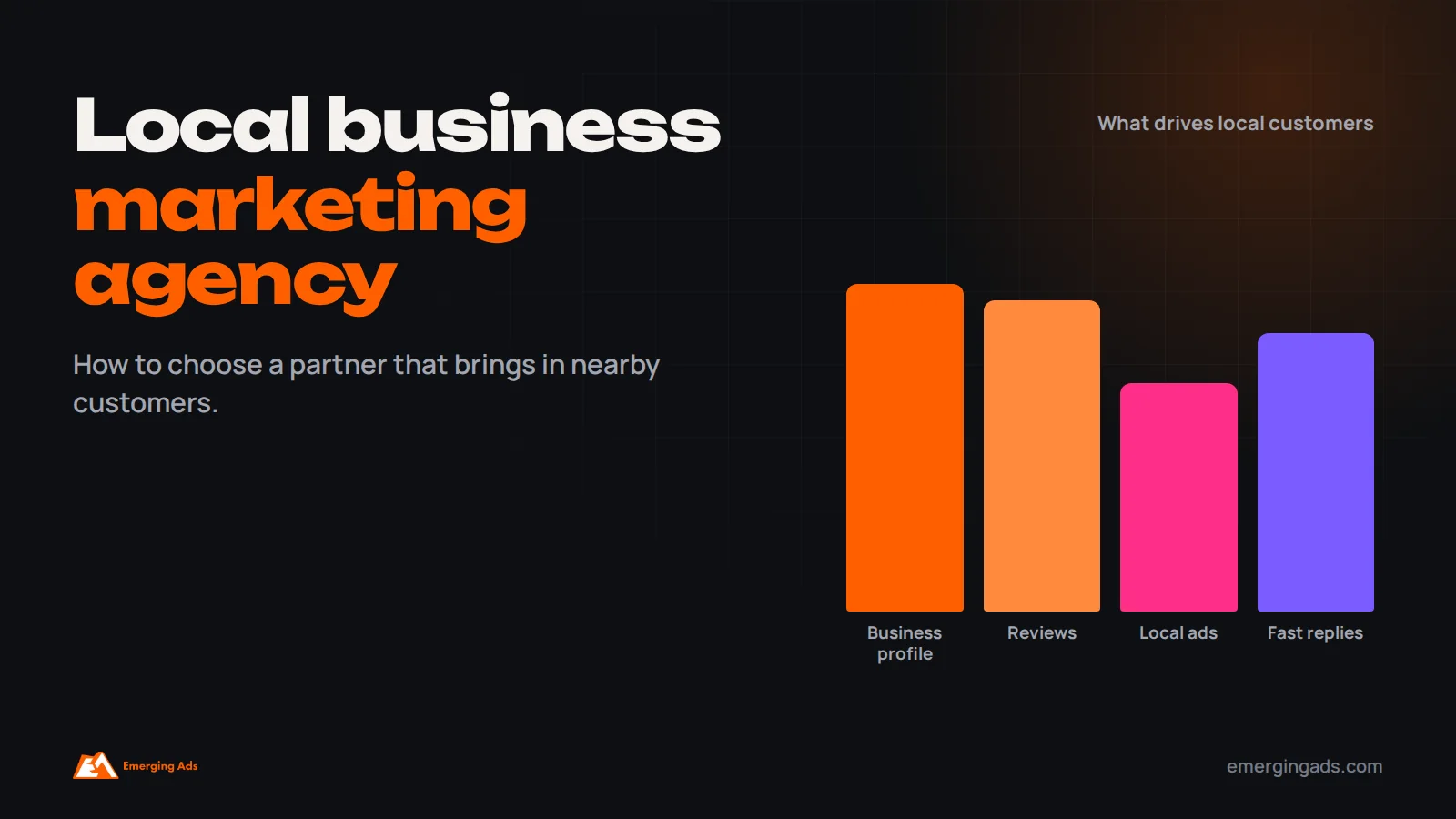
The top local business marketing agency for you understands how people in your area find and choose businesses like yours, and focuses on what drives local customers: a strong Google Business Profile, a steady flow of genuine reviews, local SEO, tightly targeted search and social ads, a website that converts on mobile, and fast follow-up on calls and messages. It measures success in calls, bookings, visits and sales rather than likes. Being nearby can help, but proven results with local businesses matter more than an office down the road.
Local businesses, such as restaurants, salons, clinics, gyms, dentists, contractors, retailers, cleaners, accountants and repair shops, depend on customers within a few miles. Their marketing challenge is specific: be found when someone nearby needs them, look more trustworthy than competitors on the same street, and turn that interest into a call, booking or visit quickly.
Many marketing agencies offer “local marketing”, but their packages often consist of generic social media posts and vague reports. The agencies that actually grow local businesses focus on the few things that move local customers. We work with local and service businesses through our local business marketing and local SEO services. This guide explains what to look for in a local business marketing agency.

How local customers find and choose businesses
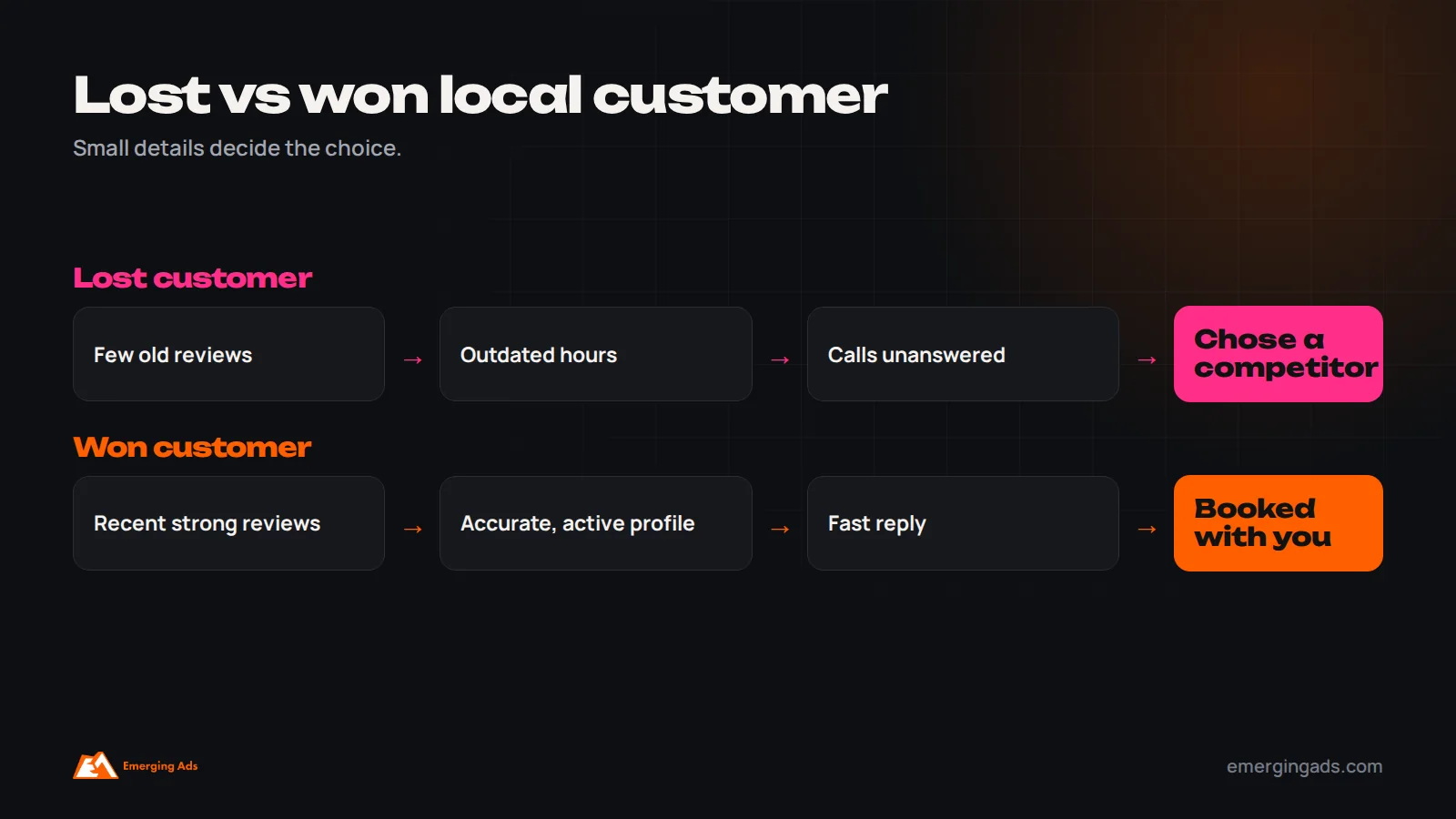
Most local purchases start with a search on a phone: “dentist near me”, “best pizza in [area]”, “plumber open now”, or the name of a business someone has heard of. Google shows a map with a handful of businesses, their ratings, photos and opening hours. People compare a few options, check reviews, look at photos, visit a website or social profile, and then call, book, message or visit. Recommendations from friends, local social media groups and community reputation also play a big role. A local marketing strategy should strengthen every part of that path.
Google Business Profile: the most important local asset
For most local businesses, the Google Business Profile is more important than the website. A complete, active profile includes the right primary and secondary categories, accurate address, service area and hours, including holidays, a clear description, products or services with prices where possible, regular photos of the business, team and work, posts about offers and news, answers to common questions, and booking or ordering links. Profiles that are complete, accurate and active tend to appear more often and convert more searchers into customers.
Reviews: the deciding factor
Ratings and reviews strongly influence which local business people choose and how prominently businesses appear in maps. A good agency helps you build a simple, consistent process for asking every happy customer for a review, such as a text or WhatsApp message after a visit with a direct link, and for responding to every review professionally, including negative ones. Recent, specific reviews matter more than a large number of old ones. Never buy reviews or offer rewards for positive reviews, which breaks platform rules and can lead to penalties.

Local SEO beyond the profile
Local SEO also includes consistent business details across directories and platforms, a website with pages for each main service and each location or area served, local content that answers customers’ questions, links and mentions from local organizations, news sites and partners, and technical basics such as fast mobile pages and structured data. These signals help search engines trust that your business is relevant and established in the area.
Local paid advertising
Paid campaigns work best for local businesses once the profile, reviews and website are in good shape, because ads send people to those same places to decide. With strong foundations, a modest local budget can bring a steady flow of calls and bookings.
Paid ads can bring customers immediately while organic visibility builds. Google Search ads capture people searching for your services nearby, with location targeting, call extensions and ad schedules that match your opening hours. Local Services Ads, where available for your category, appear at the top of results and charge per lead. Meta and Instagram ads reach people in your area with offers, events and new services, and work well for restaurants, salons, gyms and retail. Keep targeting tight, use real photos of your business and team, and make sure ads lead to pages or profiles that make calling or booking easy. Our guide to lowering Google Ads CPA covers the mechanics.
Fast follow-up wins local customers
Marketing creates the enquiry; how quickly and warmly you respond usually decides whether it becomes a customer.
Local customers often contact several businesses and choose the one that responds first. Answer calls during business hours, use voicemail and call-back processes outside them, reply to messages on WhatsApp, Instagram and Facebook quickly, and confirm bookings promptly. Track missed calls and response times. For many local businesses, improving response speed brings more customers than any change to marketing. Our article on CRM automation mistakes explains simple automations that help.
What different local businesses need
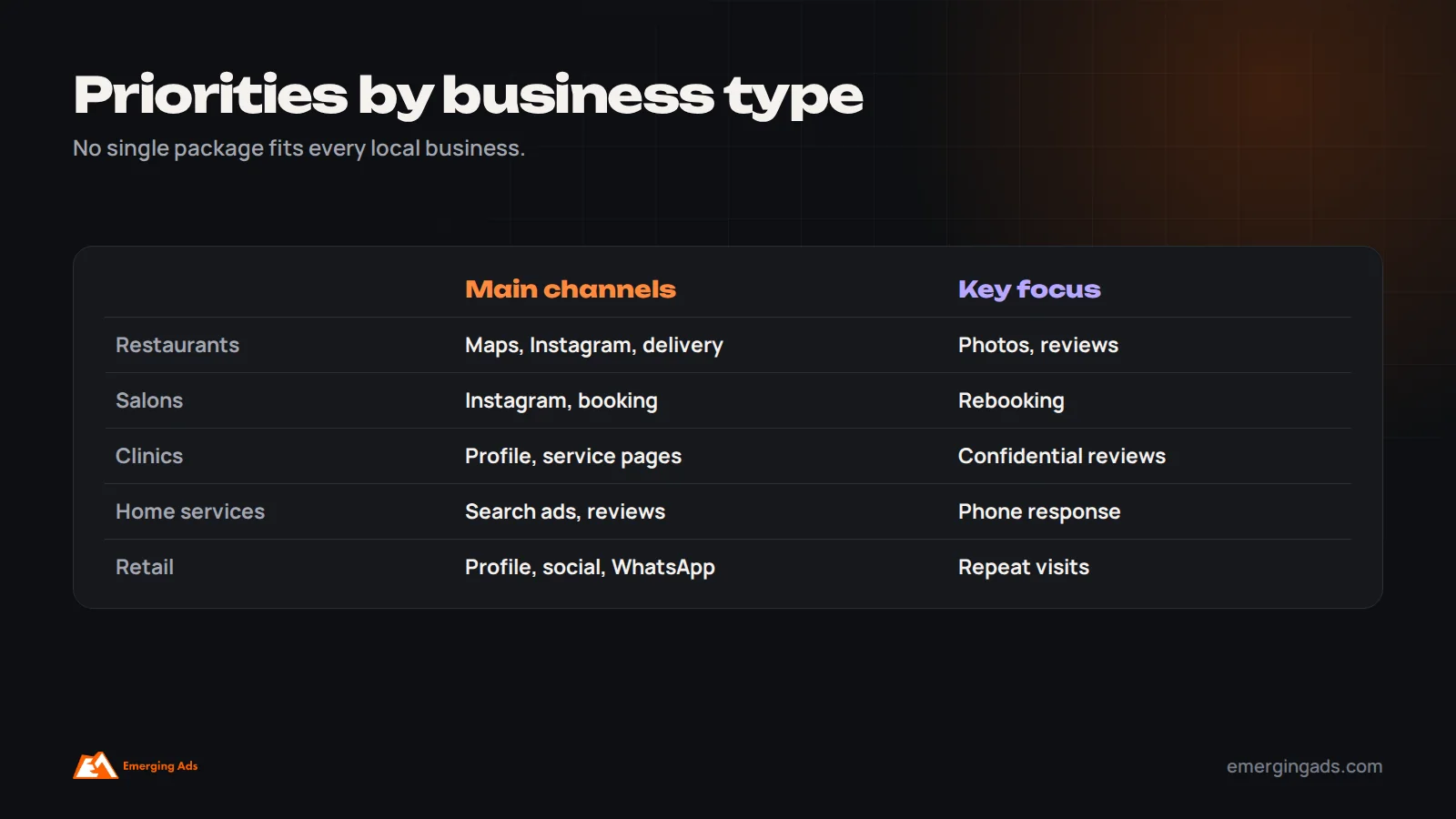
Restaurants and cafes rely on Google Maps, reviews, appetizing photos, menus, delivery platforms and Instagram, with offers timed around busy periods and local events. Salons, spas and barbers depend on Instagram, reviews, online booking and rebooking reminders, with before-and-after work showcased where clients consent. Clinics and dentists need complete profiles, reviews handled with confidentiality, clear service pages and easy booking, within healthcare advertising rules. Gyms and fitness studios grow through trial offers, social video, community and referrals, with quick follow-up on enquiries; our guide to gym marketing covers this. Home services and trades win through search ads, Local Services Ads where available, reviews, photos of completed work and fast phone response. Retail shops combine Google profiles, local inventory information, Instagram and email or WhatsApp for loyal customers. Professional services such as accountants and lawyers rely on reputation, reviews, local SEO and helpful content. A good agency adapts the mix to your type of business rather than offering a generic package.
A website that converts local visitors
Your website does not need to be large, but it must work on phones and make the next step obvious. Show what you do, where you are and your hours at the top of the homepage; put a click-to-call button and booking or ordering links on every page; include real photos of your business and team; show reviews prominently; create a page for each main service and each area you serve; and make sure pages load quickly. Many local businesses get more customers from improving their website’s clarity and speed than from increasing ad spend. Our website design team builds sites with this in mind.
Organic social media for local businesses
Social media helps local businesses stay visible to people nearby and to existing customers. The content that works best is real and local: behind-the-scenes moments, team introductions, customer stories with permission, new products or menu items, before-and-after work, local events and community involvement. Consistency matters more than volume. Engage with local community pages and other local businesses, respond to comments and messages quickly, and use social posts to encourage reviews and repeat visits. Our guide to influencer collaborations explains how local creators can extend reach.
Bringing customers back
For most local businesses, repeat customers are the foundation of profitability. Simple retention tactics include collecting email or WhatsApp opt-ins at checkout or booking, sending reminders for rebooking or regular services, loyalty programs, birthday or anniversary offers, and occasional updates about new products, services or events. Referral rewards encourage happy customers to bring friends. These channels cost little compared with acquiring new customers, and a good agency should include them in your plan.
Measuring local marketing
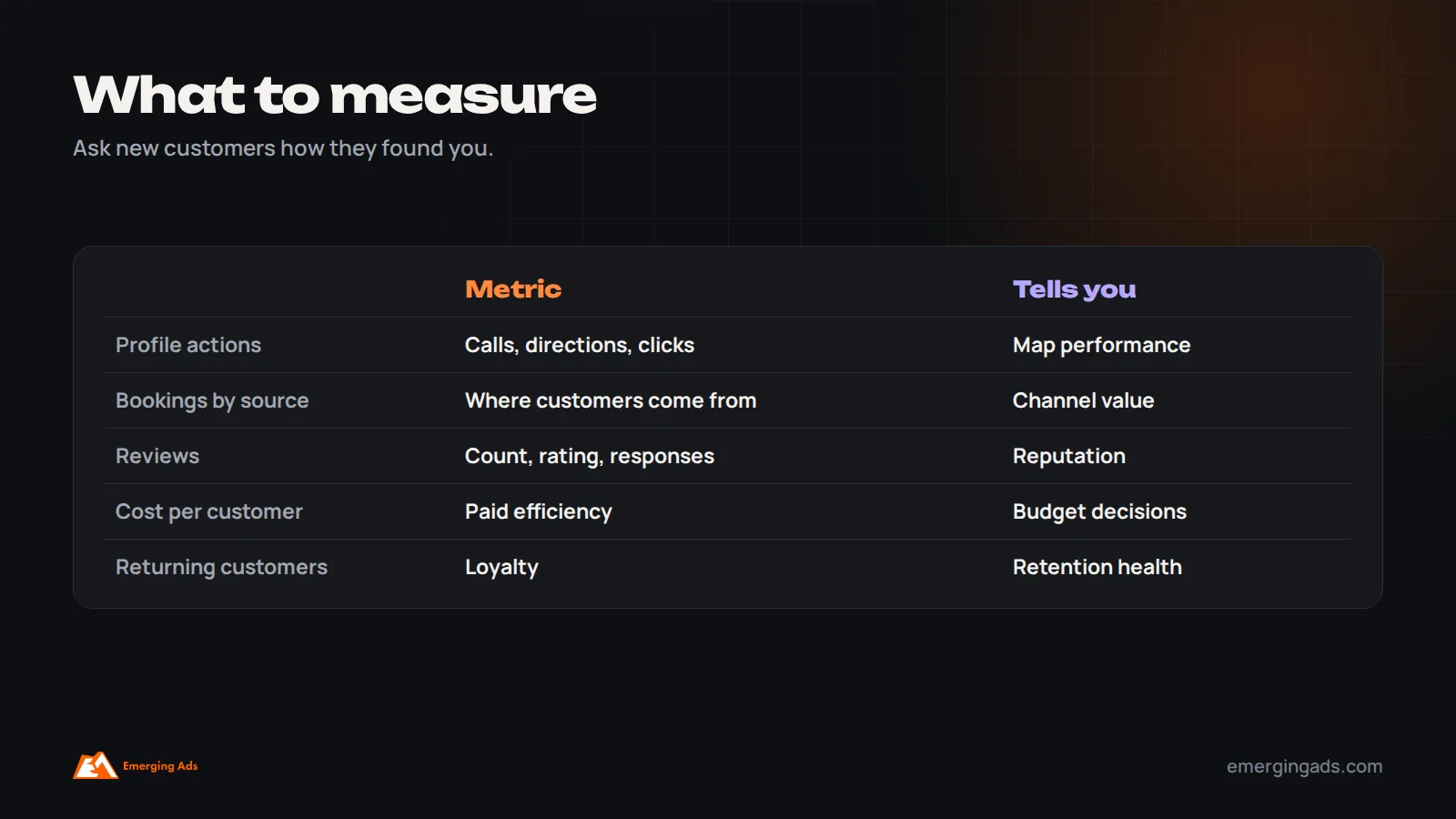
Judge local marketing on real customers through the door, measured in the same simple way every single month.
- Calls, direction requests and website clicks from the Google Business Profile.
- Bookings, enquiries and orders by source.
- Review count, rating and response rate.
- Map visibility for key searches in your area.
- Cost per lead and per customer for paid campaigns.
- New versus returning customers.
Ask new customers how they found you, and record it. It is one of the simplest and most useful measures for local businesses.
Getting the most from your Google Business Profile
Many local businesses claim their profile once and never touch it again. Active management makes a real difference. Choose the most accurate primary category, since it strongly affects which searches you appear for, and add relevant secondary categories. Write a description that explains what you do, who you serve and what makes you different, in plain language. Add products or services with descriptions and prices where possible. Upload new photos regularly, showing the outside of the premises so people can find you, the inside, your team, and your work or products. Publish posts about offers, events and news. Answer common questions in the questions section before customers ask. Keep hours accurate, especially around public holidays, since wrong hours frustrate customers and generate negative reviews. Enable messaging or booking features where they suit your business, and respond quickly. A good agency handles all of this as an ongoing task, not a one-time setup.
Service-area businesses
Plumbers, electricians, cleaners, mobile mechanics, landscapers and other businesses that travel to customers have different needs from shops and clinics with a storefront. Their profiles usually show a service area rather than a public address, and visibility depends heavily on reviews, categories and relevance. Their websites should include pages for each main service and for the key towns or neighborhoods they serve, with genuine local details such as projects completed there, rather than identical pages with only the place name changed. Search ads with tight location targeting and call extensions often bring the fastest results, and photos of completed jobs build trust.
Multi-location local businesses
Businesses with several branches, such as clinic groups, restaurant chains, gyms and retail stores, need each location to stand on its own in local search. Each branch should have its own verified profile, accurate details, local photos and reviews, and its own page on the website with address, hours, staff, services and directions. Managing reviews, posts and updates across many profiles benefits from a clear process and, for larger groups, specialist tools. Reporting should show results by location so underperforming branches can be identified and helped.
Community and offline marketing
Local businesses have an advantage online-only competitors lack: they are part of a community. Sponsoring local sports teams and events, partnering with neighboring businesses, joining local business associations, hosting workshops or open days, and supporting local causes all build recognition and goodwill. These activities often earn mentions and links from local websites, which help local SEO, and create content for social media. Offline materials, such as in-store signage asking for reviews, receipts with a WhatsApp opt-in, and business cards with a booking link, connect physical visits to digital channels.
WhatsApp and messaging
In many markets, customers prefer messaging a business to calling. Adding WhatsApp to your profile, website and social pages makes it easy for customers to ask questions, check availability and book. Quick replies, saved answers for common questions and an automatic greeting outside business hours help small teams respond fast. Messaging can also be used, with consent, for booking reminders, follow-ups and occasional offers to loyal customers. Our guide to WhatsApp broadcast campaigns explains how to do this responsibly.
Budgeting for local marketing
Local businesses usually get the best return by spending first on the foundations, such as the Google Business Profile, reviews, a fast mobile website and response processes, then adding paid campaigns once those are solid. When setting ad budgets, work back from the value of a new customer, including repeat visits, and the share of enquiries that become customers. Keep campaigns focused on your best services and the areas closest to you, and review results monthly. A small, well-targeted budget often outperforms a larger one spread across many services and a wide area.
An example local marketing plan
Consider a family-run Italian restaurant in a busy neighborhood. It has a decent rating but only a few dozen reviews, outdated photos on its profile and a website menu that does not work well on phones. In the first month, the agency updates the Google Business Profile with accurate categories, current hours, the full menu and fresh photos of dishes, the dining room and the team, and sets up a simple review request through a card on each table and a message after online orders. The website menu is rebuilt for mobile, with clear buttons to book a table, order online and call. In the second month, the restaurant starts posting short videos on Instagram of dishes being prepared and introduces its chefs, and runs small Meta ads to people within a few kilometers promoting weekday lunch and family Sunday dinners. A WhatsApp number handles bookings and questions. By the third month, the restaurant has many more recent reviews, appears more often in map results for nearby searches, and tracks bookings and online orders by source each week, shifting ad spend toward the offers that fill tables on quieter days.
AI search and local recommendations
People increasingly ask AI assistants and see AI Overviews for questions like the best family dentist nearby or a reliable electrician in a particular area. These answers draw on business listings, reviews, websites and local mentions. Businesses with complete, consistent information across platforms, many genuine and recent reviews and clear service pages are more likely to be recommended. Our guide to ChatGPT SEO explains what helps.
What good reporting looks like
Local businesses need simple, practical reports. A useful monthly report shows profile actions such as calls, direction requests, website clicks and bookings; reviews gained, average rating and responses; visibility for key local searches; paid campaign spend, leads and cost per customer; website conversion actions; and what was done and what is planned. It should be short enough to read in a few minutes and focused on customers rather than impressions or follower counts.
What your business needs to provide
Agencies can only do so much without your input. Share photos and news, approve posts quickly, tell the agency about offers, events, new services and changes to hours, ask customers for reviews consistently and make sure calls and messages are answered promptly. The most successful local campaigns are partnerships, where the agency handles strategy and execution and the business provides the authentic details and fast service that turn interest into customers.
Does the agency need to be local?
Many business owners search for a marketing agency near them, and a local agency can bring real advantages: knowledge of the area and competitors, in-person meetings, and the ability to visit for photos and video. But most local marketing work, including profile management, SEO, ads, website improvements and reporting, is done remotely. An agency in another city with a strong track record of growing local businesses like yours will usually outperform a nearby agency without that experience. If you choose a remote agency, make sure they take time to understand your area, your customers and your competitors, and that you can easily supply local photos and content.
How local marketing agencies charge
Local marketing agencies typically charge monthly retainers covering profile management, local SEO, reviews, social content and reporting, with paid ad management priced as a fixed fee or a percentage of ad spend. Website builds and one-off setups are usually project fees. Ad spend is paid separately to the platforms. Compare proposals on what is included and on the outcomes they focus on, rather than the number of posts or hours. Our guide on agency pricing explains common models and hidden costs.
What the first 90 days should look like
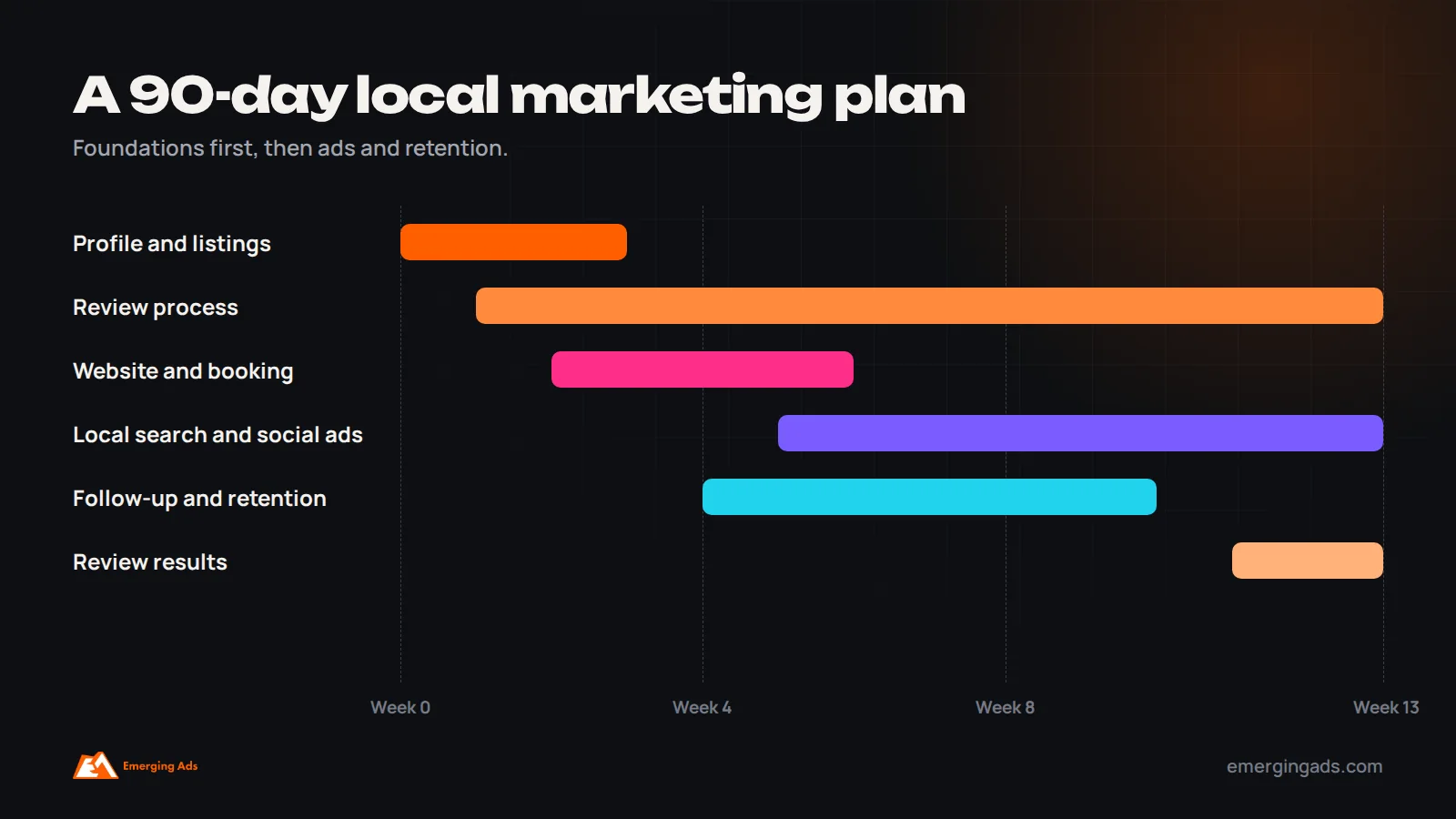
A good agency starts by auditing your profile, listings, reviews, website and any ads, then fixes the foundations: profile categories, hours, photos and services; consistent listings; a review request process; and website clarity, speed and booking. Next, it launches or restructures tightly targeted local ads, sets up call tracking, and helps improve follow-up on calls and messages. By the end of three months, you should see more profile actions, more reviews, clearer data on where customers come from and a plan for the next quarter.
Photos and video that build local trust
Real photos and short videos are among the most persuasive local marketing assets. Customers want to see what your premises look like, who will serve them and the quality of your work or products. Businesses with many recent, genuine photos on their profile and website tend to get more clicks, calls and visits than those using stock images. Photograph the outside of your premises so people recognize it, the inside so they know what to expect, your team at work, finished products or projects, and happy customers where they consent. Short videos, such as a quick tour, a team introduction or a behind-the-scenes look, work well on profiles and social media. Refresh content regularly so it reflects the business today.
Learning from local competitors
Search for your main services in your area and study the businesses that appear in the top map results. Compare their review counts and ratings, how recently they received reviews, their profile completeness, photos, categories, website service pages and offers. You will usually find specific gaps you can close, such as fewer recent reviews, missing services in your profile or a slow mobile website. Focus on being genuinely better and more helpful than nearby competitors rather than copying them.
Planning around local seasons and events
Local demand rises and falls with seasons, holidays, school calendars, weather and local events. Restaurants get busier around holidays and celebrations, gyms see demand peak in January and before summer, home services follow weather patterns, and retailers depend on gifting seasons. Plan offers, ads and content around your own busy and quiet periods: build awareness before peaks, run promotions to fill quiet periods, and keep profile hours accurate around holidays. Local events, festivals and sports matches can also be opportunities for timely offers and content.
A quick local marketing checklist
Check that your Google Business Profile is verified, complete and accurate, with current hours, the right categories and recent photos; that your name, address and phone number match across directories; that you ask every happy customer for a review and respond to every review; that your website works well on phones, with click-to-call and booking on every page; that you have a page for each main service and area; that calls and messages are answered quickly; that you collect contact details for repeat marketing with consent; and that you record how new customers found you. Most local businesses find several quick improvements here before spending more on ads.
How to choose a local business marketing agency
Use these criteria to compare the agencies on your shortlist side by side.
- Local business experience, ideally in your industry, with results in calls, bookings and sales.
- Focus on Google Business Profile, reviews and local SEO, not just social posting.
- Tight, local paid campaigns with call tracking.
- Help with follow-up and conversion, not just traffic.
- Clear, simple reporting on business results.
- Ownership: your profile, accounts, website and data.
- Fair terms with no long lock-ins.
Red flags
These warning signs suggest an agency will deliver activity rather than customers.
- Packages based on a number of social posts with no business outcomes.
- Guaranteed first place in Google Maps.
- Fake or incentivized reviews.
- Agency ownership of your Google Business Profile or website.
- Long contracts with heavy cancellation fees.
- Reports full of impressions and likes.

Frequently asked questions
What does a local business marketing agency do?
It improves how local customers find and choose you: Google Business Profile, reviews, local SEO, targeted search and social ads, website conversion and follow-up, measured in calls, bookings and sales.
How do I choose a local marketing agency?
Look for results with local businesses like yours, focus on profiles, reviews and local SEO, tight paid campaigns, help with follow-up, simple outcome-based reporting, your ownership of accounts and fair terms.
Does the agency need to be in my town?
Not necessarily. Local knowledge helps, but proven results with local businesses matter more than location.
What is the most important local marketing channel?
For most local businesses, the Google Business Profile, supported by reviews and local SEO.
How do I get more Google reviews?
Ask every happy customer through a simple, consistent process with a direct link, and respond to every review. Never buy or incentivize positive reviews.
Are social media ads worth it for local businesses?
Often yes for restaurants, salons, gyms and retail, with tight location targeting, real photos and clear offers.
How should local marketing be measured?
By calls, direction requests, bookings, orders, reviews, map visibility and cost per customer, not likes or impressions.
How long does local SEO take?
Profile and review improvements can help within weeks to a few months; competitive areas take longer.