
The short answer
The top gym marketing agency for your club or studio understands how people choose a gym locally, drives trial signups through Google, Meta, Instagram and local SEO, responds to every enquiry within minutes, converts trials into members with a structured follow-up process, keeps members through community and engagement, and measures success in new members, cost per member and retention rather than leads. Local knowledge helps, but proven results with gyms and fitness studios matter more than location.
Gyms and fitness studios face a specific marketing challenge. Most members live or work nearby, demand peaks in January and before summer, competition is intense, and many people sign up with good intentions and then stop coming. Growth depends on three things: attracting the right local prospects, converting them into members quickly, and keeping them.
We have worked with fitness businesses including T Sport, a fitness brand in Riyadh, where localized Meta and Snapchat campaigns delivered a 4.4x return on ad spend, 38% lower cost per lead, 165% audience growth and reply times under a minute, filling the calendar within 60 days. Our boutique fitness automation case study shows how instant routing and follow-up turn enquiries into trials. This guide explains what to look for in a gym marketing agency.

How people choose a gym
Most people choose a gym based on location and convenience, price and membership terms, the type of training offered, atmosphere and community, reviews and recommendations, and how they feel during a trial or first visit. They usually compare a few options nearby, check Google Maps and reviews, look at Instagram to see the space and the people, and then enquire or book a trial. Marketing should support every step, and the trial experience should be designed to convert.
Channels that bring in members
Most successful gyms combine several channels rather than relying on just one source of new members.
Google Business Profile and local SEO: people search “gym near me”, “yoga studio in [area]” or “CrossFit [city]”. A complete profile with photos, class types, hours, prices where possible and many recent reviews is essential.
Meta and Instagram ads: reach people in the local area with trial offers, transformation stories, class videos and community content. Lead forms and messaging ads make enquiring easy.
Snapchat and TikTok: strong for younger audiences, and Snapchat in particular across the Gulf.
Google Search ads: capture people actively looking for a gym, personal trainer or specific class type nearby.
Referrals: bring-a-friend offers and member referral rewards are among the most cost-effective channels for gyms.
Local partnerships: corporate wellness deals, physiotherapists, nutritionists, schools and local events.

How strategy differs by type of fitness business
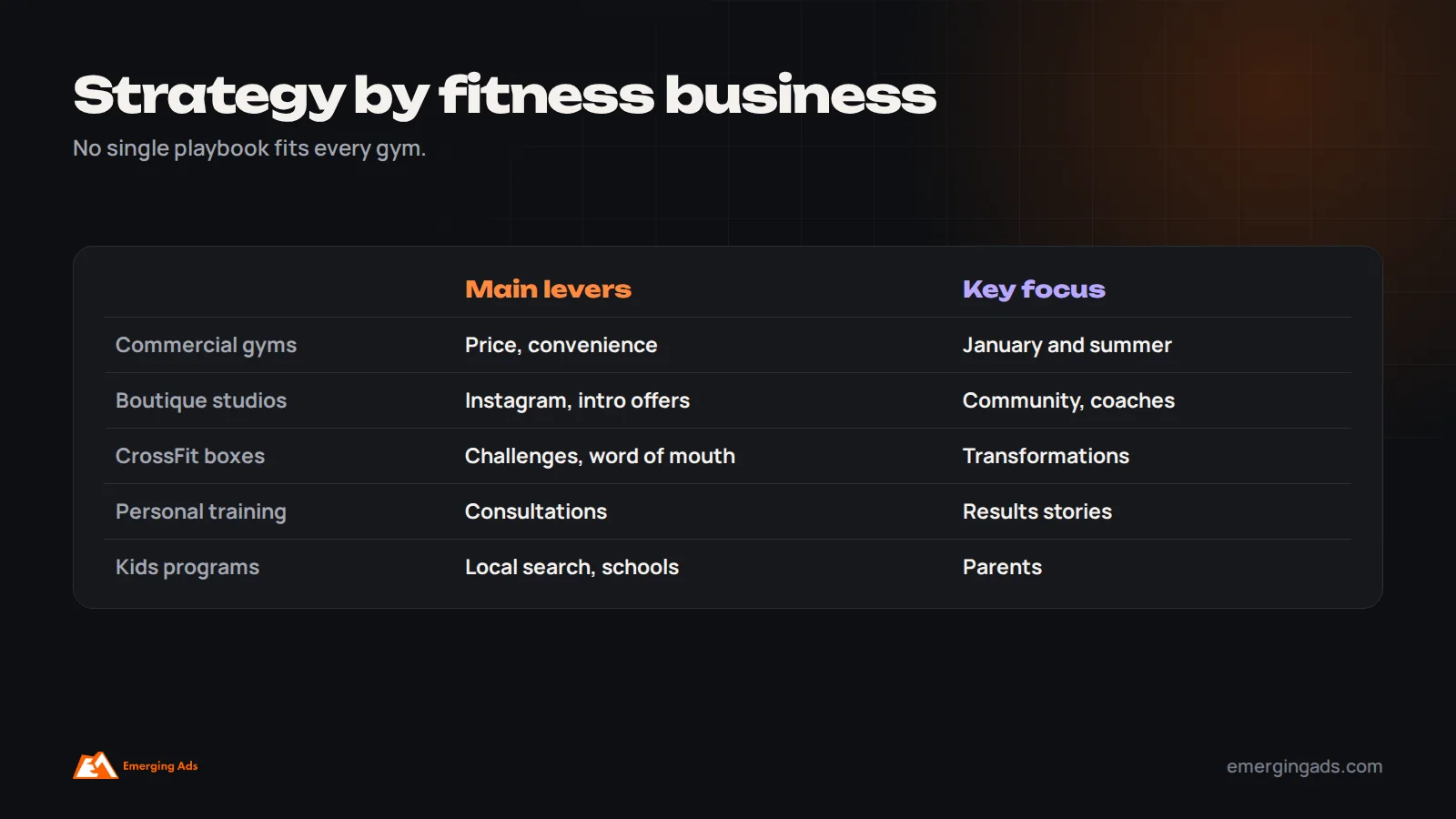
Large commercial gyms compete on price, convenience, facilities and opening hours, and often run high-volume campaigns around January and summer, with strong focus on membership terms and joining offers. Boutique studios, such as cycling, HIIT, Pilates, yoga and boxing studios, compete on experience, community and coaching, and rely heavily on Instagram, class packs, intro offers and referrals. CrossFit and functional training boxes grow through community, challenges, word of mouth and transformation stories. Personal training studios sell higher-value programs and benefit from consultations, before-and-after stories with consent, and targeted search and social ads. Women-only gyms and specialist facilities often need careful messaging, appropriate imagery and targeting, especially in markets such as the Gulf. Martial arts and kids’ programs market to parents through local search, schools and community events. An agency should adapt channels, offers and creative to your model.
Creative that fills a gym
The best gym ads show the real experience: the space, the coaches, the classes and the members. Effective creative includes short videos of classes in action, coach introductions, member stories and transformations shared with consent, quick tours of the facility, challenges and community events, and simple explainers of what a first visit looks like. Vertical video for Instagram Reels, Snapchat and TikTok usually performs best. Avoid generic stock footage of models in perfect gyms; prospects want to know what your gym is actually like and whether people like them belong there. Arabic creative with local coaches and members performed strongly for T Sport in Riyadh, and localized content generally outperforms translated campaigns.
Local SEO for gyms
For many gyms, the Google Business Profile is the most important marketing asset. Choose accurate categories, such as gym, fitness center, yoga studio or personal trainer, list class types and amenities, keep opening hours accurate including holidays, upload fresh photos of the space and classes regularly, post updates about challenges and events, and collect reviews from members steadily. A website with pages for each class type, membership options with clear pricing where possible, a timetable and easy trial booking supports the profile and converts visitors. Our local SEO service covers this work.
Planning around fitness seasons
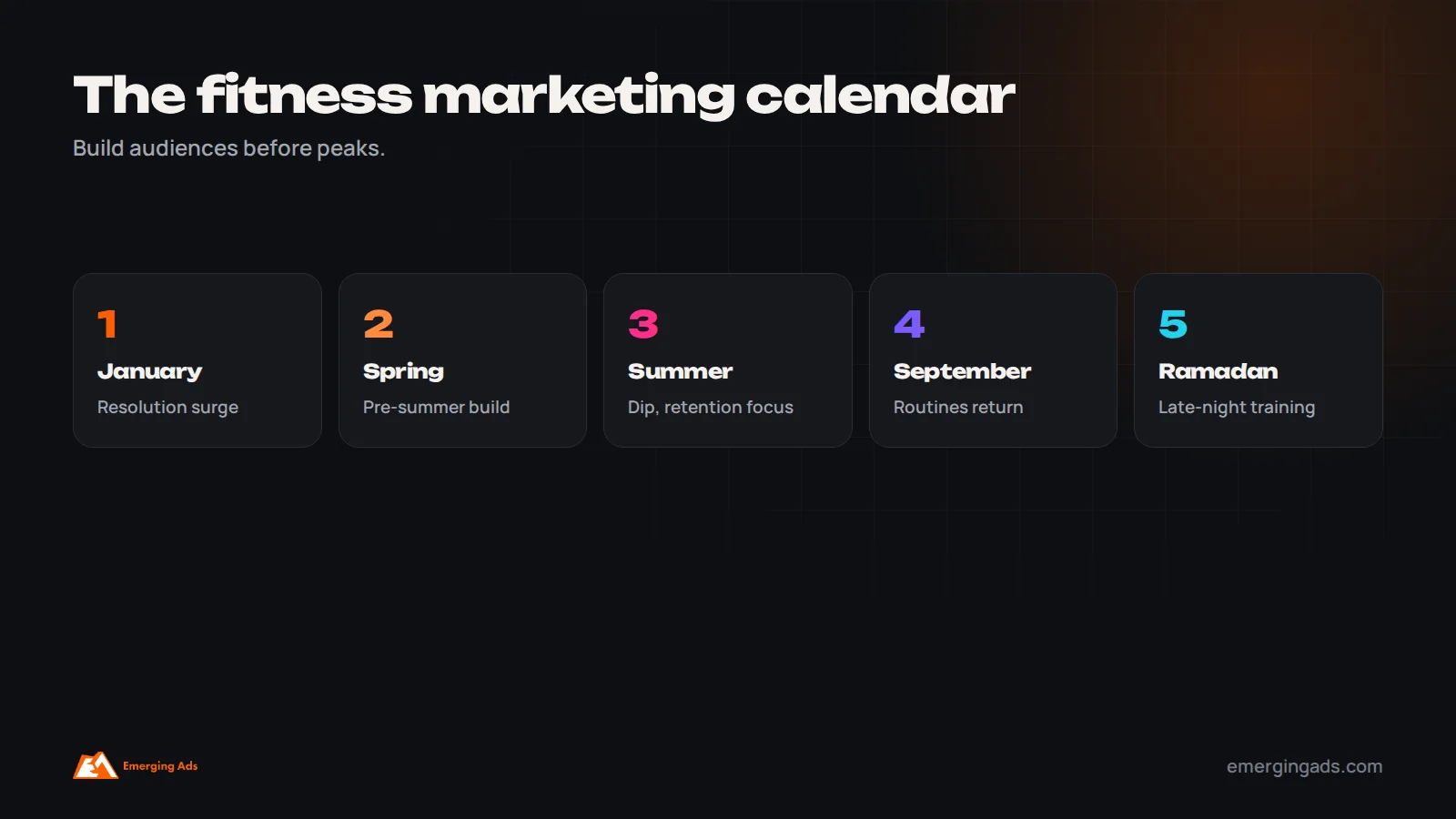
Demand for gyms follows predictable patterns. January brings a surge of new-year resolutions, followed by a spring build-up before summer. Demand often dips in mid-summer and during holidays, then recovers in September as routines return. In the Gulf, Ramadan changes training times and behavior, with many gyms shifting to late-night hours, and summer heat drives indoor training demand. Plan campaigns, offers and staffing around these cycles: build audiences and content before peaks, run strong offers during them, and use quieter periods for retention, referrals and community events that keep members engaged.
Corporate and partnership channels
Corporate wellness partnerships can bring groups of members at once. Approach local employers with membership discounts, on-site sessions or wellness challenges. Partnerships with physiotherapists, nutritionists, sports clubs, schools and local businesses create referral flows and community presence. Local events, such as charity runs, open days and free outdoor classes, introduce the gym to new people in a low-pressure way. These channels complement paid ads and often produce members who stay longer because they joined with colleagues or friends.
Offers that convert
Common gym offers include free or low-cost trial passes, a first week or month at a reduced price, no-joining-fee periods, bring-a-friend sessions, challenges with a clear start date, and introductory packages for personal training or classes. The best offer lowers the risk of trying the gym while attracting people who are likely to stay. Very deep discounts can attract bargain hunters who leave as soon as the price rises. Test offers and measure trial-to-member conversion, not just signups.
Speed to lead
People enquiring about a gym are often motivated in the moment and comparing several options. The first gym to reply helpfully usually wins. Strong systems send an instant WhatsApp, SMS or email reply, offer trial booking times immediately, alert staff to call or message within minutes, and send reminders before the trial. For T Sport, getting reply times under a minute was central to filling the calendar. Our article on CRM automation mistakes explains how to set this up.

Converting trials into members
The trial or first visit is where most members are won or lost. Make it welcoming: greet visitors by name, give them a tour, introduce them to a coach and other members, help them complete a session that suits their level, and talk about their goals. Follow up the same day with a friendly message, and offer a clear, time-limited membership option. Track the conversion rate from trial to member by staff member and offer, and coach staff based on what works.
Retention: the biggest growth lever
Many gyms lose a large share of new members within the first few months. Improving retention often adds more revenue than acquiring new members. Effective tactics include onboarding programs that set goals and build habits in the first weeks, check-ins from coaches when members stop attending, community events and challenges, progress tracking and celebrations, and personalized communication through email, WhatsApp and app notifications. Our guide to community-led growth explains how community keeps members engaged.
Landing pages and booking for gyms
Gym ads should send people to a page built for the offer they clicked, not to a general homepage. A strong trial landing page shows the offer clearly in the first screen, includes real photos or a short video of the gym and classes, explains what happens during the trial, shows reviews and member stories, lists class types and opening hours, gives the location with parking or transport information, and makes booking easy with a short form, a calendar or a WhatsApp button. On mobile, the booking button should always be visible. Many gyms find that simplifying the booking step, for example letting people pick a trial time immediately instead of waiting for a call, noticeably increases trials. Our landing page design team builds pages like this for fitness businesses.
Automation that saves staff time
Front desk and sales staff at gyms are often busy with members, so automation helps make sure no enquiry is forgotten. Useful automations include an instant reply to every new lead with trial booking options, routing leads to the right staff member or location, reminders before a booked trial, a follow-up message after the trial, a short nurture sequence for people who do not book or do not join, and alerts when members stop attending. Connect lead sources, such as Meta lead forms, website forms, Instagram messages and WhatsApp, into one CRM so nothing slips through. Automation should support personal contact, not replace it: the best conversions still come from a coach or staff member reaching out personally. Our comparison of HubSpot and GoHighLevel covers common tools.
Pricing presentation and membership terms
How memberships are presented affects conversion and retention. Clear pricing, simple options and transparent terms build trust; hidden fees and confusing contracts cause complaints and negative reviews. Many gyms offer a small number of options, such as monthly flexible, discounted longer commitments and class packs, with clear explanations of what each includes. Test whether showing prices on the website increases or decreases enquiries in your market; transparency often attracts better-qualified prospects. Make cancellation terms clear and fair, since difficult cancellations damage reputation quickly through reviews.
Reviews and reputation
Reviews strongly influence which gym people try. Ask happy members for reviews at moments of success, such as after hitting a goal, completing a challenge or a milestone anniversary, and make it easy with a direct link. Respond to every review, thanking members and addressing complaints constructively. Common complaints, such as crowded peak hours, cleanliness or equipment, are useful feedback for operations as well as marketing. A gym with many recent, specific reviews mentioning friendly coaches and a welcoming community has a real advantage over competitors with few or old reviews.
Gym marketing in the Gulf
Gyms in Saudi Arabia, the UAE and other Gulf markets have specific considerations. Arabic creative with local coaches and members performs strongly, as T Sport’s results showed. Snapchat and Instagram are central channels, and WhatsApp is often the main way prospects enquire. Women-only gyms and ladies’ sections need appropriate imagery, messaging and targeting. Training patterns shift significantly during Ramadan, when many gyms open late into the night, and summer heat increases demand for indoor training. Our guide to Ramadan marketing covers seasonal planning in the region.
Budgeting for gym marketing
Set budgets from member economics. Estimate the average monthly membership value, how long members typically stay, and the share of trials that convert. From those figures, work out what you can afford to pay for a trial and a new member. Allocate more budget before seasonal peaks and keep a steady baseline the rest of the year. Track cost per new member by channel monthly, and shift spend toward the channels and offers that bring members who stay.
An example gym marketing plan
Consider an independent strength and conditioning gym in a busy suburb. It has good coaches but relies on word of mouth and gets inconsistent enquiries. In the first month, the agency updates its Google Business Profile with accurate categories, class types, photos and hours, starts a review request process for members, and rebuilds the trial page with a short video, coach introductions, a clear free-week offer and instant online booking. All enquiries, from Instagram, Meta lead forms, the website and WhatsApp, flow into one CRM with an automatic reply offering trial times and an alert to the head coach. In the second month, Meta and Instagram ads with real class footage target people within a few kilometers, and a bring-a-friend week is promoted to existing members. Every trial visitor gets a welcome tour, a coach-led session and a same-day follow-up message. In the third month, the gym reviews results: cost per trial, trial show rate, trial-to-member conversion and early retention. It finds that personal coach follow-ups convert far better than generic emails, so it makes that standard, and shifts ad budget toward the class types that bring members who stay.
Onboarding new members
The first few weeks decide whether new members build a habit or quietly stop coming. Strong onboarding includes a welcome session to set goals and explain how to get started, a simple plan for the first month, introductions to coaches and other members, reminders and encouragement in the first weeks, a check-in after a few sessions to see how they are feeling, and recognition of early milestones. Gyms that invest in onboarding typically see noticeably better retention, which makes every marketing dollar spent on acquisition go further.
Organic content and community
Beyond ads, consistent organic content keeps a gym visible to prospects and engaged members. Post class highlights, coach tips, member spotlights with permission, challenge updates, behind-the-scenes moments and community events. Encourage members to share and tag the gym. Run monthly challenges that give members a reason to keep coming and create stories worth posting. A gym with an active, welcoming social presence makes prospects feel they would belong before they ever visit.
Does a gym marketing agency need to be near you?
Gym owners often look for an agency nearby, hoping local knowledge will help. It can, especially for understanding the neighborhood, competitors and local events, and for filming content at the gym. But most gym marketing work, including ads, local SEO, landing pages, automation and reporting, is done remotely. An agency with proven results for gyms and studios elsewhere will usually outperform a nearby generalist. If you choose a remote agency, make sure they study your area and competitors, and plan for regular photo and video content from your gym, whether filmed by your team, a local videographer or the agency on visits.
How gym marketing agencies charge
Agencies typically charge a monthly management fee or a percentage of ad spend for paid campaigns, retainers for social media and local SEO, and project fees for websites, landing pages and automation setup. Some offer performance-based pricing tied to leads or trials; if you consider this, define what counts as a qualified lead or trial carefully. Ad spend is paid separately to the platforms. Compare proposals on what is included, especially creative, follow-up automation and reporting on members, rather than the monthly fee alone. Our guide on agency pricing explains common models.
What good reporting looks like
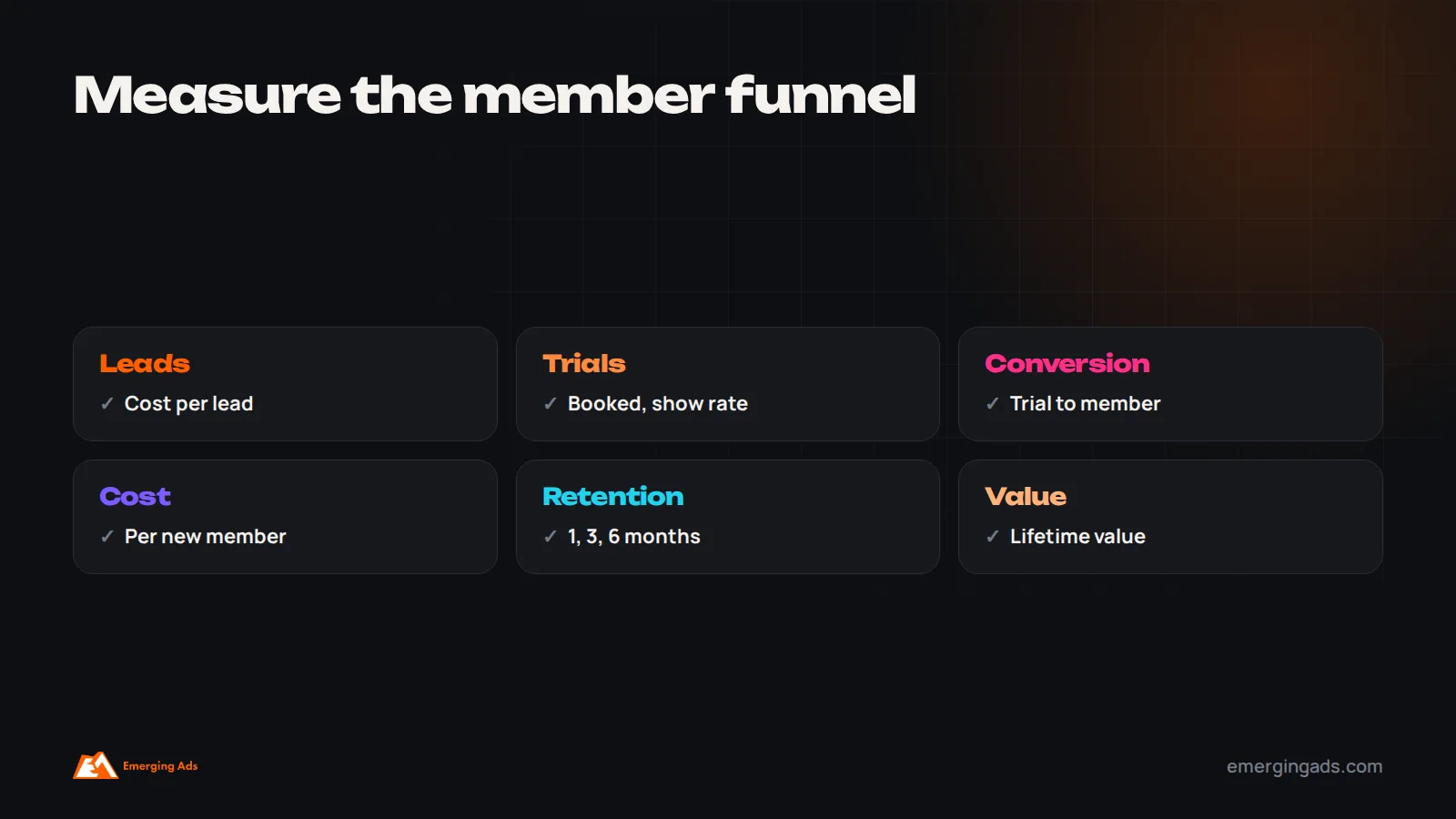
Monthly gym marketing reports should be simple and focused on members. They should show spend and leads by channel, trials booked and attended, trial-to-member conversion, cost per new member, retention trends, reviews gained, and what was changed and planned. Reports that stop at leads hide the most important question: did marketing bring in members who stay?
Referral programs for gyms
Members who love their gym are its best salespeople, and people who join with a friend tend to stay longer. Make referrals easy and rewarding: a bring-a-friend week, a free month or merchandise for members whose friends join, and a simple link or card to share. Promote the program in the gym, in emails and WhatsApp messages to members, and at moments when members are proud of their progress, such as after completing a challenge. Track referred members separately so you can see their retention, which is often higher than average. Our guide to referral programs explains how to design rewards.
Winning back former members
Former members are a valuable audience: they already know the gym, and many left for reasons that may have changed, such as moving, schedules or motivation. A friendly win-back campaign by email or WhatsApp, with an invitation to return, a reduced rejoining offer or an invitation to a new class or challenge, often brings back a meaningful share at low cost. Ask why they left, and use the answers to improve the gym and retention efforts.
A quick gym marketing checklist
Check that your Google Business Profile is complete, accurate and active with recent reviews; that ads use real video of your gym; that every enquiry gets an instant reply and a personal follow-up within minutes; that trial booking is simple; that trials follow a structured welcome; that new members go through onboarding; that you track trial-to-member conversion and retention; and that you run referral and win-back programs. Most gyms find several quick wins here.
Training staff to convert and retain
Marketing can bring people through the door, but staff decide whether they join and stay. Train front desk staff and coaches to greet prospects warmly, ask about goals, give a confident tour, explain membership options clearly and follow up promptly after trials. Give them simple scripts and templates, but encourage genuine conversation. Share marketing results with the team, such as trials booked and conversion rates, and celebrate wins. When staff understand how their behavior affects membership numbers, conversion and retention usually improve quickly.
AI search and gym recommendations
People increasingly ask AI assistants for recommendations, such as the best gym for beginners nearby or a women-friendly fitness studio in a particular area. These answers draw on business listings, reviews, websites and local mentions. Gyms with complete, consistent profiles, many genuine reviews describing their atmosphere and coaching, and clear website pages for each class type are more likely to be recommended. Our guide to ChatGPT SEO explains what helps.
What the first 90 days should look like
A good gym marketing agency starts with an audit of your profile, reviews, website, ad accounts and follow-up process, then fixes the foundations: profile details and photos, a review request process, a clear trial landing page and instant follow-up for every enquiry. Next it launches local campaigns with real video and a tested offer, and helps you structure the trial experience. By the end of three months, you should know your cost per trial, trial-to-member conversion and cost per new member by channel, with a plan to improve each.
Measuring gym marketing
Measure every step from first enquiry to retained member, every single month.
- Cost per lead and cost per trial booked.
- Trial show rate and trial-to-member conversion.
- Cost per new member by channel.
- Member retention at one, three and six months.
- Member lifetime value.
- Referral rate and reviews.
How to choose a gym marketing agency
Use these criteria to compare every agency on your shortlist side by side.
- Fitness experience with results in new members and retention.
- Local targeting skill and local SEO knowledge.
- Creative ability: real video of your space, coaches and members.
- Follow-up and automation to convert leads into trials and members.
- Reporting on members and revenue, not just leads.
- Ownership of your ad accounts, pages and data.
- Fair terms without long lock-ins.
Common mistakes
These are the patterns we see most often in gyms that spend on marketing without filling their memberships.
- Judging marketing on cost per lead alone.
- Slow follow-up on enquiries.
- Deep discounts that attract members who leave quickly.
- Stock photos instead of real footage of the gym and community.
- No structured trial experience.
- Ignoring retention.
- Marketing only in January.

Frequently asked questions
How do I choose a gym marketing agency?
Look for fitness experience with results in new members and retention, strong local targeting, real creative, follow-up automation, reporting on members and revenue, your ownership of accounts and fair terms.
What is the best way to get new gym members?
Combine local SEO and reviews, targeted Meta, Instagram and Google ads with a trial offer, fast follow-up, a great trial experience and referrals.
How fast should gyms respond to enquiries?
Within minutes, ideally with an instant automated reply and a quick personal follow-up.
What offers work best for gyms?
Low-risk trial offers, reduced first periods, bring-a-friend sessions and challenges, tested on trial-to-member conversion rather than signups.
How important is retention for gyms?
Very. Improving retention often adds more revenue than acquiring new members, through onboarding, check-ins, community and progress tracking.
Does the agency need to be local?
Not necessarily. Fitness experience and local targeting skills matter more than location.
How should gym marketing be measured?
By cost per trial and per new member, trial-to-member conversion, retention, lifetime value and referrals.
When is the best time for gym marketing?
January and pre-summer are peaks, but consistent marketing year-round keeps membership stable.