The short answer
Community-led growth is a strategy where a brand grows by building a community of customers, fans or practitioners who connect with each other, not just with the brand. The community helps attract new customers through word of mouth and shared content, keeps existing customers engaged and loyal, and gives the business direct feedback. It works best when members get real value from each other, such as support, learning, belonging or status, and when the brand invests consistently in hosting, moderating and showing up. It is slower to build than paid acquisition but compounds over time.
Most marketing is one-to-many: a brand speaks, an audience listens. Community-led growth is many-to-many: members talk to each other, help each other and bring in others like them. The brand hosts the conversation rather than dominating it.
The idea is not new. Running clubs around sports brands, user groups around software, local business networks and fan clubs have existed for decades. What has changed is how easy it is to build communities online through WhatsApp communities, Discord, Slack, Facebook Groups, forums and social platforms, and how much more valuable owned relationships have become as advertising costs rise and organic social reach falls.
This guide explains what community-led growth is, when it suits a business, how to build a community from scratch, how to keep it healthy, how to measure its impact and the mistakes to avoid.
What community-led growth means
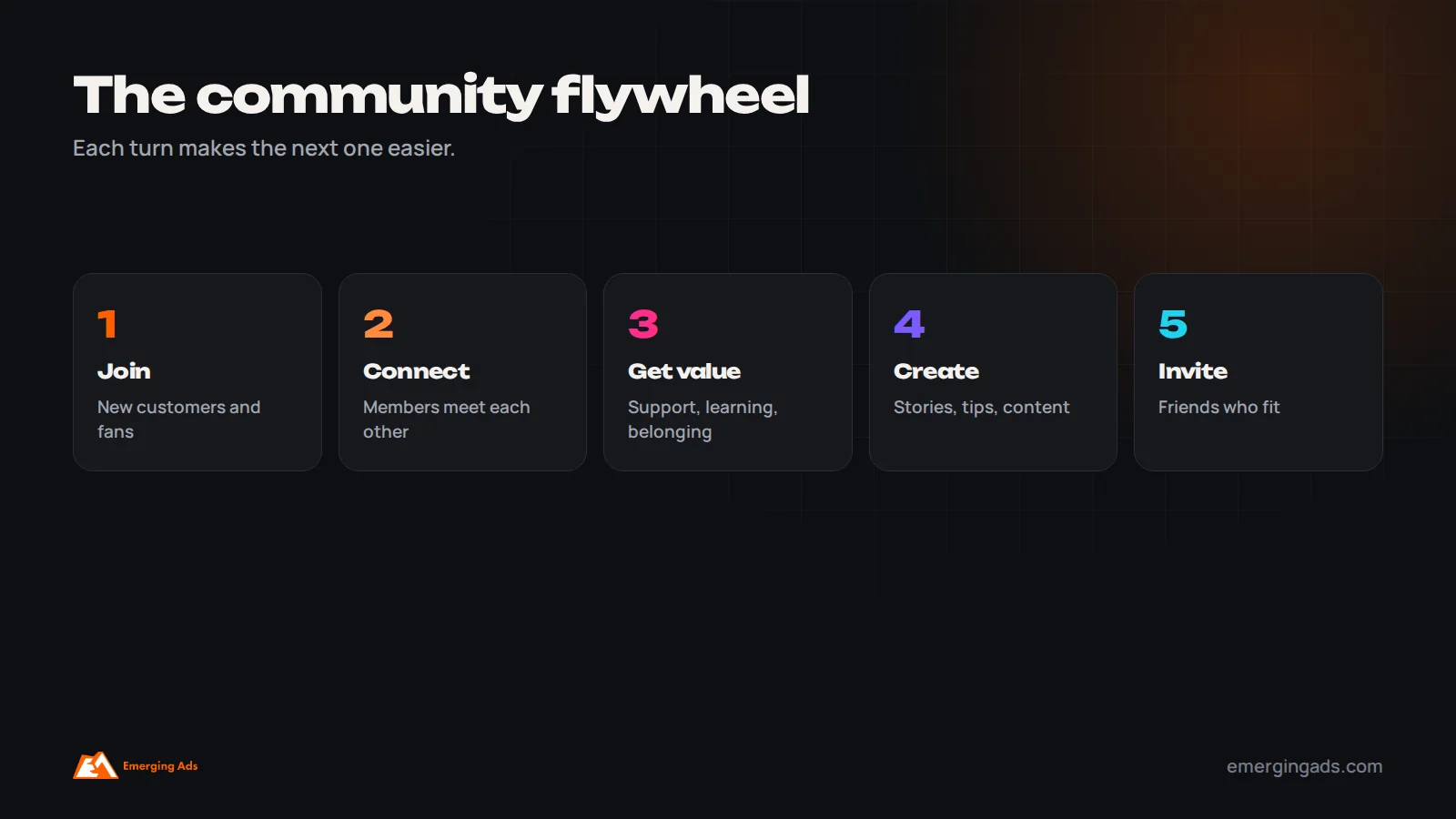
Community-led growth uses a community as a core part of how a business acquires, retains and grows customers. The community can be online, offline or both. What makes it a community rather than an audience is connection between members: people interact with each other, share experiences, answer questions and build relationships, with the brand as host and participant.
A brand with 50,000 social media followers who only react to brand posts has an audience. A brand with 2,000 customers in a group who share progress, swap tips and invite friends has a community. The second is usually far more valuable.
Why community-led growth matters now
- Rising acquisition costs: paid ads keep getting more expensive, so word of mouth and owned relationships matter more.
- Declining organic reach: social platforms show brand posts to fewer followers, while communities offer direct, owned connections.
- Trust: people trust other customers more than brands.
- Retention: customers who feel part of a community tend to stay longer and buy more.
- Insight: communities give direct feedback on products, messaging and needs.
- Content: members create stories, reviews, photos and ideas that brands can share with permission.
Types of community
Communities come in several forms, and many brands run more than one.
- Customer communities: customers helping each other use a product, such as software users or fitness members.
- Practice or interest communities: people who share an activity or profession, such as runners, home cooks or marketers, hosted by a brand that serves them.
- Brand fan communities: enthusiasts of a particular brand, often around launches, collections or lifestyle.
- Local communities: in-person events and groups around a location, such as a gym, cafe or store.
- Professional and partner communities: agencies, consultants or resellers who work with a product.

When community-led growth fits a business
Not every business needs a community, and building one where it does not fit wastes effort that could go into other channels.
Community works best when customers have reasons to talk to each other: shared goals, ongoing use, learning, identity or local connection. It fits fitness and wellness brands, software and SaaS, education and courses, hobby and lifestyle brands, parenting and baby products, beauty and skincare, professional services with practitioner audiences, and local businesses with loyal regulars.
It fits less well for one-off, low-involvement purchases where customers have little to discuss. In those cases, reviews, referrals and retention emails may deliver more than a community.

How to build a community from scratch
1. Define the purpose
Start with why members would join and stay. The answer should be about them, not the brand: getting better at something, solving a shared problem, meeting people like them, accessing expertise, or being first to new things. Write a one-sentence purpose that a potential member would find compelling.

2. Choose the right platform
Go where your members already spend time. WhatsApp communities and groups suit markets such as the Gulf and India and audiences who prefer messaging. Discord and Slack suit tech and creator audiences. Facebook Groups suit many consumer audiences. Forums and your own platform suit communities that need searchable knowledge. In-person meetups suit local businesses and complement online spaces.
3. Start with founding members
Do not launch to everyone at once. Invite 20 to 100 of your most engaged customers or fans personally. Early members set the culture, generate the first conversations and help shape the community. Give them a sense of ownership, such as input on rules, recognition as founders or early access.
4. Create rituals
Communities thrive on regular, predictable activities: weekly challenges, monthly live sessions, member spotlights, Q&A with experts, show-and-tell threads, local meetups and seasonal events. Rituals give members a reason to come back.
5. Moderate and set norms
Clear rules, consistent moderation and a welcoming tone protect the community. Remove spam and hostility quickly, welcome new members personally, and model the behavior you want.
6. Show up consistently
Brands that launch a community and disappear watch it fade. Assign a community manager or owner, respond to members, share behind-the-scenes updates and involve the community in decisions such as product feedback.

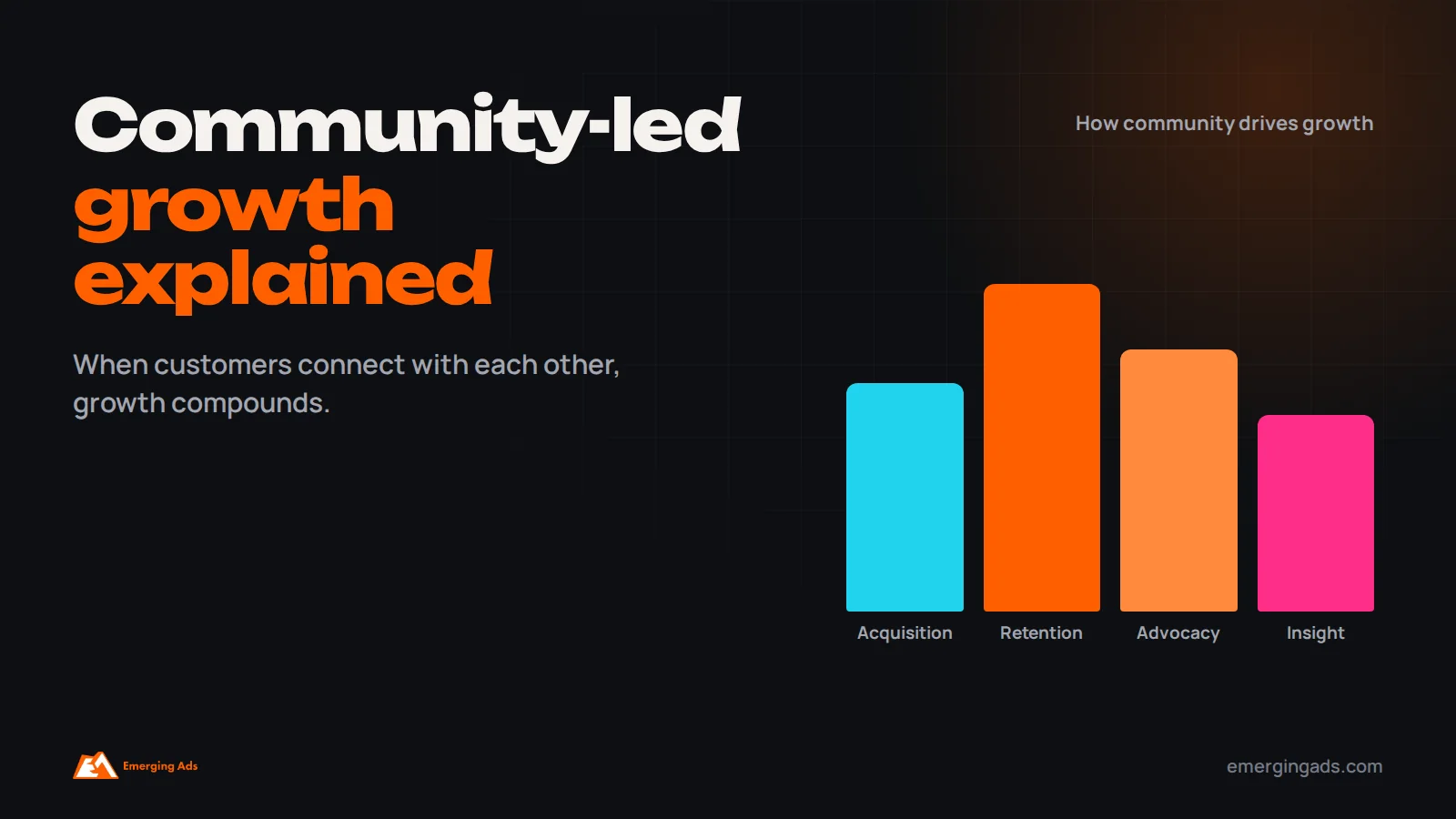
How community drives growth
Community affects almost every stage of the customer journey, which is why its impact can be larger than any single campaign. These are the main ways it contributes to growth.
- Acquisition: members invite friends, share content and recommend the brand. Public community content can attract new people.
- Activation: new customers learn faster from other members, which improves early experience.
- Retention: belonging and habits keep customers engaged and loyal.
- Expansion: engaged members buy more products, upgrade or renew.
- Advocacy: the most engaged members become ambassadors, creators and referrers. Our guide to referral programs shows how to reward them.
- Insight: feedback shapes products, content and messaging.
Content and activities that keep communities active
Active communities need a steady rhythm of reasons to participate. Useful formats include weekly prompts, such as sharing progress, a win or a question; challenges with a clear goal and timeframe; expert sessions where a team member or guest answers questions live; member spotlights that celebrate people and their stories; behind-the-scenes updates and early previews of new products; polls and feedback requests on real decisions; resource libraries with guides and templates; and local or online meetups. Mix formats so members who prefer to read, ask, share or attend all have a way to take part. Plan a simple monthly calendar so activity does not depend on someone remembering.
Community-led growth for DTC brands
Direct-to-consumer brands can use community to stand out in crowded markets where products are easy to copy. A skincare brand might host a community where members share routines and results, ask experts questions and get early access to new products. A fitness apparel brand might run local run clubs and online training challenges. A baby product brand might host a community of new parents sharing advice. In each case, the community creates value beyond the product, keeps customers engaged between purchases, generates authentic content and brings in friends. Brands such as The Simple Seed Baby show how much value comes from customers who return: its returning customer rate rose from 21.62% to 34.81%, and community-style engagement is one way to push that further.
Community-led growth for SaaS and B2B
Software and B2B companies often build communities around practice: helping users get better at their jobs, not just use the product. Examples include user groups, Slack or Discord communities, certification programs, annual events, templates and resource libraries, and expert networks. Community reduces support costs as users answer each other’s questions, speeds up onboarding, surfaces product feedback and creates advocates who recommend the product within their professional networks. Our guide to B2B leads for SaaS covers how community fits with paid acquisition.
Community for local businesses
Local businesses, such as gyms, cafes, bookshops, salons and studios, can build some of the strongest communities, because members meet in person. Regular events, member clubs, WhatsApp groups for regulars, challenges, partnerships with other local businesses and recognition of loyal customers all build belonging. Local communities also generate reviews, referrals and social content naturally. For a fitness studio, a community of members who train together and encourage each other often drives retention more than any promotion.
Who should run the community?
Communities need an owner. In small businesses, the founder or a passionate team member often starts it; as it grows, a dedicated community manager becomes valuable. The role includes welcoming members, starting conversations, running rituals and events, moderating, gathering feedback, highlighting member contributions and reporting on impact. Equally important are member leaders: engaged members who help moderate, host sessions or welcome newcomers. Recognize and support them, because they often make the difference between a community that relies on the brand and one that sustains itself.
Community vs social media following
Many brands confuse a social media following with a community. A following is a list of people who may see your posts if the algorithm shows them. Engagement is mostly between the brand and individual followers, and reach depends on the platform. A community is a group of people connected to each other around a shared purpose, where most conversation happens between members. Social media can host communities, for example through groups, close friends lists or channels, but a large following does not automatically become one. The test is simple: if the brand stopped posting for a week, would members still talk to each other? In a real community, they would.
Getting the first members talking
The hardest moment in any community is the beginning, when there are few members and little conversation. Several tactics help. Seed the community with founding members who already know and like the brand. Prepare the first few weeks of prompts in advance. Personally welcome each new member and invite them to introduce themselves with a simple question. Ask a few members in advance to share stories or questions in the first days. Run a small, time-bound challenge or event early, which gives everyone a shared reason to participate. And keep the group small enough that each contribution gets responses; an active group of 50 is far better than a silent group of 5,000.
Turning community activity into content
Communities produce a steady flow of stories, photos, tips, questions and results. With permission, this material can power the rest of your marketing: member stories in emails, testimonials on product pages, real results in ads, answers to common questions as blog content, and behind-the-scenes posts on social media. Content from real members is often more persuasive than anything the brand produces itself. Always ask before sharing, credit members properly and respect privacy, especially in communities where members discuss personal topics such as health or parenting.
Does a community need to make money directly?
Most brand communities are free to join and create value indirectly, through retention, referrals, insight and content. Some businesses also run paid communities or membership tiers, especially in education, coaching, professional networks and creator businesses, where the community itself is part of the product. If you charge, the value must be clear and consistent: access to experts, exclusive content, events, tools or connections members cannot get elsewhere. For most product and service brands, keeping the community free and measuring its indirect impact is the better approach.
Risks and how to manage them
Communities carry some risks. Negative feedback becomes visible to other members. Conversations can drift into topics that conflict with your brand values. Spam and self-promotion can overwhelm genuine discussion. Members may share inaccurate advice, which matters especially in health, finance and safety topics. And communities take time, which can lead to neglect once the initial enthusiasm fades. Manage these with clear rules, active moderation, quick and honest responses to complaints, expert input on sensitive topics, and a realistic commitment of time and people before launch. Handled well, visible complaints become an opportunity: members see you listen and act.
Community in different markets
Where and how communities form varies by market. In the Gulf and India, WhatsApp communities and groups are often the natural home, and family and social networks are strong, which can accelerate word of mouth. Arabic and local language spaces may be needed alongside English. In the UK and US, Facebook Groups, Discord, Slack, Reddit-style forums and in-person clubs are common, with growing interest in local events. Across all markets, in-person events remain powerful for building strong bonds that online spaces then sustain.
Example communities
A fitness studio: a WhatsApp community for members with weekly challenges, class buddy matching, member spotlights and monthly social events, which keeps attendance high and brings in friends.
A skincare brand: an online group where customers share routines and results, monthly live sessions with a skincare expert and early access to new launches, generating reviews and creator content.
A B2B software company: a Slack community for users with channels by role and industry, office hours with product experts, templates shared by members and an annual user conference, reducing support load and creating advocates.
A local cafe: a regulars’ club with tasting events, a loyalty program and a WhatsApp group announcing new menu items, turning regulars into a source of reviews and referrals.
Ambassador and advocate programs
As a community grows, a small group of members usually becomes especially active: answering questions, welcoming newcomers, creating content and recommending the brand. Ambassador programs recognize and support these people. Benefits might include early access to products, exclusive events, direct contact with the team, special badges or titles, free products or commission on referrals. In return, ambassadors might host local meetups, moderate discussions, create content or mentor new members. Keep programs genuine: ambassadors are most valuable when their enthusiasm is real, so choose people who are already active rather than recruiting for reach alone. Our guide to influencer collaborations covers how creator partnerships differ from ambassador programs.
Using the community for product and marketing insight
One of the most underused benefits of community is insight. Members tell you what they love, what frustrates them, what they wish existed and how they describe your product to others. Use this deliberately: run polls before product decisions, invite members to test new products, ask how they would describe the brand to a friend, and track the most common questions and complaints. Feed these insights into product development, website copy, ad creative and customer service. When members see their feedback lead to changes, their commitment to the community grows further.
Community and email work together
Community spaces and email complement each other. Email reaches every customer, including those who never join the community, and can invite them in with a clear reason. The community gives email content worth sharing: member stories, upcoming events, popular discussions and results. Many brands send a monthly community digest highlighting the best conversations and inviting more people to participate. Our guide to improving ecommerce email results covers how to structure regular campaigns.
The role of events
Events turn loose online communities into real relationships. Even communities that live mainly online benefit from occasional in-person or live virtual events: meetups in cities where members cluster, workshops, product launches, annual gatherings, live Q&A sessions and member-hosted local events. People who meet in person tend to engage more online afterwards, stay customers longer and recommend the brand more enthusiastically. Events also create content, such as photos, talks and stories, that keeps the community active between gatherings. Start small with something simple, such as a monthly online session or a quarterly local meetup, and grow from there.
Welcoming new members well
The first days in a community decide whether a new member becomes active or quietly leaves. Make joining easy, with a clear link and simple instructions. Send a welcome message explaining what the community is for, the main rules and where to start. Encourage a short introduction with a simple prompt, and make sure someone responds to it. Point new members to the most useful resources and upcoming events. Pair them with an existing member or ambassador where possible. A personal welcome takes a few minutes and dramatically improves the chance that a new member returns.
Scaling a community without losing what makes it work
As communities grow, they can lose the intimacy that made them valuable. Large groups become noisy, newcomers feel lost and the brand’s voice can dominate. Address this by creating smaller spaces within the community, such as channels or groups by topic, location or experience level; developing member leaders to host and moderate; documenting the most useful knowledge so it is easy to find; and keeping rituals that bring everyone together. Measure engagement rate as well as size, because a growing community with falling participation is a warning sign.
How to measure community-led growth
- Active members: how many members post, comment or attend events in a period.
- Engagement rate: the share of members who participate.
- Member retention in the community over time.
- Customer retention and repeat purchase for members compared with non-members.
- Referrals and new customers attributed to members.
- Support deflection: questions answered by members rather than staff.
- User-generated content created and reused.
The most persuasive measure is usually comparing members with similar non-members on retention, purchase frequency and lifetime value.

Combining community with paid marketing
Community and paid acquisition reinforce each other. Ads bring in new customers who can join the community; the community raises their lifetime value, which lets you afford higher acquisition costs. Member stories and content make strong ad creative, with permission. Community members also make good seed audiences for lookalike targeting. Our guide to scaling Meta ads explains how higher customer value supports scaling.
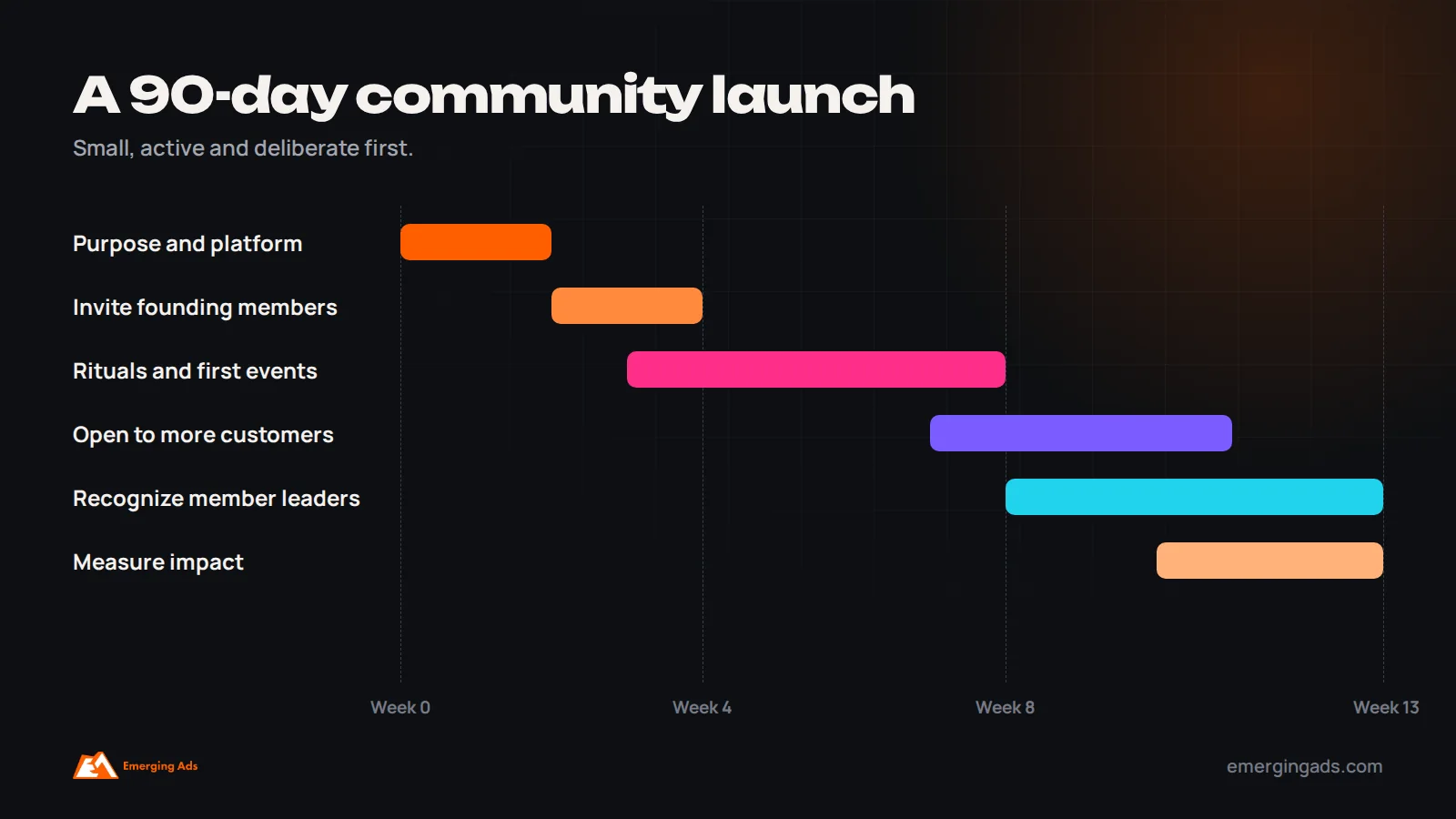
A 90-day plan to launch a community
- Weeks 1 to 2: define the purpose, choose the platform, write simple rules and plan the first month of rituals.
- Weeks 2 to 4: personally invite founding members, welcome each one, and run the first prompts and a small event.
- Weeks 4 to 8: establish weekly and monthly rituals, gather feedback, and identify potential member leaders.
- Weeks 8 to 11: open the community to more customers through post-purchase emails, the website and social channels.
- Weeks 11 to 13: compare members with similar non-members on retention and purchases, and plan the next quarter.
Be patient, and commit
Community-led growth is a long game. The first months often feel slow, with modest numbers and a lot of effort from the team. But communities compound: each engaged member makes the space more valuable for the next, and the effects on retention, referrals and content build over time. Commit to at least six months of consistent effort before judging results, and measure engagement and member value rather than size alone.
Common mistakes
These are the reasons most brand communities stall.
- Launching a community with no clear purpose for members.
- Treating the community as another channel for promotions.
- Launching to everyone at once with nobody talking.
- No consistent owner or moderator.
- Choosing a platform members do not use.
- Measuring only member count, not engagement or business impact.
- Expecting results within weeks.
Frequently asked questions
What is community-led growth?
A strategy where a business grows by building a community of customers or fans who connect with each other, driving acquisition through word of mouth, improving retention and providing feedback.
What is the difference between an audience and a community?
An audience listens to a brand. A community’s members interact with each other, share experiences and help each other, with the brand as host.
Which businesses benefit most from community-led growth?
Businesses where customers share goals, ongoing use, learning or identity, such as fitness, software, education, lifestyle, parenting and beauty brands, and local businesses with loyal regulars.
Which platform should I use for a community?
The one your members already use: WhatsApp communities in the Gulf and India, Discord or Slack for tech audiences, Facebook Groups for many consumer audiences, plus in-person events where relevant.
How do I start a community from scratch?
Define a purpose that benefits members, choose the right platform, invite a small group of founding members, create regular rituals, moderate consistently and show up yourself.
How do I measure community ROI?
Compare members with similar non-members on retention, purchase frequency and lifetime value, and track active members, referrals, support deflection and user-generated content.
How long does community-led growth take?
Usually months. Communities grow gradually, but their impact on retention and word of mouth compounds over time.
Can a small business build a community?
Yes. Small businesses often have an advantage, because founders can personally connect with members and create a genuine sense of belonging.