The short answer
What an SEO agency in Saudi Arabia charges depends on your website’s size and condition, how competitive your keywords are, whether you need Arabic and English SEO, how much content and link building is included, and the agency’s experience. Most agencies charge a monthly retainer, sometimes with a setup or audit fee, quoted in Saudi riyals and usually subject to 15% VAT. Good SEO in Saudi Arabia requires genuine Arabic keyword research and content, not translation, plus technical work and local SEO in cities such as Riyadh, Jeddah and Dammam. Judge quotes on scope and evidence, not monthly price alone.
Saudi Arabia’s digital economy has grown rapidly, with more businesses selling online, more consumers researching on Google before buying and more competition for search visibility in Arabic and English. That has created strong demand for SEO, and a crowded market of agencies offering it at very different prices.
We work with brands across the Gulf, including Arabic-first campaigns and SEO for businesses targeting Saudi customers. This guide explains how SEO agencies in Saudi Arabia price their work, what drives cost, what a proper Saudi SEO scope includes, the taxes and hidden costs to check, how to judge value and the red flags to avoid. It does not quote specific riyal figures that would quickly go out of date; instead, it shows you how to evaluate any quote.

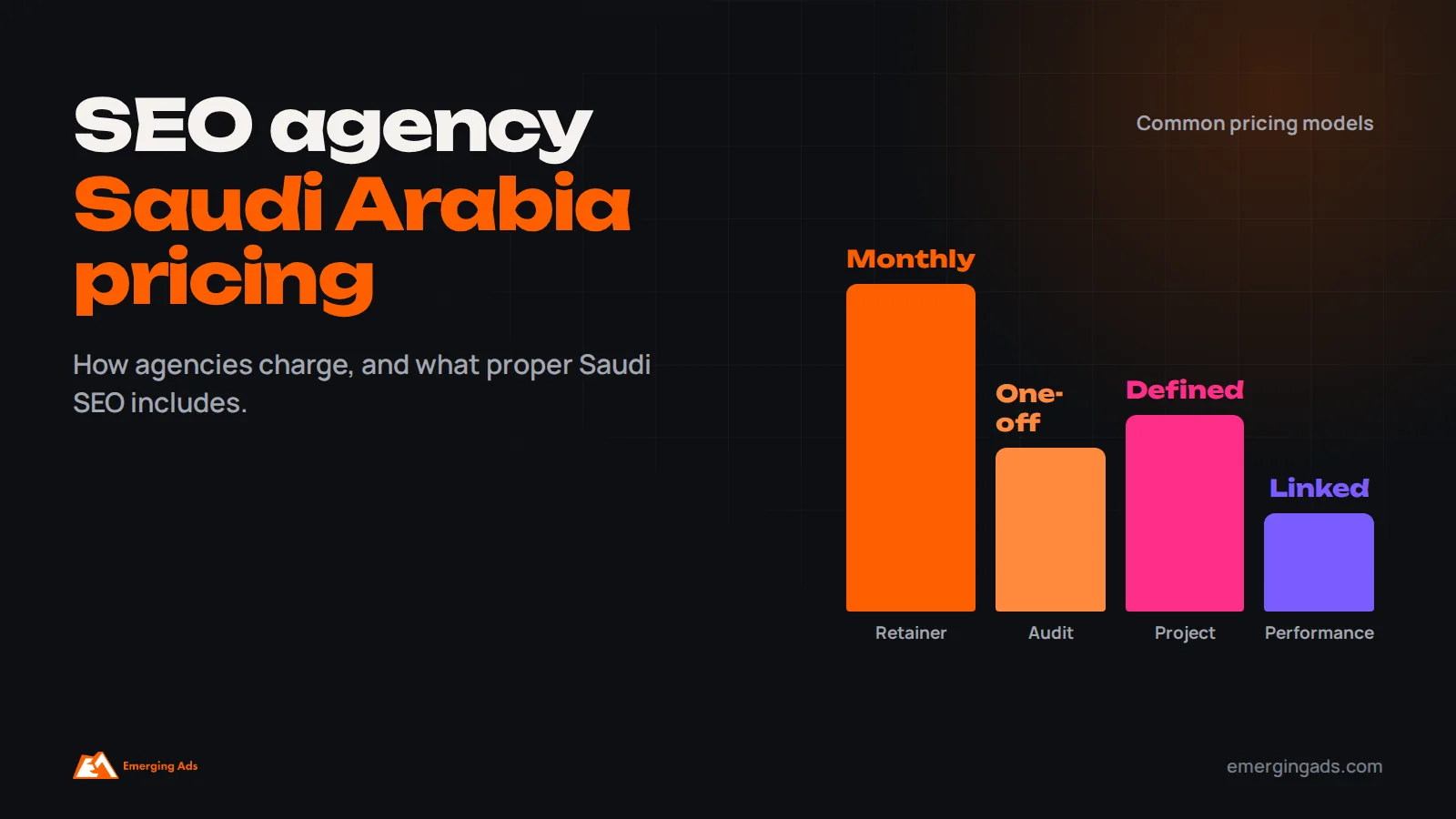
How SEO agencies in Saudi Arabia charge
Monthly retainers
The most common model. You pay a fixed monthly fee for ongoing SEO work: technical improvements, content, on-page optimization, local SEO, link building and reporting. Retainers suit SEO because results build over months.
Audit and setup fees
Many agencies charge a one-off fee for an initial audit, keyword research and fixing major technical issues before ongoing work starts.
Project fees
Used for defined pieces of work, such as a website migration, a technical SEO project, Arabic content production for a set of pages, or local SEO setup for several branches.
Performance-linked pricing
Some agencies tie part of their fee to rankings, traffic or leads. This can align incentives, but rankings-based pricing can encourage targeting easy keywords with little commercial value. If you consider it, link it to business outcomes such as qualified organic leads or sales.
What drives the cost of SEO in Saudi Arabia
Eight factors explain most of the difference between SEO quotes in the Saudi market. Website size, competition and the number of languages usually matter most, because they decide how much research, content and technical work is needed every month.
- Website size and complexity: a 20-page service site costs less to optimize than an ecommerce store with thousands of products.
- Current condition: sites with serious technical problems, poor structure or thin content need more work initially.
- Competition: sectors such as real estate, healthcare, finance, education, travel and ecommerce are highly competitive in Saudi search.
- Languages: Arabic and English SEO is effectively two programs, with separate keyword research, content and optimization.
- Content volume: how many pages and articles are created or improved each month.
- Link building and digital PR: earning links from reputable Saudi and regional sites takes time and relationships.
- Local SEO: number of locations and cities targeted.
- Agency experience: proven Saudi results and native Arabic expertise usually cost more and deliver more.

Why Arabic SEO is its own discipline
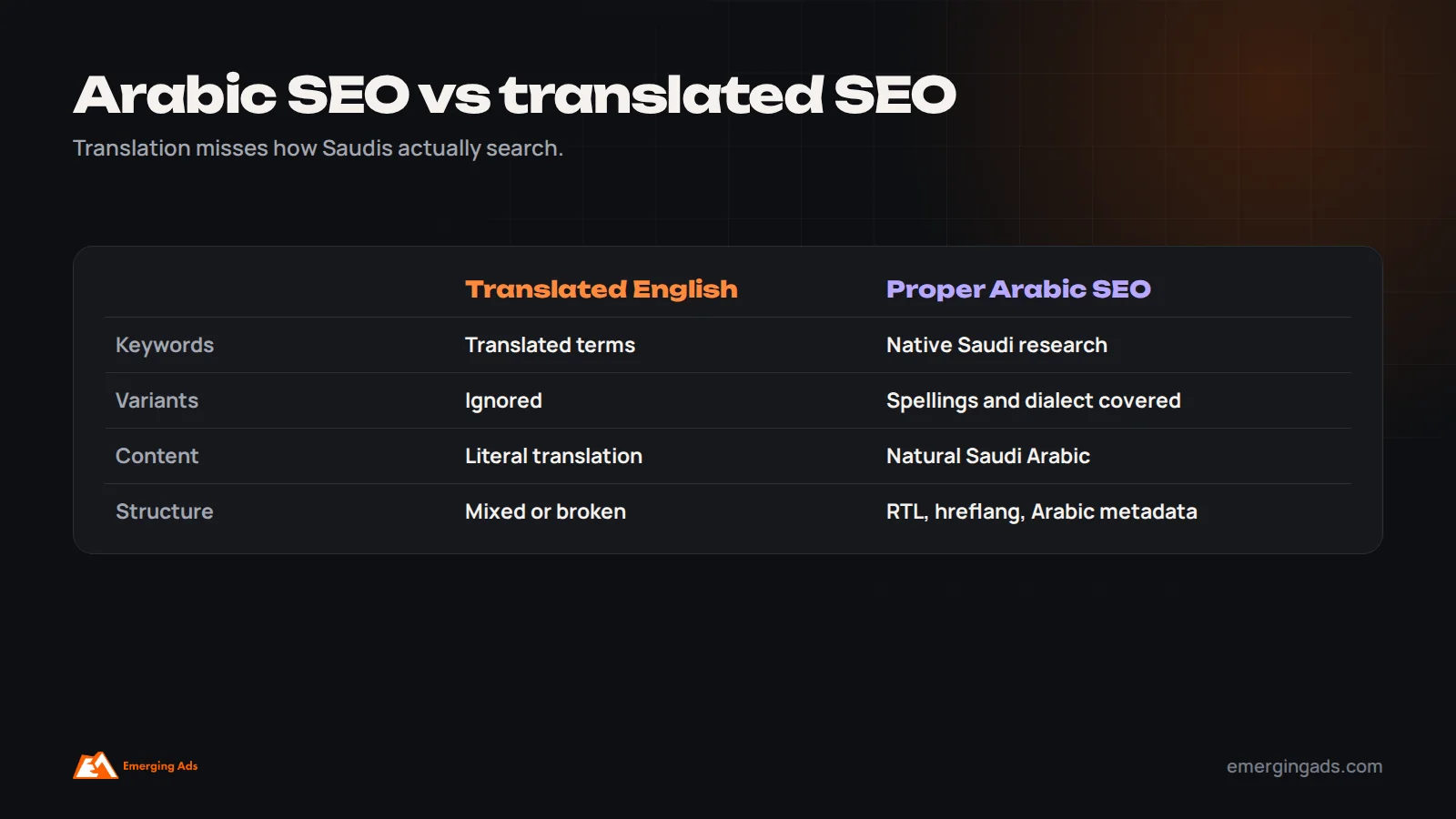
Arabic SEO is not English SEO translated. Saudi users search in Arabic, in English and sometimes in transliterated Arabic using Latin characters. Arabic keywords have variations in spelling, word forms and dialect, and the words Saudi users choose can differ from those used in other Arab countries. Search intent may also differ between Arabic and English queries for the same topic.
Good Arabic SEO starts with native-level keyword research for the Saudi market, content written in natural Arabic for Saudi readers, correct right-to-left page layout, Arabic URLs or clean equivalents, proper hreflang tags linking Arabic and English versions, and Arabic metadata. Ask agencies who does their Arabic keyword research and writing, and request examples of Arabic pages they have ranked.
What a proper Saudi SEO scope includes
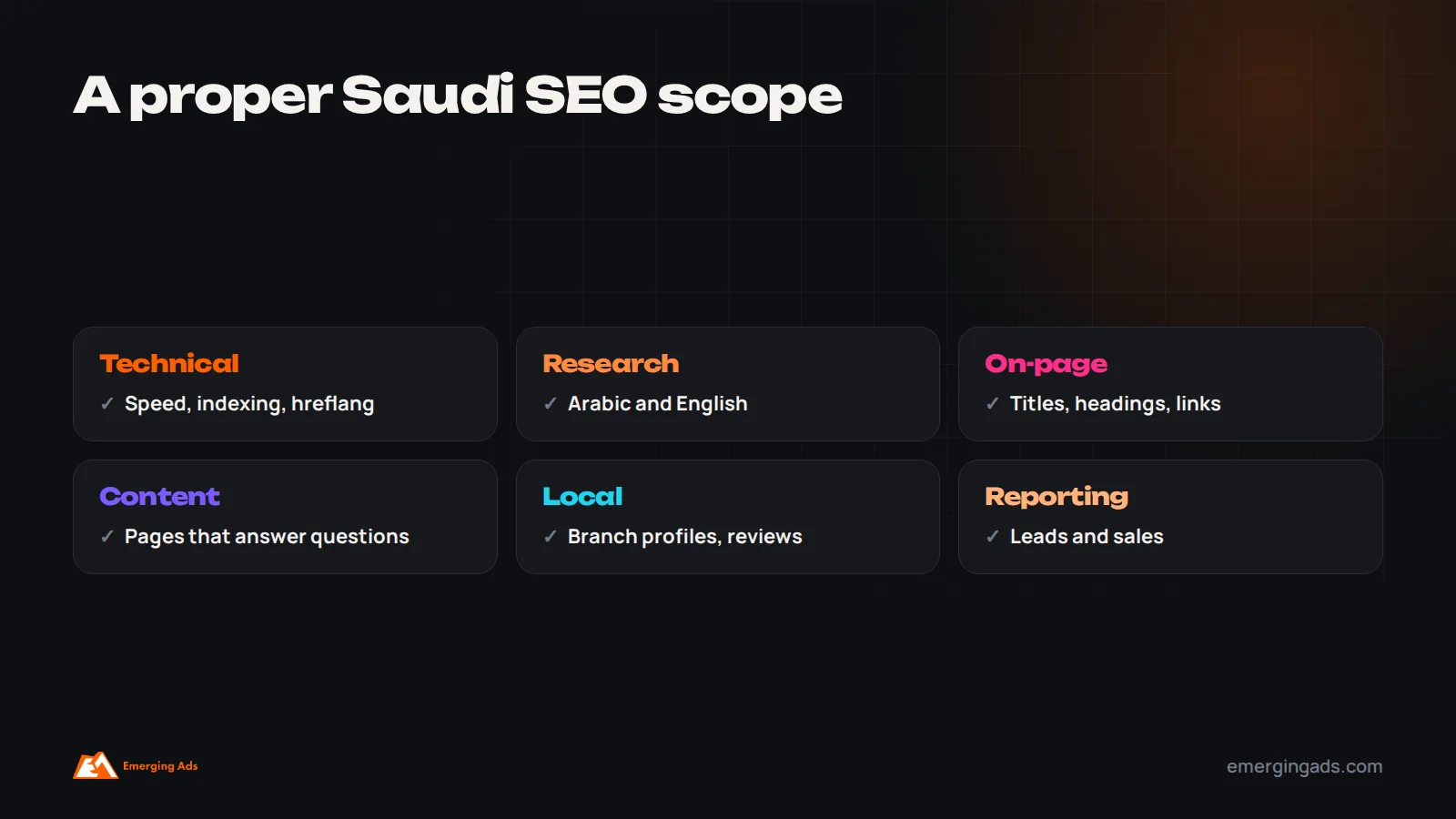
- Technical SEO: crawling, indexation, site speed, mobile usability, structured data and bilingual site structure. Our technical SEO checklist covers the essentials.
- Keyword research: Arabic and English, by intent and city where relevant.
- On-page optimization: titles, headings, content and internal links for priority pages.
- Content: new and improved pages and articles that answer Saudi customers’ questions.
- Local SEO: Google Business Profiles for each branch, consistent business details and reviews.
- Link building: earning links from relevant Saudi, Gulf and industry sites.
- AI search visibility: structured, specific content that can be cited in AI answers.
- Reporting: rankings, organic traffic, leads and sales, in Arabic and English.
Local SEO in Riyadh, Jeddah and other cities
For businesses that serve customers in specific Saudi cities, such as clinics, restaurants, retailers, gyms, schools and service providers, local SEO is often the most valuable part of the program. Google Maps results dominate searches for services nearby. Winning them requires a verified Google Business Profile for each branch, with Arabic and English names and descriptions where appropriate, accurate categories, opening hours that reflect Ramadan and holiday changes, regular photos, and a steady flow of genuine reviews with responses. Each branch should also have its own page on your website with location details, services and reviews. Businesses with many branches across Saudi cities need a consistent process to manage this at scale. Our local SEO service covers this work.
SEO for Saudi ecommerce stores
Saudi ecommerce has grown quickly, and organic search is an important source of customers for online stores. Ecommerce SEO focuses on category pages that target valuable commercial searches in Arabic and English, product pages with original descriptions rather than supplier text, clean filtering that does not create thousands of duplicate pages, structured data for products, prices, availability and reviews, and fast mobile performance. Product information in both languages, with prices in riyals and clear delivery information, also supports Google Shopping and AI shopping answers. Our ecommerce SEO team specializes in this.
AI search and Saudi users
Google’s AI Overviews and AI assistants increasingly answer questions directly, in Arabic as well as English. Content that answers specific questions clearly, uses well-structured headings and tables, and shows real expertise is more likely to be cited. Consistent business information across your website, Google Business Profile and directories helps AI tools describe your business accurately. A modern SEO program in Saudi Arabia should consider AI visibility alongside traditional rankings. Our guide to generative engine optimization explains the approach.
Data protection and website compliance
Saudi Arabia’s Personal Data Protection Law sets rules for how businesses collect and use personal data, including data collected through websites, forms and analytics. While not strictly an SEO matter, SEO and website work often touch forms, tracking and cookies. Make sure your agency understands the requirements and that your website’s privacy policy, consent mechanisms and data handling are appropriate for your business.
VAT and other costs to check
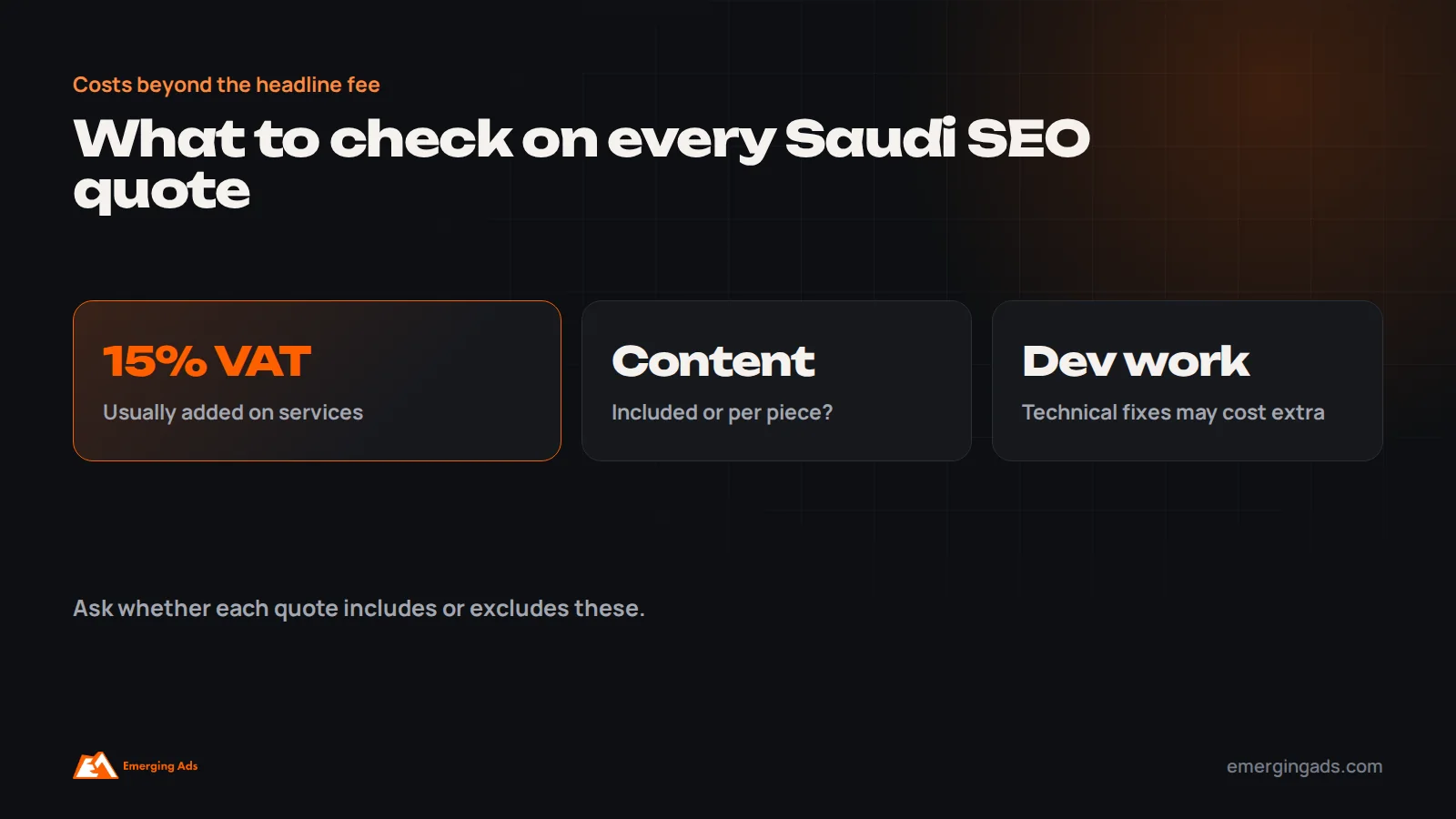
- VAT: Saudi Arabia applies VAT at 15% to most services. Check whether quotes include it.
- Content production: some retainers include a set number of articles; others charge per piece.
- Link building: may be included, limited or charged separately.
- Development work: technical fixes may need your developers or the agency’s, at extra cost.
- Tools: SEO software, rank tracking and reporting dashboards.
- Minimum terms: many SEO contracts require several months’ commitment.
How long SEO takes in Saudi Arabia
Timelines depend on your starting point, competition and how quickly recommended changes go live, so treat these as typical ranges rather than promises.
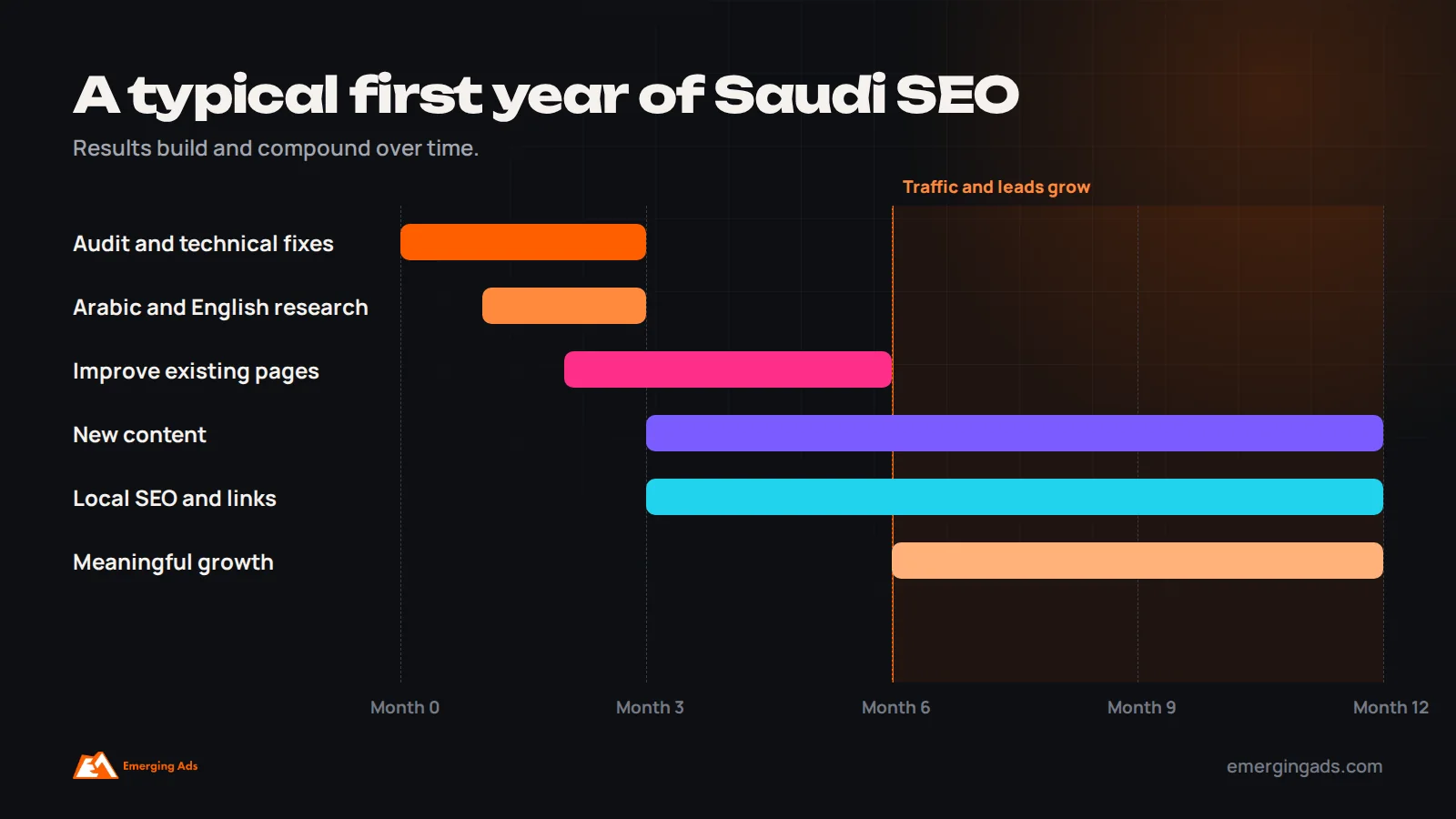
SEO is a medium to long-term investment. Technical fixes and improvements to existing pages can show results within weeks to a few months. New content and competitive keywords typically take several months to rank, and highly competitive sectors can take longer. Expect visible progress in Search Console, such as impressions and rankings for target keywords, within the first three months, and more meaningful traffic and lead growth over six to twelve months.
How to judge whether the fee is worth it
- Identify the keywords and pages most likely to bring customers, not just traffic.
- Estimate realistic traffic and conversion rates for those pages.
- Put a value on the leads or sales using your margins or deal values.
- Compare with the total cost over at least a year, including VAT and content.
- Remember that SEO results keep working after the investment, unlike paid ads.
How Saudi users search
Understanding how people in Saudi Arabia search is the foundation of any SEO program. Smartphone use is extremely high, so most searches happen on mobile, often on the move and often by voice. Many users switch between Arabic and English depending on the topic: technical products, software and some professional services are frequently searched in English, while local services, everyday products and many consumer topics are searched in Arabic. Searches often include a city or district name, such as Riyadh, Jeddah or a specific neighborhood, and phrases meaning “near me” or “best”. Brand names are often searched in both scripts. A good agency maps these patterns for your specific sector before choosing keywords, rather than assuming English keywords simply need translating.
Bilingual site structure done properly
Many Saudi businesses run bilingual websites, and the way the two versions are structured has a large effect on SEO. The cleanest approach usually places each language in its own folder, such as one for Arabic and one for English, with each page available in both languages where relevant. Each version should have its own titles, descriptions, headings and content written for that audience, rather than a single page that switches language with scripts. Hreflang tags should connect equivalent pages, telling Google which version to show to Arabic and English searchers. Arabic pages need correct right-to-left layout, readable Arabic fonts and properly mirrored navigation. Problems in this structure, such as Arabic pages that are not indexed or English pages showing to Arabic searchers, are among the most common issues we find on Saudi sites.
What good Saudi SEO content looks like
Content that ranks in Saudi search answers real questions Saudi customers ask, in the language they use, with local detail. For a clinic, that might mean pages explaining specific treatments, recovery, costs and insurance in natural Arabic, with the doctor’s credentials. For an ecommerce store, it might mean category pages that explain how to choose a product, with prices in riyals and delivery information for Saudi cities. For a B2B company, it might mean guides that address Saudi regulations, market conditions or Vision 2030 sectors. Generic content translated from English rarely performs as well as content written for Saudi readers from the start. Our guide to blog writing services covers how to produce content consistently.
Link building in the Saudi market
Links from reputable, relevant websites remain an important signal of authority. In Saudi Arabia, valuable links often come from local news and business publications, industry associations, partner and supplier websites, event and sponsorship pages, local directories and Arabic content sites in your sector. Earning them usually involves genuinely newsworthy activity, useful resources and relationships, rather than buying links in bulk. Be cautious of agencies offering large numbers of links for a low monthly fee; low-quality links rarely help and can create risk. Ask agencies to show examples of real links they have earned for Saudi clients.
Advice for small businesses in Saudi Arabia
Small businesses with limited budgets should focus SEO where it pays back fastest. For most local businesses, that means a strong Google Business Profile and reviews, clear Arabic and English service pages, basic technical health and a handful of pages answering the questions customers ask most often. For small online stores, it means improving the most important category and product pages before producing lots of blog content. A focused program with clear priorities usually beats a broad package that tries to do everything at once on a small budget.
How SEO works alongside paid search and social
SEO works best alongside other channels. Google Ads search terms data shows which keywords actually convert, which helps prioritize SEO. Snapchat, Instagram and TikTok campaigns create demand that often turns into branded searches on Google, which SEO and branded search campaigns then capture. Strong organic rankings for important terms can reduce reliance on paid search over time. When choosing an SEO agency, ask how it would coordinate with your paid campaigns, or whether it can manage both. Our guide to performance marketing in 2026 explains how we balance channels.
How to measure SEO results
Agree measures before work starts. Leading indicators include rankings and impressions for target Arabic and English keywords in Search Console, the number of pages indexed, and technical health scores. Outcomes include organic traffic to commercial pages, organic leads, calls and bookings, and organic revenue for ecommerce. Compare results with the same period last year to account for seasonality, especially around Ramadan and other peak periods. A short monthly report with these numbers, a summary of work done and next steps is far more useful than long lists of keyword positions.
What the first 90 days should look like
A good SEO agency’s first three months typically include a full technical audit and fixes for the most serious issues, Arabic and English keyword research mapped to pages, improvements to the most important existing pages, local SEO setup for each branch, a content plan for the following months, and baseline reporting. You should see early signs, such as more impressions and better positions for target keywords, within this period, with traffic and leads growing over the following months.
Contract terms to look for
SEO needs time, so a minimum commitment of several months is reasonable. But look for a clear scope of monthly deliverables, transparent reporting, ownership of all content and accounts by your business, access to Search Console and analytics at all times, VAT shown clearly, and a reasonable notice period after the initial term. Avoid contracts that lock you in for long periods without clear deliverables or a break clause.
SEO considerations by industry in Saudi Arabia
Real estate: highly competitive searches for property types, districts and developments, with strong demand for Arabic content, project pages and location-based landing pages. Fast-loading pages with clear details and contact options matter.
Healthcare: clinics and hospitals compete for treatment and specialist searches. Content must be accurate, written or reviewed by qualified professionals, and consistent with healthcare advertising rules. Local SEO for each branch is essential.
Education and training: searches peak around admissions and course start dates. Program pages, fees information and outcomes content in Arabic and English help.
Retail and ecommerce: category and product pages, buying guides and seasonal pages for Ramadan, Eid, White Friday and national days.
B2B and professional services: services pages, expertise content and case studies targeting decision-makers, often in English as well as Arabic.
Hospitality and restaurants: Google Maps visibility, reviews, menus and photos, with content that reflects local tastes and occasions.
Seasonality in Saudi search
Search demand in Saudi Arabia shifts with the calendar. Ramadan and Eid change what people search for and when, with more activity in the evening and late at night, and rising searches for gifts, food, fashion and travel. White Friday drives retail searches in November. Saudi National Day and Founding Day create seasonal interest. Summer brings travel and back-to-school searches. SEO content for these moments needs to be published and indexed well before the peak, often several weeks in advance. Our guide to Ramadan marketing in the UAE and Saudi Arabia covers the most important season.
Agency, freelancer or in-house?
Smaller businesses can get good results from a skilled freelancer, especially one with native Arabic SEO experience, for a focused scope such as local SEO or improving key pages. Agencies bring several specialists, such as technical SEO, Arabic and English content, link building and reporting, and continuity when people are unavailable. Larger businesses with significant organic revenue often build an in-house SEO role and use agencies for specialist work such as migrations or digital PR. Whichever you choose, make sure the people doing the work have proven experience with Saudi search.
Two example SEO scopes
A multi-branch clinic in Riyadh and Jeddah. The first three months cover a technical audit and fixes, Arabic and English keyword research for each treatment and city, Google Business Profile optimization for every branch, a review process, and new or rewritten pages for the top treatments in both languages. From month four, the scope adds regular content answering common patient questions and earning links from health and local publications. Success is measured on organic appointment requests and calls per branch.
An online fashion store shipping across Saudi Arabia. The first three months focus on fixing indexing of Arabic pages, cleaning up filters that create duplicate URLs, improving the top category pages in Arabic and English, adding product structured data and speeding up mobile pages. From month four, the scope adds buying guides, seasonal pages for Ramadan, Eid and White Friday, and outreach to fashion and lifestyle sites. Success is measured on organic revenue and the share of sales from non-branded searches.
Making the decision
When you compare SEO agencies for the Saudi market, look past the monthly fee. Ask which agency showed the best understanding of how your customers search in Arabic and English, which gave the clearest plan for your site, whose results with Saudi businesses were most convincing, and whose terms let you see your data and leave if it does not work. The agency that answers best on those questions usually delivers the best value over a year.
What your business needs to provide
SEO depends on cooperation from the client side. Agencies need access to your website, Search Console and analytics; input from people who know your products, services and customers; approvals for content in both languages; and developer time for technical fixes. Assign one person to own the relationship, answer questions quickly and make sure approved changes go live. Projects with fast approvals and developer support usually show results months sooner than those where recommendations wait in a queue.
Red flags
These warning signs come up repeatedly when Saudi businesses describe SEO engagements that disappointed them. Ask about each one directly before signing.
- Guaranteed first-page rankings.
- Very low fees for “full SEO” with no clear deliverables.
- Machine-translated Arabic content.
- Bulk link packages from irrelevant or low-quality sites.
- Reports showing rankings for keywords nobody searches.
- No access to your Search Console and analytics data.
- Long contracts without break clauses.

Questions to ask an SEO agency in Saudi Arabia
Use these questions with every agency on your shortlist and compare the answers side by side. Specific, evidence-based answers are a good sign.
- Which Saudi businesses have you helped grow organic traffic and leads, and by how much?
- Who does your Arabic keyword research and content writing?
- What would you fix first on our website, and why?
- How do you handle bilingual site structure and hreflang?
- How do you build links, and can we see examples?
- What exactly is included each month?
- Is VAT included, and what costs are extra?
- How will you report, and which business metrics will you track?
- What are the contract length and notice period?
Our guides on how much to pay an agency and choosing an ecommerce SEO agency cover these decisions in more detail. If you would like a proposal, our SEO team works with businesses targeting Saudi customers in Arabic and English.
Frequently asked questions
How much does an SEO agency in Saudi Arabia charge?
It depends on website size, competition, languages, content and link building, and agency experience. Most charge monthly retainers in riyals, sometimes with an audit or setup fee, usually plus 15% VAT.
Is VAT charged on SEO services in Saudi Arabia?
Saudi Arabia applies VAT at 15% to most services. Check whether each quote includes it.
Do I need Arabic SEO in Saudi Arabia?
Usually yes. Many Saudi users search in Arabic, and Arabic SEO requires native keyword research, natural content and correct bilingual site structure.
How long does SEO take in Saudi Arabia?
Technical and on-page improvements can show results within weeks to a few months. Competitive keywords usually take six to twelve months.
What should a Saudi SEO retainer include?
Technical SEO, Arabic and English keyword research, on-page optimization, content, local SEO, link building, AI search visibility and business-focused reporting.
Can SEO agencies guarantee rankings?
No. Nobody controls Google’s rankings. Treat guarantees as a red flag.
Is local SEO important in Saudi cities?
Yes, for businesses serving customers in Riyadh, Jeddah, Dammam and other cities. Google Business Profiles, reviews and location pages are central.
Should I choose a Saudi-based agency?
Local presence helps, but native Arabic expertise, proven Saudi results and transparent scope matter more than office location.