The short answer
The best ecommerce SEO agency is not necessarily the nearest one. It is the one with proven experience on stores like yours, a clear technical process for catalogs, category and product pages, honest reporting on organic revenue rather than just rankings, and a realistic plan for the first 90 days. Ask to see real results from comparable stores, insist on a short pilot or clear exit terms, and be wary of guaranteed rankings or link packages.
Search for an ecommerce SEO agency near you and you will get a page of agencies that all promise more traffic, better rankings and more sales. Their websites look similar. Their case studies all show lines going up. Their proposals use the same vocabulary.
We are one of those agencies, so we know how hard it is to tell apart from the outside. This guide is our honest view of what separates agencies that actually grow ecommerce revenue from organic search from those that mainly produce reports. Use it to judge anyone you talk to, including us.

Why “near me” is not the filter it used to be
For local businesses such as restaurants, clinics and trades, a local agency has a real advantage. It understands the area, the competitors and how local search results behave. For ecommerce, location matters much less. Your customers are not searching in one neighborhood, the work happens in your store platform, Search Console and analytics, and most collaboration happens on calls and shared documents anyway.
What does matter is that the agency understands your market. A store selling mainly in the UK needs someone who knows UK search behavior and competitors. A brand selling across the Gulf needs Arabic and English search experience. A US store needs someone comfortable with US competition levels. Market knowledge matters far more than whether you can visit their office.
There are two situations where proximity is still worth weighing. If you value regular in-person workshops, a nearby agency is easier. And if you run physical stores alongside your online shop, local SEO for those locations becomes part of the brief, which our local SEO team handles separately from ecommerce work.
What a real ecommerce SEO agency does differently
Ecommerce SEO is a different discipline from SEO for a services website or a blog. The work centers on the catalog, and the catalog creates problems and opportunities that general SEO agencies often miss.
They start with the catalog, not the blog
Category pages usually target the most valuable commercial searches: “women’s running shoes”, “organic baby clothes”, “office chairs with lumbar support”. A strong ecommerce agency spends much of its early effort making category pages rank: clear structure, useful introductory and supporting content, good internal links, and filters that create indexable pages only where people actually search for that combination.
They understand catalog-scale technical problems
Faceted navigation, product variants, out-of-stock and discontinued products, pagination, duplicate descriptions from suppliers, and site search pages getting indexed. These are everyday problems on stores and rare on brochure sites. Ask any agency how they would handle each one. A confident, specific answer is a good sign. We cover these in more detail in our technical SEO checklist.
They connect SEO to revenue
A good ecommerce agency reports organic revenue, organic orders and the revenue from non-branded searches, not just rankings and traffic. Traffic to a blog post about care tips is nice. Traffic to the category page that sells the product is what pays for the work.
They work with your platform, not against it
Shopify, WooCommerce, BigCommerce, Magento and custom builds each have their own limitations. Shopify, for example, imposes some URL structures that cannot be changed and handles collections and product URLs in particular ways. An experienced agency knows which battles are worth fighting on your platform and which are not.
They think about product data beyond the website
Product information now appears in Google’s shopping results, in Merchant Center free listings and increasingly in AI-generated shopping answers. Clean product titles, accurate structured data, prices, availability, shipping and return details help a product show up in all of those places. An ecommerce agency should be talking about your product feed as well as your pages.
Red flags we see constantly
Some warning signs come up so often in proposals that clients bring to us for a second opinion that we now keep a list.
- Guaranteed rankings. Nobody controls Google’s results. A guarantee is either a promise for keywords nobody searches for or a promise that cannot be kept.
- Link packages sold by quantity. “50 backlinks a month” usually means low-quality links that do little or carry risk. Links should be earned through content, digital PR and genuine relationships, and reported individually.
- Vague deliverables. “Ongoing optimization” with no list of what will actually be done each month.
- Reports full of vanity metrics. Impressions and keyword counts with no mention of organic revenue.
- Long lock-in contracts before any proof. Twelve months with no break clause, signed before the agency has shown it understands your store.
- Mass AI-generated content plans. Hundreds of thin articles a month published with little editing. Google’s guidance targets content made mainly to manipulate rankings, and it rarely helps anyway.
- No access for you. Accounts and tools set up under the agency’s ownership. You should own your Search Console, analytics, content and any accounts created for your business.
Questions to ask before you sign
These questions separate experienced ecommerce agencies from generalists quickly. Listen for specifics rather than polished generalities.

- Which stores like ours have you grown, and by how much in organic revenue? Ask for examples of similar size, platform and catalog complexity. A team that has only worked with 50-product boutiques may struggle with 20,000 products, and the reverse is also true.
- What would you look at first on our site, and why? A good agency will have looked before the call and will mention something specific.
- How do you handle faceted navigation and variants on our platform?
- What does a 90-day roadmap look like for a store our size? Expect phases, not a list of buzzwords.
- Who will actually do the work? Meet the people, not only the salesperson.
- How do you build links, and can we see examples?
- What will you report monthly, and how will we know it is working before rankings move?
- What do you need from us? Developer time, content approval and product data access often decide the pace more than the agency does.
- What happens if we stop working together? Who owns the content, accounts and reports?
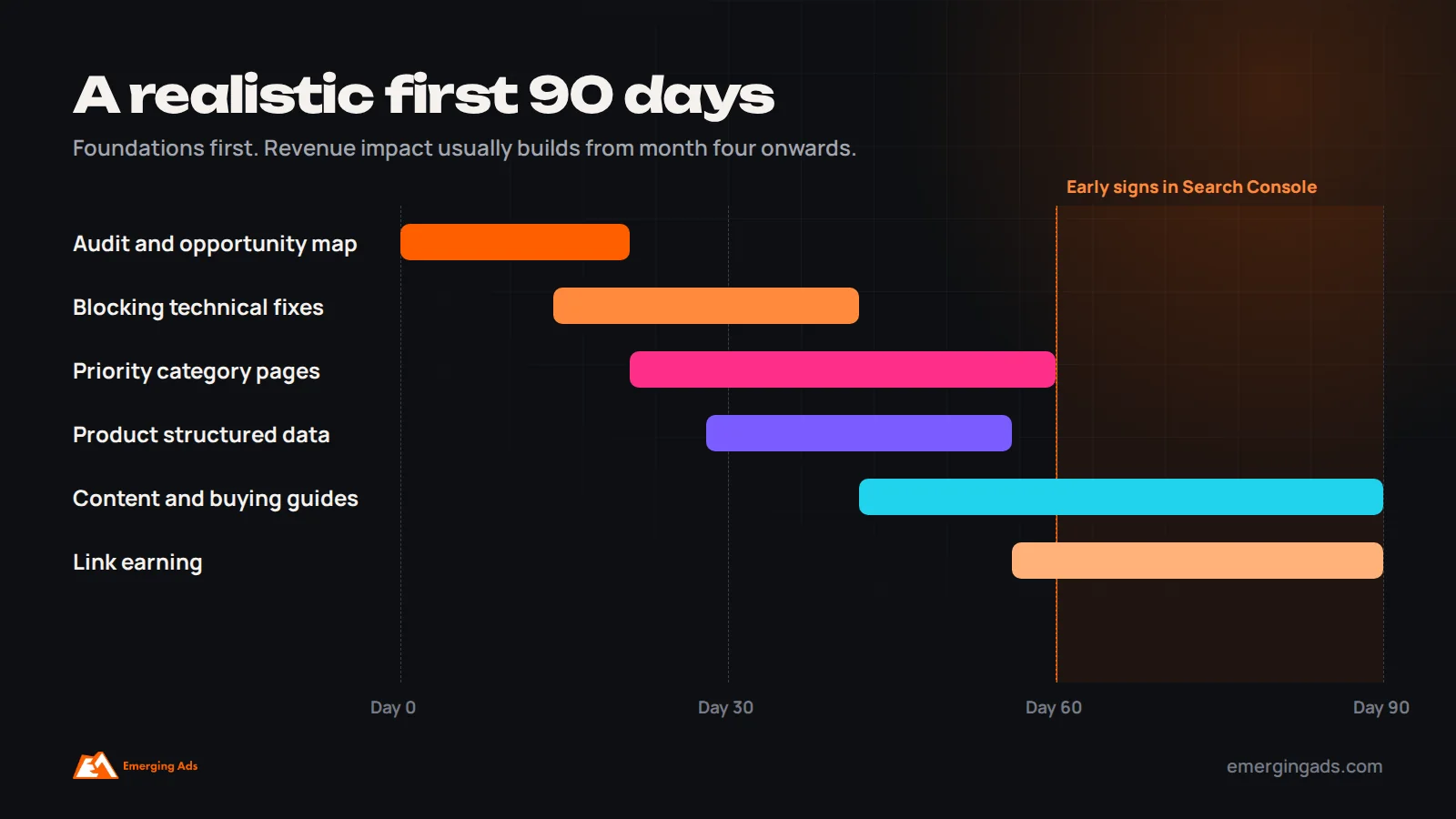
What to expect in the first 90 days
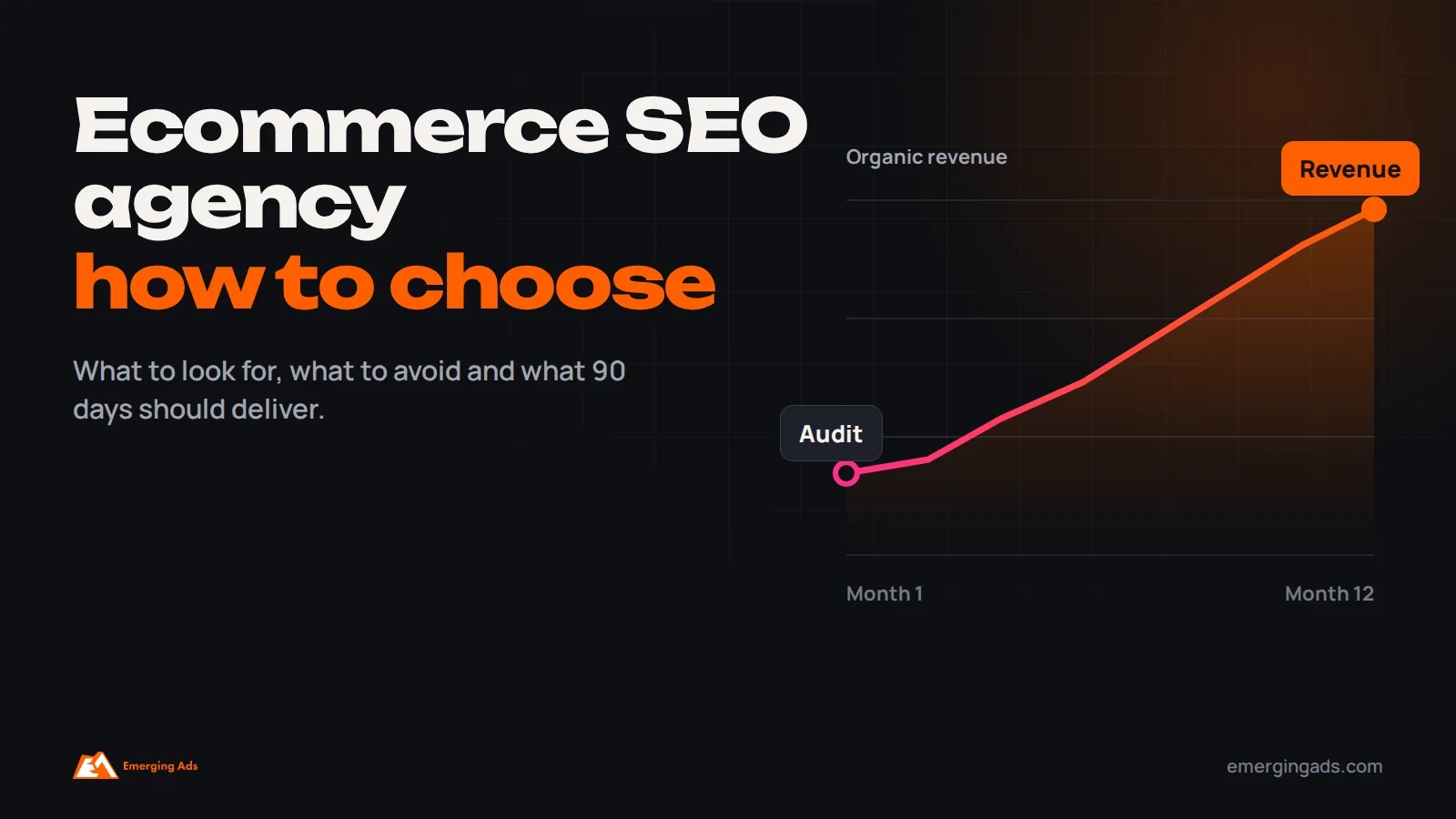
You should not expect a dramatic traffic spike in 90 days. Organic growth on an established domain usually moves in a curve, not a cliff. What you should expect is visible, meaningful progress on the foundations.
- Weeks 1 to 3: a full technical audit, a keyword and category opportunity map, and analytics and Search Console set up properly. You should receive a prioritized list of fixes, not a 200-page PDF.
- Weeks 3 to 8: blocking technical issues fixed, priority category pages improved, internal linking strengthened, product structured data in place.
- Weeks 6 to 12: new or improved content for priority categories and buying guides, a link-earning plan underway, and early signs in Search Console such as more impressions for target terms and better average positions.
Revenue impact usually becomes clearer from month four to six onwards, depending on how competitive your category is and how quickly fixes are implemented. If an agency is still talking about “foundations” in month nine with nothing measurable to show, ask harder questions.
What ecommerce SEO should cost
Pricing varies widely by market, store size and scope, so be cautious of anyone quoting a figure without understanding your store. What matters more than the headline number is what is included: technical work, content production, link earning, developer support and reporting all cost time.
Lower-cost retainers often cover reporting and light on-page changes but little content or link work. Mid-range retainers typically include ongoing technical work, regular category and content improvements and some outreach. Larger engagements add substantial content production, digital PR and development support. Our guides on how much to pay a digital marketing agency and what content marketing costs break down typical ranges and what drives them.
A useful sense check: compare the monthly fee to the organic revenue you could realistically add within a year. If the numbers cannot work even in an optimistic case, the scope or the agency is wrong for your stage.
Why a 90-day pilot beats a 12-month contract
We prefer to start ecommerce SEO with a defined first phase, typically around 90 days, with clear deliverables: the audit, the fix list, a set number of category pages improved, and agreed measures of progress. At the end, both sides decide whether to continue on an ongoing basis.
That protects you from paying a year for an agency that does not fit, and it forces the agency to show real work early. If an agency refuses any form of trial period or break clause, ask why.
Agency, freelancer or in-house?
There is no single right answer. It depends on size, budget and how much SEO work there is.
A freelancer can be excellent value for a smaller store with a clear technical or content need, especially if they specialize in your platform. The limit is capacity and range of skills.
An agency brings several specialists, such as technical SEO, content, links and analytics, and continuity when people are away. It suits stores that need breadth without hiring a full team.
An in-house SEO makes sense once organic search is a major revenue channel and there is enough work to keep someone fully occupied. Many brands then keep an agency for specialist projects such as migrations or digital PR.
Whichever you choose, make sure SEO has access to a developer. On ecommerce sites, many of the highest-impact fixes require template or theme changes. An SEO with no development support ends up writing recommendations that sit in a backlog.
Why SEO should talk to your paid team
On most stores we work with, paid search and organic search compete for the same customers on the same results pages. Search terms data from Google Ads shows exactly which queries convert, which is invaluable for prioritizing SEO. Organic rankings, in turn, can reduce how much you need to spend on branded and high-volume terms.
For Recov Athlete, a US retailer of high-ticket recovery equipment, we manage Google Ads and SEO together, which lets keyword and conversion data from paid campaigns shape which category pages get organic investment first. Agencies that run both channels, or at least share data with whoever runs the other, tend to make faster decisions.
What changes with AI search and shopping answers
Google’s AI Overviews, ChatGPT shopping features and other AI tools are changing how some shoppers research products. For ecommerce, the practical implications so far are clear rather than mysterious: accurate and complete product data, helpful buying guides that answer comparison questions directly, genuine reviews, and consistent brand information across the web all increase the chance of being mentioned. Ask any agency how it accounts for this, and be wary of anyone selling it as a separate, secret discipline. Our explainer on generative engine optimization covers what is known so far.
What the agency needs from you
Even the best agency moves at the speed of the client. The ecommerce SEO projects that deliver fastest have three things in common on the client side. Someone with authority approves content and changes within days rather than weeks. Developer time is reserved each month, so technical fixes do not wait in a queue behind feature work. And product, merchandising and customer service teams share what they know, such as which products have the best margins, what customers ask most often and which ranges are being discontinued. If you cannot commit to those, tell the agency at the start, because it changes what a realistic plan looks like.
How to measure an ecommerce SEO agency
Agree measures before work starts, in three layers:
- Activity: what was delivered this month, such as fixes shipped, pages improved and links earned. This shows the work is happening.
- Leading indicators: impressions and average position for target non-brand terms, indexed pages, Core Web Vitals. These move before revenue does.
- Outcomes: organic sessions to category and product pages, organic orders, organic revenue and non-brand organic revenue, compared year on year to account for seasonality.
Ask for these in the same format every month, with a short written summary of what changed and what is planned next. A consistent format makes it much easier to spot trends, and it makes it obvious when a report is avoiding a difficult number.
Brand searches grow when other marketing works, so separating non-brand organic performance is the clearest view of what SEO itself contributed.
A simple brief to send every agency
Proposals are only comparable if every agency answers the same question. Before you speak to anyone, write a one-page brief covering:
- The store: platform, number of products and categories, main markets and languages.
- Where you are now: approximate monthly organic sessions and revenue, the share that comes from branded searches if you know it, and any recent drops or migrations.
- What you sell best: the categories that matter most to margin, not just volume.
- Resources: who can approve content, whether you have developer time, and how quickly changes can go live.
- Goals and timeframe: what success would look like in twelve months.
- Budget range: sharing it saves everyone time and gets you proposals sized to reality.
Agencies that come back with questions about your brief are usually the ones paying attention.
If you are planning a migration or redesign
Replatforming, for example from WooCommerce or Magento to Shopify, or launching a new theme, is the moment ecommerce stores most often lose organic revenue. URLs change, redirects are missed, content is dropped and structured data disappears. If a migration is on the horizon, involve the SEO agency before development starts, not after launch. A proper migration plan includes a full URL map with one-to-one redirects, content and metadata carried over, pre-launch crawling of the staging site, and close monitoring of Search Console for several weeks after launch. Our Shopify store setup team works alongside SEO on exactly this.
Signs it is time to change agency
Sometimes the question is not which agency to hire but whether to replace the current one. Signs it may be time include: reports that look the same every month and never mention revenue, no clear answer when you ask what was done last month, organic revenue flat or falling for two or more quarters while the agency reports keyword wins, recommendations that are never prioritized or followed up, and the people doing the work changing so often that nobody knows your store. Before switching, ask for a frank review meeting with specific questions. A good agency will welcome it. If you do switch, make sure you keep ownership of all accounts, content and tracking.
How to build your shortlist
Start with three to five agencies. Look for case studies with real numbers from stores like yours, ideally with the store named. Read what they publish: an agency that writes specifically and usefully about ecommerce SEO usually practices it the same way. Check reviews on independent platforms. Then send each the same brief, with your platform, catalog size, markets, current organic revenue and goals, so proposals are comparable.
If you want a broader framework for comparing agencies across all channels, our guide on how to choose a digital marketing agency covers the wider decision. And if you would like us to look at your store, our ecommerce SEO team starts every engagement with an audit and a 90-day plan, and our wider SEO services cover non-ecommerce sites as well.
Frequently asked questions
Do I need a local ecommerce SEO agency?
Usually not. For online stores, experience with your platform, catalog size and target markets matters far more than physical location. A local agency mainly helps if you want regular in-person meetings or also need local SEO for physical stores.
What does an ecommerce SEO agency do?
It improves how your store’s category and product pages rank and convert from organic search. That includes technical fixes for catalog issues, category and product content, internal linking, structured data, product feed quality, link earning and revenue-focused reporting.
How long does ecommerce SEO take to work?
Foundational improvements show in Search Console within the first few months, while revenue impact usually becomes clearer from around month four to six, depending on competition and how quickly changes are implemented.
How much does an ecommerce SEO agency cost?
It varies widely by market, catalog size and scope. Compare what each proposal includes, such as technical work, content, links and development support, rather than the monthly fee alone.
What are red flags when hiring an SEO agency?
Guaranteed rankings, link packages sold by quantity, vague deliverables, reports with no revenue data, long contracts without break clauses, and the agency keeping ownership of your accounts or content.
Should SEO and Google Ads be handled by the same agency?
It is not required, but it helps. Paid search data shows which queries convert, which helps prioritize SEO, and coordinating both avoids paying for clicks you could win organically. At minimum, the two teams should share data.
What should an SEO agency report every month?
Work completed, leading indicators such as rankings and impressions for target non-brand terms, and outcomes such as organic orders and revenue, compared year on year.
Is Shopify good for SEO?
Shopify can rank very well. It has some fixed URL structures and duplicate path behaviors to manage, but an experienced ecommerce SEO can work around nearly all of them.