

The short answer
The top legal lead generation agency for your firm has proven results for law firms in your practice areas, understands legal advertising rules, generates exclusive leads through your own campaigns rather than reselling shared leads, combines Google search, Local Services Ads where available, local SEO and selective social ads, tracks calls and forms through to signed cases, and helps your intake team respond fast. Judge agencies on cost per signed case, not cost per lead, and insist on owning your accounts and data.
Legal services are among the most competitive and expensive categories in digital advertising. In many markets, clicks for practice areas such as personal injury, family law, immigration and criminal defense cost far more than in most industries. Prospective clients are often stressed, searching urgently and contacting several firms at once. And professional rules govern how lawyers can advertise.
That makes choosing a lead generation partner important. Some providers sell the same leads to several firms, others chase cheap form fills that never become clients, and some ignore advertising rules in ways that expose firms to complaints. This guide explains how legal lead generation works, the channels that matter, what to look for in an agency, how to measure results and the red flags to avoid. We work with professional services firms through our Google Ads and local SEO teams.

Agency campaigns versus bought leads
Law firms usually get leads in one of two ways. Lead vendors sell leads generated through their own websites and ads, sometimes exclusive, often shared with several firms. They are quick to start but quality varies widely, and you build nothing you own. Agencies running your own campaigns build ads, landing pages, SEO and tracking under your brand and accounts, generating leads that come only to you. It takes longer to optimize, but you build lasting assets: search visibility, reviews, data and a brand prospective clients recognize. Many firms use both while building their own channels, then reduce reliance on vendors as owned channels grow.
Channels that generate legal leads
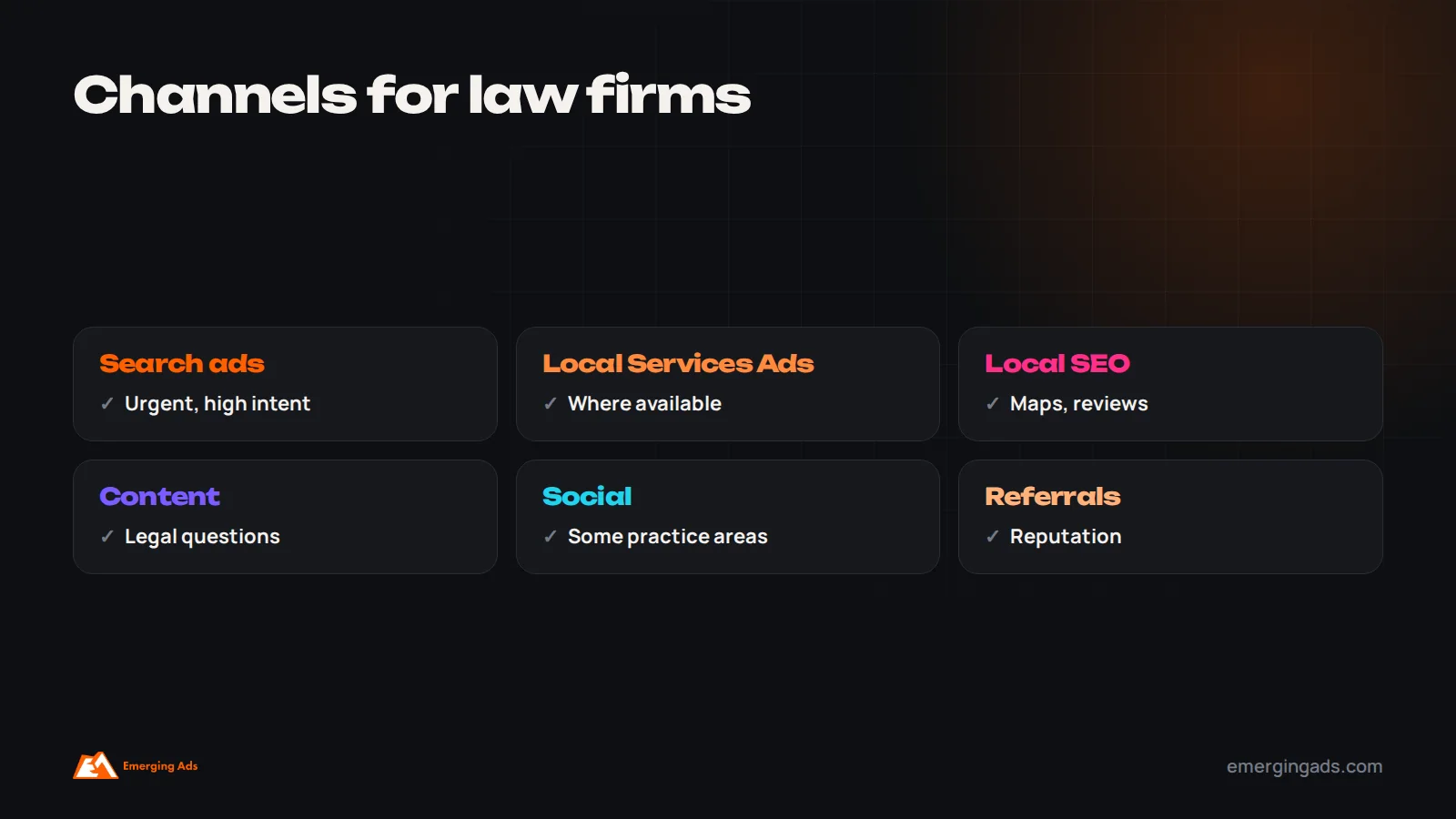
Most successful firms combine several channels, each reaching prospects at a different moment. The right mix depends on practice area, location, budget and how quickly your intake team can respond to new enquiries.
Google Search ads capture people actively looking for a lawyer, often urgently. Campaigns should be split by practice area and location, with strong negative keywords to exclude searches for free advice, jobs, law school and unrelated topics. Call extensions and call-only ads matter, since many prospects prefer to phone.
Local Services Ads, where available for legal services, appear at the top of results with a screening badge and charge per lead, which can suit many firms.
Local SEO and Google Business Profile help firms appear in map results for “lawyer near me” searches. Reviews, accurate details and practice area pages are central.
Organic content answering legal questions, such as how a process works, what it costs and what to do after an incident, builds visibility and trust over time.
Meta and other social ads can work for some practice areas, such as estate planning, family law and certain consumer claims, usually with educational content and careful compliance.
Referrals and reputation remain powerful; digital marketing should support them, not replace them.
How lead generation differs by practice area
Personal injury is among the most competitive areas, with high click costs, urgent searches and many prospects calling multiple firms. Fast phone response, strong reviews and clear explanations of fee arrangements, where permitted, matter enormously. Family law prospects are often emotional and cautious; content that explains processes, timelines and options builds trust, and discreet, empathetic intake is essential. Criminal defense searches are urgent and often happen outside office hours, so call answering around the clock can decide who gets the case. Immigration prospects may search in several languages and need clear information on processes and eligibility. Estate planning and wills suit educational content, seminars and social ads, with longer decision times. Business and commercial law relies more on reputation, referrals, LinkedIn and content than on high-volume search ads. An agency should build different campaigns, landing pages and follow-up for each practice area rather than one generic approach.

Landing pages for law firms
Sending paid traffic to a firm’s homepage wastes money. Each major practice area and location should have a landing page that states clearly what the firm handles, who it helps and where; explains the process and what happens at the first consultation; shows proof such as reviews, credentials and, where permitted, relevant experience; answers common questions about cost and timelines; and makes contacting the firm easy, with a click-to-call button, a short form and, where appropriate, chat. Pages should load quickly on mobile, since many prospects search on phones in stressful moments. Our guide to conversion rate optimization explains how small changes improve enquiry rates.
Reviews and reputation
Prospective clients rely heavily on reviews when choosing a lawyer. A steady flow of genuine reviews on Google and relevant legal directories improves local search visibility and conversion. Build a simple, compliant process for asking satisfied clients for reviews at the right moment, such as after a matter concludes, and respond professionally to all reviews, being careful about confidentiality. Never offer incentives for positive reviews or write reviews on clients’ behalf, which breaches platform rules and, in many jurisdictions, professional conduct rules.
Why local visibility matters so much for law firms
Most people looking for a lawyer want someone nearby, or at least licensed and experienced in their jurisdiction. That makes local search central. When someone searches for a family lawyer or a personal injury solicitor in their town, the map results and the firms with strong reviews often get the first calls. A complete Google Business Profile for each office, with accurate practice categories, opening hours, photos, regular posts and a steady stream of genuine reviews, is one of the most cost-effective assets a firm can build. Supporting it with location pages on the website, consistent details across legal directories and content that reflects local courts and procedures helps further. Our local SEO team works on exactly these foundations. Unlike paid ads, strong local visibility keeps producing enquiries even when budgets are paused.
Content that builds trust before the first call
Many prospective clients research their situation before contacting a lawyer. Clear, accurate content that answers their questions, such as what happens after a road accident, how custody arrangements are decided, what to expect in a first immigration consultation or how long probate takes, builds trust and brings visitors who are already informed. It also ranks in search and increasingly appears in AI-generated answers. Content should be reviewed by qualified lawyers, avoid giving specific advice that creates confusion, and point readers clearly to a consultation. Plain language matters: prospects are rarely lawyers, and jargon makes firms feel distant. Our guide to generative engine optimization explains how clear content earns visibility in AI search.
Where social media fits
Social ads are not the first channel for most legal practice areas, because people rarely browse social media looking for a lawyer. They can work well for areas where prospects plan ahead or need education, such as wills and estate planning, some family law services, employment rights and certain consumer claims, and for building familiarity with a firm’s name in its local area. Educational videos from lawyers, explaining common questions in plain language, often perform better than promotional ads. Retargeting website visitors with testimonials, where permitted, and helpful guides can bring back prospects who were not ready to call. Every social ad must follow the same professional rules as other advertising.
Intake: where many leads are lost
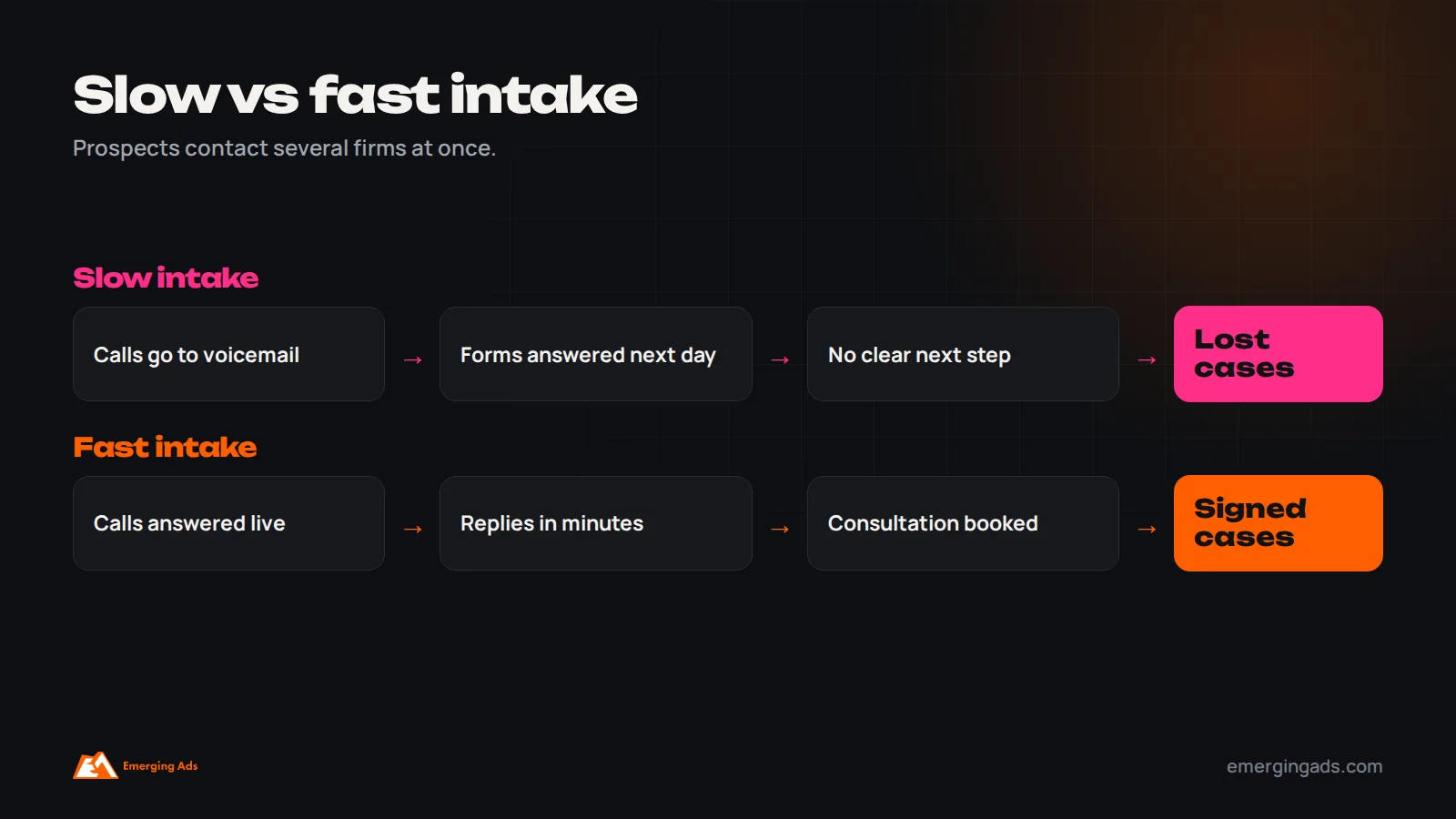
The best campaign fails if calls go unanswered or forms wait hours for a reply. Legal prospects often contact several firms and hire the first one that responds helpfully. Strong intake means answering calls live, including outside office hours through an answering service where appropriate, responding to forms and chats within minutes, using a consistent screening process, scheduling consultations quickly, and recording every lead and outcome in a CRM. A good agency reviews intake as part of its work and may recommend call recording and scoring. Our article on CRM automation mistakes explains common gaps.
Legal advertising rules
Compliance is not optional for law firms, and your agency should treat it as part of every campaign.
Lawyers’ advertising is regulated by professional bodies and, in some cases, by law, and the rules differ by jurisdiction. Common themes include avoiding misleading claims, restrictions on guaranteeing outcomes, rules on testimonials and past results, requirements to identify the responsible lawyer or firm, restrictions on solicitation and on paying for referrals, and rules about calling yourself a specialist. Ad platforms also have their own policies for legal services. A good agency knows the rules in your jurisdiction and builds compliance into ads, landing pages and follow-up, and expects your firm to review and approve claims.

Measure signed cases, not leads
Cheap leads that never become clients are expensive. Track every stage from first contact to signed case.
- Cost per lead, as a starting point only.
- Qualified lead rate: leads that match practice area, location and case criteria.
- Consultation rate and signed case rate.
- Cost per signed case by channel and campaign.
- Case value and revenue by source.
- Response time to calls and forms.
Track calls with call tracking numbers, capture source data on forms, and record outcomes in your case management system or CRM. Sending signed case data back to ad platforms helps them find more prospects like your best clients.

Keyword strategy in a high-cost market
With expensive clicks, every wasted click hurts. Strong legal campaigns focus on high-intent keywords that combine a practice area with hiring intent and location, such as “car accident lawyer near me” or “divorce solicitor in Manchester”. They separate emergency or urgent searches from research searches, bid more on the former, and use extensive negative keyword lists to exclude searches for free legal advice, legal aid where you do not offer it, jobs, salaries, law school, templates and unrelated meanings. Search term reports should be reviewed weekly at first. Ad schedules can focus budget on hours when your intake team or answering service can respond. Our guides to lowering cost per click and lowering CPA explain these techniques in more depth.
Call tracking and call quality
Most legal leads arrive by phone, so call tracking is essential. Dynamic number insertion shows a unique number to visitors from each source, recording which campaign produced each call. Call recording, where lawful and disclosed, lets firms review how intake handles calls and identify missed opportunities. Many firms discover that a significant share of calls go unanswered, reach voicemail or are handled without a clear next step. Fixing that often improves results more than any change to the ads. Make sure tracking numbers are owned by your firm, so you keep them if you change agencies.
What the first 90 days should look like
A good legal lead generation agency starts by auditing current campaigns, tracking, intake and case outcomes; setting up call tracking and conversion tracking linked to your CRM or case management system; building practice-area landing pages; restructuring or launching search campaigns with careful keyword targeting; improving Google Business Profile and review collection; and reviewing results by cost per qualified lead and signed case. Meaningful optimization usually takes two to three months, because signed cases take time to confirm.

How legal marketing agencies charge
Agencies typically charge monthly management fees, a percentage of ad spend, or project fees for websites and setup, while lead vendors charge per lead or per signed case. Pay-per-signed-case arrangements can be subject to professional rules on fee sharing and referral payments in some jurisdictions, so check with your regulator before agreeing to them. Compare offers on total cost per signed case and on what you own at the end. Our guide on agency pricing explains common models.
Reaching clients in several languages
In many cities, a significant share of potential clients prefer to speak a language other than the main local language. Immigration, family and personal injury practices in particular often serve communities who search in Spanish, Arabic, Hindi, Urdu, Polish or other languages. Firms that can genuinely serve clients in those languages benefit from separate campaigns, landing pages and intake in each language, with ads targeted by language preference. Only advertise in a language if your intake team and lawyers can actually work in it, and make sure translated content is accurate and reviewed by a qualified professional.
An example of a well-run legal campaign
Consider a mid-sized firm handling personal injury and family law in one metropolitan area. The agency builds separate search campaigns for each practice area and key towns, with tight keyword lists, extensive negative keywords and call extensions, and schedules the budget around the hours when intake can answer calls live. Each campaign leads to a matching landing page with clear explanations, lawyer profiles, reviews and a click-to-call button. Call tracking numbers record the source of every call, and calls are recorded with appropriate notice so intake quality can be reviewed. Every lead is logged in the firm’s CRM with its outcome. After a few weeks, the firm notices that many evening calls reach voicemail and adds an answering service, which noticeably raises consultations. Monthly reviews focus on cost per signed case by practice area and town, and budget shifts toward the combinations that produce the most valuable cases.
Advice for small and solo firms
Small firms cannot outspend large competitors in the most expensive practice areas, but they can compete by focusing. Choose a narrow practice area and location, build an excellent Google Business Profile with many genuine reviews, create a handful of high-quality pages answering local clients’ common questions, run a tightly targeted search campaign during hours when someone can answer the phone, and respond to every enquiry within minutes. Referral relationships with other professionals and community visibility remain powerful complements to digital channels.
Making the decision
When comparing agencies or vendors, ask which one understood your practice areas and jurisdiction best, which explained how they would track leads through to signed cases, which took advertising rules seriously, and which will leave your firm owning its accounts, data, website and phone numbers. Choose the partner that measures success the way your firm does: in signed cases and revenue.
Connecting marketing to case management
Law firms often keep marketing data and case data in separate places, which makes it impossible to know which campaigns produce valuable clients. Connecting them changes that. Every lead should be recorded with its source, whether a call tracking number, form submission or chat, and carried into the CRM or case management system. As matters progress, record whether a consultation took place, whether the client was retained and, eventually, the approximate fee value. With this data, firms can see cost per signed case by channel, campaign and practice area, and agencies can send signed-case conversions back to Google and other platforms so bidding focuses on prospects who become clients. Our guide on attribution modeling explains how to measure across channels.
What good monthly reporting looks like
Useful reports for law firms are short and focus on outcomes. They show spend, leads, qualified leads, consultations and signed cases by practice area and channel; cost per signed case and trends over time; call answer rates and response times; search terms added as negatives; landing page conversion rates; review growth; and planned changes. Reports that stop at clicks and leads hide the most important questions: are the leads right for the firm, and are they becoming clients? A good agency raises problems openly, including intake issues on the firm’s side, rather than reporting only good news.
AI search and legal questions
People increasingly ask AI assistants legal questions before contacting a lawyer, such as what to do after an accident or how a divorce process works in their area, and sometimes ask for recommended firms. These answers draw on reputable legal content, reviews and business listings. Firms that publish clear, accurate, locally relevant content, maintain strong reviews and keep business details consistent across directories improve their chances of being referenced. Our guide to ChatGPT SEO explains what helps.
Setting a realistic budget
Legal advertising budgets should start from case economics, not from what competitors seem to spend. Estimate the average fee value of a signed case in each practice area, the share of qualified leads that become consultations, and the share of consultations that become clients. From those figures, you can work out what the firm can afford to pay per qualified lead while staying profitable. In competitive practice areas, a small budget may only buy a handful of clicks a day, which is not enough to learn from; it is often better to concentrate budget on one practice area and location, or to invest first in local SEO and reviews, than to spread it thinly. Review budgets every month using cost per signed case, and increase spend only where the numbers support it.
Does the agency need to be near your firm?
Many firms search for a legal lead generation agency near them. Location helps if the agency knows your local market, courts and competitors, or if you value in-person meetings. But most of the work, including campaigns, landing pages, tracking and reporting, is done remotely. Experience with law firms in your practice areas and jurisdiction, understanding of the professional rules that apply to you, and proven results in signed cases matter far more than the agency’s postcode.
What your firm needs to provide
Agencies need your input to succeed. Share which practice areas and case types are most valuable, typical fee values, the geographic areas you serve, intake procedures and hours, access to call recordings and case outcomes, approved claims and credentials, and prompt approvals for ads and pages. Most importantly, make sure intake can respond quickly and consistently, because even the best campaigns cannot win cases that nobody calls back.
A quick checklist before you sign
Before choosing a partner, confirm that leads will be exclusive to your firm, campaigns will run in accounts you own, call tracking numbers belong to your firm, landing pages will be built for each priority practice area, the agency understands the advertising rules that apply to you, results will be reported through to signed cases, intake will be reviewed as part of the work, and the contract has a defined first phase and reasonable notice period. A partner that meets all of these is far more likely to deliver clients rather than just leads.
How to choose a legal lead generation agency
Use these criteria to compare every agency and vendor on your shortlist.
- Law firm experience in your practice areas and jurisdiction, with results measured in signed cases.
- Exclusive leads from campaigns in your accounts, not shared or resold leads.
- Compliance knowledge of legal advertising rules.
- Call tracking and intake support.
- Transparent reporting from ad spend to signed cases.
- Ownership: your ad accounts, website, data and phone numbers.
- Fair terms: a defined first phase and reasonable notice period.
Red flags
Watch for these warning signs when talking to agencies and lead vendors. Any of them can mean wasted budget or professional risk for your firm.
- Leads sold to multiple firms without disclosure.
- Guaranteed case volumes or outcomes.
- Ad accounts, tracking numbers or websites owned by the agency.
- Reports that stop at cost per lead.
- Ads that promise results or use questionable claims.
- Long contracts with heavy exit penalties.
Frequently asked questions
What does a legal lead generation agency do?
It runs campaigns such as Google search ads, local SEO, Local Services Ads and selected social ads under your firm’s brand, builds landing pages, tracks calls and forms, and helps improve intake so leads become signed cases.
Should I buy leads or run my own campaigns?
Bought leads can fill gaps quickly, but quality varies and you build nothing you own. Your own campaigns generate exclusive leads and lasting assets.
Why are legal ads so expensive?
Many practice areas involve high case values and intense competition, which drives up click costs in ad auctions.
How should legal marketing be measured?
By cost per signed case and case value by channel, not just cost per lead.
Are there rules on lawyer advertising?
Yes. Professional bodies and laws regulate legal advertising, including claims, testimonials and solicitation, and rules vary by jurisdiction.
How fast should law firms respond to leads?
Within minutes. Prospects often contact several firms and hire the first that responds helpfully.
Does local SEO matter for law firms?
Yes. Map results, reviews and practice area pages strongly influence which firms prospects contact.
Who should own the ad accounts and tracking numbers?
Your firm should own all accounts, websites, data and phone numbers, with the agency given access.