
The short answer
The best digital marketing agency in the UK for your business is the one with proven results for UK businesses like yours, deep skill in the channels that matter to you, a clear grasp of UK rules such as UK GDPR, PECR and advertising standards, transparent pricing and reporting, and fair contract terms. London and regional agencies can both be excellent; what matters more is relevant experience, the people doing the work and evidence of results. Shortlist three to five, compare proposals on scope and proof, and start with a defined first phase of around 90 days.
The UK has one of the most developed digital marketing industries in the world, with thousands of agencies ranging from global networks to specialist boutiques in every major city. That choice is a strength, but it also makes picking the right partner difficult. Many agencies claim to be the best, the rankings in search results are often paid directories, and proposals tend to sound the same.
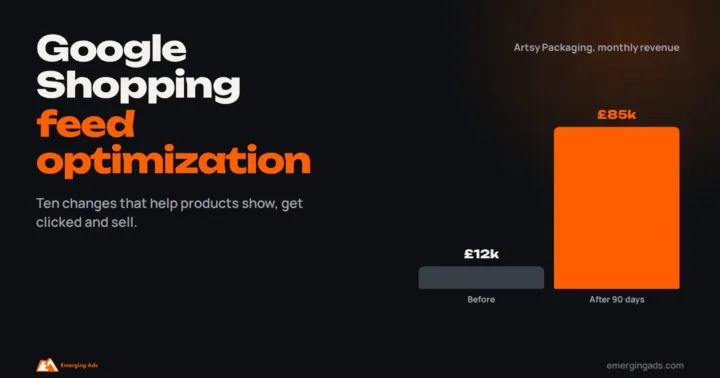
We work with UK businesses across ecommerce and services, including Artsy Packaging, a UK packaging brand where fixing Google Ads cut cost per acquisition by 71% on the same budget, and Fit Kit Bodycare, a UK bodycare brand where Meta produced £2.23M in purchase value and rebuilt email flows lifted flow revenue by 29%. This guide is our honest view of how to choose a UK agency, including us or anyone else.

What “best” actually means
There is no single best agency in the UK. There is the best agency for your situation: your industry, size, goals, budget and channels. An agency that is brilliant for a London fintech may be wrong for a Manchester ecommerce brand or a Bristol law firm. Instead of searching for a universally best agency, look for the best fit on six things:
- Relevant results with UK businesses similar to yours.
- Channel depth in what matters most for you, such as Google Ads, Meta, Amazon, SEO, email or automation.
- UK market knowledge, including customer behavior, seasonality, competitors and regulation.
- The people who will actually manage your account.
- Transparency in pricing, reporting and account ownership.
- Fair terms that let you leave if it does not work.
The UK agency landscape
UK agencies broadly fall into a few groups. Large network agencies serve major brands with big budgets and integrated campaigns. Independent full-service agencies cover several channels for mid-sized businesses. Specialist agencies focus on one discipline, such as paid search, paid social, SEO, ecommerce or email, often with very deep expertise. Industry-focused agencies serve sectors such as retail, legal, healthcare, property or B2B technology. And boutique teams and freelancer collectives offer senior attention at lower overhead.
For most small and mid-sized UK businesses, independent specialists or full-service agencies with strong channel teams offer the best balance of expertise, attention and value.
London vs regional agencies
London has the highest concentration of agencies and talent, particularly for large brands, finance, technology and media. Major regional hubs, including Manchester, Birmingham, Leeds, Bristol, Edinburgh, Glasgow, Cardiff and Newcastle, also have strong agency scenes, often with lower costs and deep experience serving regional and national clients.
Location matters less than it used to, since most collaboration now happens online. It matters most when you want regular in-person workshops, when local market knowledge is central, such as for local SEO or regional campaigns, or when you prefer a partner in the same area. Otherwise, judge agencies on results and people rather than postcode.

How UK agencies price their work
UK agencies use the same main pricing models as elsewhere: a percentage of ad spend for paid media management, often with a monthly minimum; flat monthly retainers for SEO, content, social and email; project fees for websites, audits and setups; hourly or day rates for consulting; and occasionally performance-based arrangements. London agencies typically charge more than regional ones, and specialists with strong track records charge more than generalists.
Quotes are usually given excluding VAT, so check whether prices include it. Ad spend is paid separately to the platforms and should ideally be billed directly to your own accounts. Our guide on how much to pay a digital marketing agency covers pricing models and hidden costs in detail.
Why UK regulation should shape your choice
Marketing in the UK operates under specific rules, and a good agency knows them well. The key ones include:
- UK GDPR and the Data Protection Act 2018, which govern how personal data is collected, stored and used, including for targeting and CRM.
- PECR (Privacy and Electronic Communications Regulations), which set rules for cookies and electronic marketing, including when consent is needed for marketing emails and texts, and when the “soft opt-in” applies to existing customers.
- Cookie consent and consent mode: UK websites need valid consent for non-essential cookies, and Google requires consent mode for advertisers using its measurement and ads features with users in the UK and EEA.
- The CAP Code and ASA rulings, which govern advertising content, claims and influencer marketing disclosure.
- Consumer protection law, including rules on pricing, reference prices, fake reviews and misleading claims, enforced by the Competition and Markets Authority.
An agency that cannot explain how it handles consent, data and ad compliance is a risk. Ask directly how they set up cookie consent and consent mode, how they handle email permissions, and how they keep ad claims and influencer content compliant.

How UK consumers and buyers behave online
UK consumers are experienced online shoppers. Ecommerce makes up a large share of retail, mobile shopping is the norm, and expectations around delivery speed, free returns and customer service are high. Shoppers compare prices across retailers and marketplaces, read reviews closely and respond well to clear, honest offers rather than aggressive selling. Trust signals, such as recognized payment options, clear returns policies, UK contact details and genuine reviews, have a measurable effect on conversion.
B2B buyers in the UK typically research extensively before speaking to sales, involve several stakeholders and expect content that helps them make the case internally. Agencies that understand these behaviors build campaigns and landing pages around them, rather than importing playbooks from other markets.
Local SEO for UK businesses
For UK businesses that serve customers in specific towns or regions, local search is often the highest-value channel. A strong local presence depends on a complete and accurate Google Business Profile, consistent business details across UK directories, genuine reviews, location pages that describe services in each area, and content that reflects local needs. Many UK agencies offer local SEO, but quality varies widely. Ask for examples of local rankings and enquiries they have improved, not just reports of profile views. Our local SEO service covers this work.
AI search and the UK market
Google’s AI Overviews, ChatGPT and other AI tools are now part of how UK customers research purchases and providers. An agency worth hiring in 2026 should be able to explain how it keeps your business visible in AI answers as well as traditional results: clear, specific content, consistent business information, strong reviews and technical foundations that let AI crawlers access your site. Our guide to generative engine optimization explains the approach.
Choosing an agency size that fits
The size of agency that suits you depends on your budget and needs. Large agencies offer breadth and resources but may give smaller clients less senior attention. Small agencies and specialists often provide direct access to experienced people, but have less capacity. A good rule is to choose an agency for which your account is meaningful: big enough to matter to them, without being so large that they lack the processes to serve you well. Ask how your budget compares with their typical client and who their most senior person on your account will be.
Making the relationship work
The best UK agency relationships are partnerships. Share real business data, such as margins, customer value and stock levels, so the agency optimizes for profit. Approve work quickly, tell the agency about promotions and launches in advance, give honest feedback early and make sure leads are followed up fast. Hold a monthly review focused on business outcomes, and a deeper quarterly review that looks at strategy and priorities. Agencies do their best work for clients who treat them as part of the team.
Channels that matter most in the UK
Google Search and Shopping remain central for most UK businesses, from local services to national ecommerce brands. Our guide to lowering Google Ads CPA explains the levers.
Meta (Facebook and Instagram) drives demand for consumer brands and local businesses. See our guide to Meta ads for ecommerce.
TikTok and YouTube reach younger and video-first audiences, increasingly important for consumer brands.
Amazon UK is a major channel for product brands, with its own advertising ecosystem.
LinkedIn is the leading platform for B2B targeting in the UK.
Email and SMS remain strong for UK ecommerce, within PECR rules.
SEO and content build long-term visibility, increasingly including AI answers.
UK seasonality to plan around
UK marketing calendars revolve around a few key moments: January sales and new-year resolutions, Valentine’s Day, Mother’s Day in March (earlier than in many other countries), Easter, summer holidays, back to school in late August and September, Black Friday and Cyber Monday in late November, Christmas and Boxing Day sales. A UK-experienced agency plans budgets, stock and creative around these peaks rather than reacting to them. Our Black Friday checklist covers the biggest one.

Judge evidence, not awards
The UK has many marketing awards, and agencies often feature them prominently. Awards can indicate quality, but they are not proof of results for a business like yours. Ask instead for named case studies with specific numbers, such as cost per acquisition before and after, revenue growth, return on ad spend or lead volume; context about what changed and how long it took; references you can call; and evidence across several clients, not one standout result.
Partner badges, such as Google Partner or Meta Business Partner status, show an agency meets certain platform requirements, but they are a baseline rather than a differentiator.
Building a shortlist of UK agencies
Start with three to five agencies. Good sources include recommendations from UK businesses similar to yours, agencies whose content you have found genuinely useful, independent review platforms such as Clutch and Google reviews, platform partner directories for Google, Meta, Amazon and Klaviyo, and case studies that match your sector and size. Be cautious with “top agencies in the UK” lists in search results; many are directories where agencies pay for placement, and the ranking reflects marketing spend rather than client results.
Filter quickly using public evidence. Do they show named UK case studies with real numbers? Do they work with businesses of your size and type? Do they explain their thinking in useful, specific content? Do their reviews describe results and communication rather than just friendliness? Agencies that pass these checks are worth a conversation.
Comparing proposals fairly
Ask every shortlisted agency to respond to the same brief: your goals, current results, budget for fees and ad spend, channels of interest and timeline. Then compare proposals on the same factors: relevance of evidence, seniority and experience of the team, quality of their diagnosis of your business, approach to tracking and measurement, reporting, scope included for the fee, compliance knowledge, and contract terms. Score each from one to five on each factor, weighted by what matters most to you. The scoring exercise forces clearer thinking than comparing headline prices, and it reduces the influence of the most polished pitch.
Specialist or full-service?
If one channel drives most of your results, such as Google Ads for a local service business or Meta for a direct-to-consumer brand, a specialist agency with deep experience in that channel often delivers more than a full-service agency spreading attention across many. If you need several channels working together, a full-service agency or a small group of coordinated specialists makes more sense. Many growing UK businesses start with a specialist for their main channel, then add others as they scale, appointing one internal owner to coordinate them.
Advice for small UK businesses
Small businesses often get the most value from a focused engagement: one channel, done well, with clear goals and a defined first phase. Avoid packages that promise everything at once on a small budget, since spreading spend across many channels usually means none of them learns. Ask agencies how they would prioritize your budget, which channel they would start with and why, and what they would deliberately not do yet. Our performance marketing guide covers realistic budgets by channel.
Contract terms to look for
Strong UK agency agreements include an initial phase of around 90 days with clear deliverables and a review point, a reasonable notice period afterwards, often around 30 days, clear ownership of ad accounts, analytics, data, creative and content by your business, ad spend billed directly to you by platforms where possible, a defined scope and change process, and data processing terms that meet UK GDPR requirements, since the agency will often handle customer data on your behalf. Read the contract as carefully as the proposal.
If you are switching agencies
Many UK businesses looking for a new agency already have one. Before switching, make sure you have admin access to every account: Google Ads, Meta Business Manager, Google Analytics, Search Console, Tag Manager, email platforms and your website. Request exports of reports, audiences and creative. Plan a handover period so campaigns are not paused or reset unnecessarily, and ask the new agency to audit the existing setup before making major changes. A careful transition protects the performance history that ad platforms rely on.
How a good UK agency measures success
Ask every agency how it will measure results, because the answer reveals a lot. Strong agencies start with business outcomes, such as revenue, profit, qualified leads and customer acquisition cost, and work back to channel metrics. They check that conversion tracking is accurate before reporting anything, handle the gaps created by cookie consent honestly, compare platform-reported results with your actual sales, and track blended results across channels rather than letting each platform claim credit for the same customers. They also agree in advance what early signs of progress look like, such as fixed tracking, improved click-through rates or lower cost per click, so you can see movement before final results arrive. Our guide on attribution modeling explains why measurement deserves this attention.
What UK ecommerce brands should look for
UK ecommerce is competitive, with strong marketplaces, demanding delivery expectations and crowded peak seasons. Ecommerce brands should look for agencies with experience in Google Shopping and Performance Max, Meta and TikTok creative, product feeds, Klaviyo or similar email platforms, Amazon UK if relevant, and conversion rate optimization. Ask how they would grow new customers profitably rather than simply retargeting existing ones, how they plan for Black Friday and Christmas, and how they work with your stock and margin data. The best ecommerce agencies treat paid media, email and the website as one system rather than separate services.
What UK B2B companies should look for
B2B companies in the UK typically need search, LinkedIn, content and nurture, with patience for longer sales cycles and reporting focused on pipeline rather than raw lead counts. Look for agencies that ask about your sales process, connect campaigns to your CRM, understand account-based approaches and can produce content that genuinely helps buyers. Our guide to B2B leads with LinkedIn ads covers what good looks like.
Reviews and reputation in the UK
Online reviews strongly influence UK buyers, and UK consumer law now treats fake or misleading reviews seriously. An agency should help you collect genuine reviews from real customers, respond to reviews professionally, and display them honestly on your website and in ads. Be wary of any agency suggesting incentivized or fabricated reviews, or hiding negative ones in misleading ways; the reputational and legal risks are significant. Strong, authentic review profiles on Google, Trustpilot and industry platforms also help visibility in local search and AI answers.
Making the final decision
When the scoring is done, ask a few simple questions. Which team understood our business best? Which one would tell us bad news early? Whose evidence was most relevant to us? Whose terms let us leave if it does not work? The agency that answers well on those questions is usually the right choice, even if it is not the cheapest or the most impressive presenter.
Questions to ask any UK agency
- Which UK businesses like ours have you grown, and by how much?
- Who will manage our account day to day, and what is their experience?
- What would you look at first, and what do you think is holding us back?
- How do you handle cookie consent, consent mode and UK GDPR?
- How do you keep ad claims and influencer content compliant with ASA rules?
- What does the first 90 days look like?
- How will you report, and which metrics will you focus on?
- Are prices quoted including or excluding VAT, and what is not included?
- Who owns the ad accounts, analytics and content?
- What are the contract length and notice period?

Industry considerations in the UK
Different sectors need different strengths from an agency. These are the points we would check first for each.
Ecommerce and retail: strong competition on Google Shopping and Meta, Amazon UK, peak seasons and delivery expectations. Look for agencies with feed, creative and retention expertise.
Professional services: legal, accounting and financial firms face regulatory constraints on advertising and need agencies familiar with their professional bodies’ rules.
Healthcare and wellbeing: strict rules on health claims and advertising of medicines and treatments.
Property: local targeting, portals and lead generation with fast follow-up.
B2B and SaaS: LinkedIn, search, content and longer sales cycles.
Local services: local SEO, Google Business Profile, reviews and local search ads.
Red flags
These warning signs come up repeatedly when UK businesses describe agency relationships that went wrong. Any one of them deserves a direct question before you sign.
- Guaranteed rankings or guaranteed return on ad spend.
- “Best agency” claims backed only by paid directory listings.
- No clear answer on UK GDPR, PECR or consent mode.
- Accounts owned by the agency rather than your business.
- Long contracts without break clauses.
- Vague deliverables and reports without business outcomes.
- Undisclosed markups on ad spend.

What to expect in the first quarter
A good agency’s first 90 days typically include an audit of your accounts, tracking and website; fixes to tracking and consent setup; restructuring or launching campaigns; early testing of creative, keywords or offers; and a review comparing results with the starting point. Paid media often shows meaningful changes within the first one to three months. SEO and content usually take longer. If an agency cannot describe its first 90 days clearly before you sign, ask why.

For a broader decision framework, see our guide on how to choose a digital marketing agency. If you would like us to be one of the agencies you compare, our Google Ads, Meta ads, SEO and email teams work with UK businesses, and our free ad audit shows what we would change before you commit.
Frequently asked questions
What is the best digital marketing agency in the UK?
There is no single best agency for everyone. The best one for you has proven results with similar UK businesses, strong skills in your key channels, UK regulatory knowledge, transparent pricing and fair terms.
How much does a UK digital marketing agency cost?
It varies by services, scope, location and experience. Paid media is often priced as a percentage of ad spend with a minimum, while SEO, content and social are usually monthly retainers. London agencies typically charge more than regional ones.
Should I choose a London agency?
Not necessarily. Regional agencies in cities such as Manchester, Birmingham, Leeds and Bristol can be just as strong, often at lower cost. Choose on results, people and fit rather than location.
What UK regulations should my agency understand?
UK GDPR and the Data Protection Act 2018, PECR for cookies and electronic marketing, ASA rules under the CAP Code, and consumer protection law on pricing, reviews and claims.
Do UK websites need consent mode?
Websites need valid consent for non-essential cookies, and Google requires consent mode for advertisers using its measurement and ads features with UK and EEA users.
Are marketing awards a good way to choose an agency?
They can signal quality, but named case studies with specific results for businesses like yours are far better evidence.
How long before I see results from a UK agency?
Paid media often shows meaningful changes within one to three months. SEO and content usually take several months.
Should agency prices include VAT?
UK agencies usually quote excluding VAT. Check how each proposal is quoted so you compare like with like.