
The short answer
The right ActiveCampaign agency has proven experience building automations, CRM pipelines and integrations in ActiveCampaign for businesses like yours, understands deliverability and list health, starts with your customer journey rather than templates, measures success on revenue, pipeline and retention rather than open rates, and leaves you owning the account and able to run it. Ask for examples of automations they have built, how they handle migrations and data, and what the first 90 days look like.
ActiveCampaign is a powerful platform for email marketing, marketing automation and CRM, used by ecommerce brands, service businesses, B2B companies, course creators and agencies. Its strength is flexibility: automations can branch on almost any behavior, lead scoring can prioritize sales effort, and site tracking and integrations connect marketing to what customers actually do.
That flexibility is also why many accounts underperform. Businesses buy ActiveCampaign, import a list, send newsletters and never build the automations that make the platform worth paying for. Or they inherit tangled automations nobody understands. A good ActiveCampaign agency fixes that. A poor one adds more complexity without results.
We build email, automation and CRM systems as part of our marketing automation and email marketing work. This guide explains what an ActiveCampaign agency should do, how to evaluate one, what to expect in the first months, typical pricing structures and the mistakes to avoid.
Why businesses hire an ActiveCampaign agency
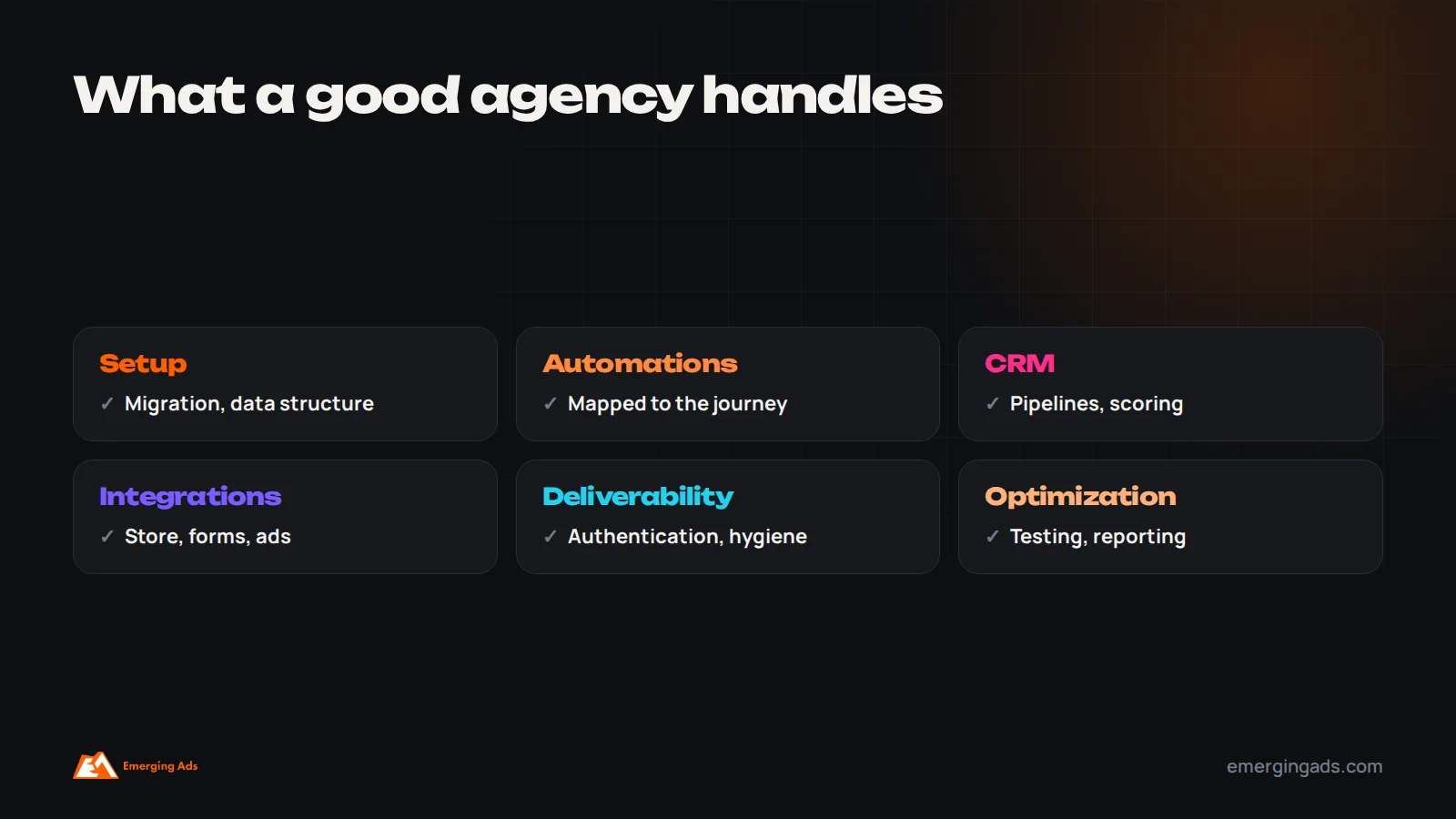
- Setup and migration: moving from another platform without losing contacts, history, consent or deliverability.
- Automation design: building welcome, nurture, abandoned cart, onboarding, re-engagement and sales automations that match the customer journey.
- CRM and sales: pipelines, lead scoring, deal automation and handoffs between marketing and sales.
- Integrations: connecting ActiveCampaign to ecommerce platforms, forms, booking tools, payment systems, ad platforms and other software.
- Deliverability: authentication, list hygiene and sending practices that keep email out of spam.
- Ongoing campaigns and optimization: testing, reporting and continuous improvement.
What a good ActiveCampaign setup looks like
- Clean data structure: consistent tags, custom fields, lists and naming, documented so anyone can understand them.
- Automations mapped to the customer journey, from first signup to repeat purchase or renewal.
- Segmentation based on behavior, interests and lifecycle stage.
- Lead scoring that sales actually trusts.
- A CRM pipeline that matches how the business sells.
- Proper authentication with SPF, DKIM and DMARC on a branded sending domain.
- Reporting on revenue, pipeline, conversions and retention.
Core automations every business should have
Before building anything advanced, make sure these essentials exist and work well. Together they usually produce most of the revenue an ActiveCampaign account generates, and they are the first things we check in any audit.
Welcome series: introduces new subscribers to the brand, sets expectations and moves them toward a first purchase or enquiry.
Lead nurture: keeps prospects engaged with education, proof and offers until they are ready. Our guide to lead nurture automation explains how to structure it.
Abandoned cart and browse abandonment for ecommerce. See our guide to ecommerce email flows.
Post-purchase or onboarding: helps customers succeed with what they bought and encourages the next step.
Sales handoff: alerts sales when leads show strong buying signals, creates deals and assigns tasks.
Re-engagement and win-back: brings back inactive subscribers or customers, and sunsets those who no longer engage.

Getting the data structure right
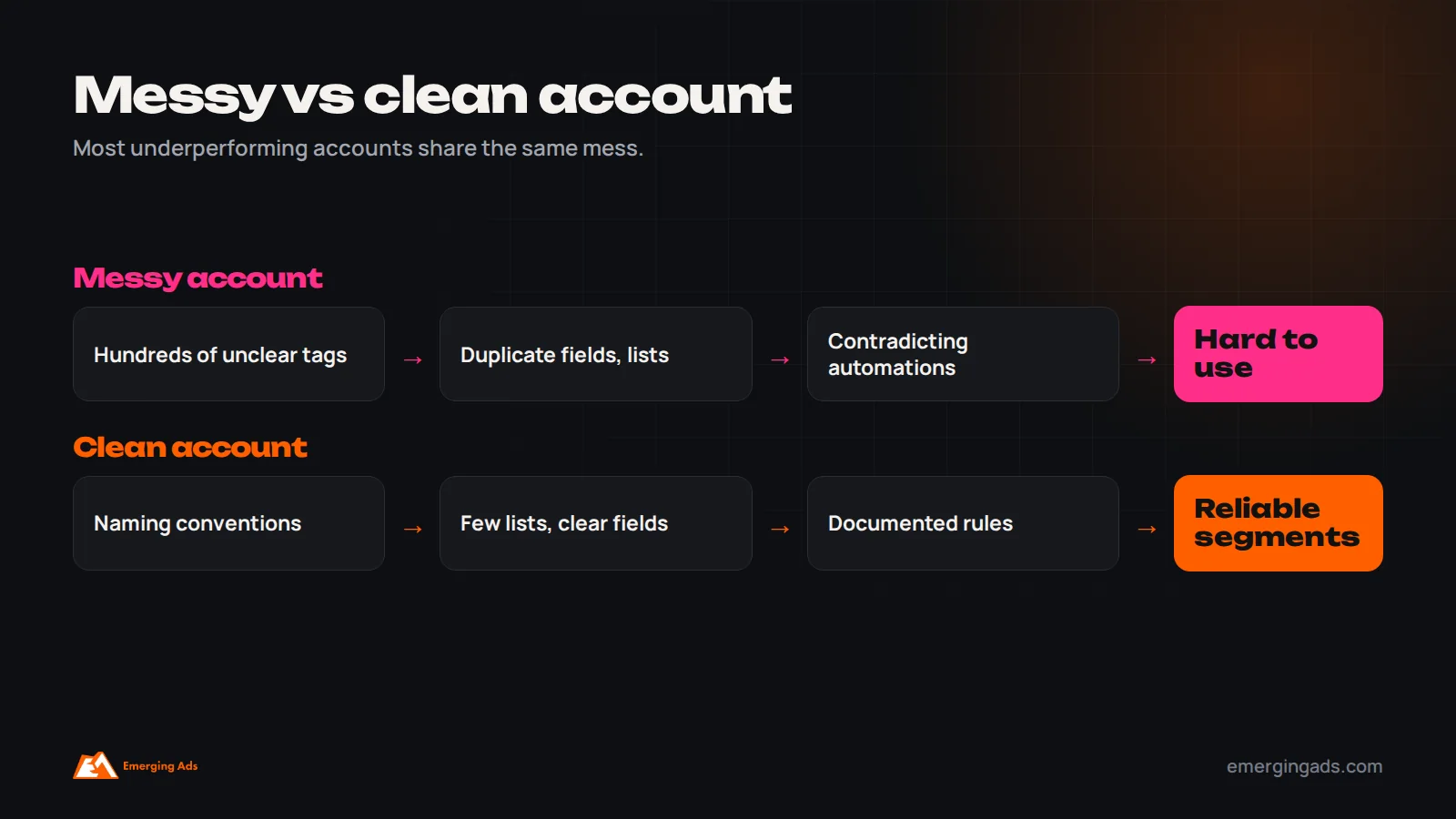
The single biggest predictor of whether an ActiveCampaign account stays useful over time is its data structure. Accounts that grow without a plan end up with hundreds of tags nobody understands, duplicate custom fields, overlapping lists and automations that contradict each other. A good agency designs the structure before building anything: a small number of lists, usually one main marketing list plus any legally separate lists; tags with a clear naming convention for interests, behaviors and sources; custom fields for information you need to personalize or segment, such as product interest, location or customer type; and documented rules for when each tag or field is set and removed. This makes segmentation reliable, reporting meaningful and future work faster.
Lead scoring that sales trusts
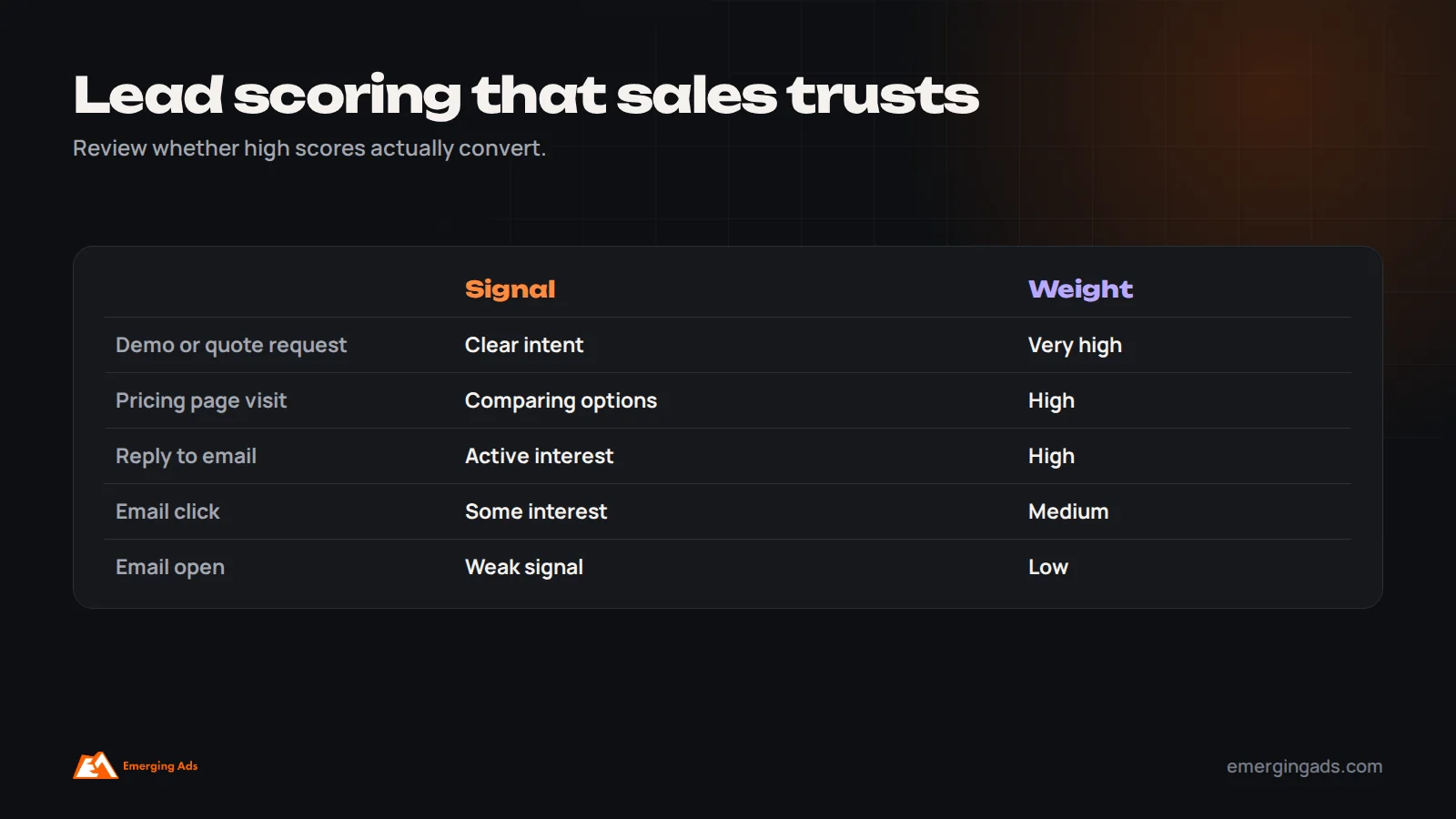
ActiveCampaign’s lead scoring assigns points for actions such as opening or clicking emails, visiting key pages, submitting forms or attending events, and can reduce scores over time as activity fades. Scoring only works if it reflects real buying signals and sales believes in it. Build scoring with input from sales: which actions usually come before a purchase or meeting? Weight strong signals, such as pricing page visits, demo requests or replies, far more than weak ones such as opens. Set a threshold that creates a deal or task for sales, and review every few months whether high-scoring leads actually convert. Adjust until the score predicts outcomes.
Using ActiveCampaign as a CRM
ActiveCampaign includes a sales CRM with deals, pipelines, stages, tasks and automations. For small and mid-sized businesses, keeping marketing and sales in one system can simplify everything: marketing automations create deals, sales actions trigger follow-up emails, and reporting connects campaigns to revenue. Pipeline stages should match how you actually sell, with clear definitions for moving deals forward. Automations can assign deals by territory or product, remind owners of stalled deals and trigger nurture when deals are lost. Larger sales teams sometimes prefer a dedicated CRM integrated with ActiveCampaign; our comparison of HubSpot and GoHighLevel covers alternatives.
Site tracking and behavioral automation
Site tracking lets ActiveCampaign record which pages known contacts visit. That enables automations such as sending a relevant follow-up to someone who viewed a pricing page, alerting sales when a lead revisits key pages, or tagging contacts by interest based on the content they read. To use it responsibly, make sure your cookie consent setup allows tracking where required, and use behavioral data to be more helpful rather than intrusive. A short, relevant email after a visit usually works better than an obvious “we saw you looking” message.
ActiveCampaign for ecommerce
ActiveCampaign integrates with major ecommerce platforms to sync customers, orders and products. Useful ecommerce automations include abandoned cart reminders, browse abandonment, post-purchase education and cross-sells, replenishment reminders, win-back for lapsed customers and VIP recognition for high-value buyers. Segment by purchase history, order value and product categories. Some ecommerce brands prefer platforms built specifically for ecommerce, such as Klaviyo, especially at larger scale; our comparison of Klaviyo vs Mailchimp covers ecommerce email platform choices. ActiveCampaign is often a strong choice for businesses that combine ecommerce with services, subscriptions or sales-led selling.
ActiveCampaign for B2B and service businesses
For B2B companies and service businesses, ActiveCampaign often acts as the bridge between marketing and sales. Typical setups capture leads from website forms, ads and events; tag them by service interest and source; nurture them with educational content and case studies; score them on engagement; and create deals for sales when they reach a threshold. After a sale, onboarding automations help new clients get started, and later automations encourage renewals, upsells and referrals. Agencies working with B2B clients should understand longer sales cycles, multiple contacts per account and the importance of sales feedback in refining automations.
ActiveCampaign for course creators and coaches
Course creators, coaches and membership businesses use ActiveCampaign for lead magnets, webinar registration and reminders, launch sequences, evergreen funnels, onboarding into programs and re-engagement of past students. The platform’s conditional logic lets messages adapt to what each person has done, such as attending a webinar, starting a course or completing a module. An agency serving this market should understand launch timing, deliverability during high-volume launches and integration with course platforms and payment systems. Our guide to online course marketing covers the wider strategy.
SMS, WhatsApp and multichannel automation
ActiveCampaign supports SMS in some markets and integrates with other messaging tools, allowing automations that combine email with text messages for time-sensitive moments such as appointment reminders, webinar start times and abandoned carts. In markets such as the Gulf and India, where WhatsApp is the preferred channel, many businesses connect WhatsApp tools to ActiveCampaign through integrations so that conversations and automations stay connected to contact records. Whatever the channel, consent rules apply, and messages should be used sparingly for high-value moments. Our guide to WhatsApp broadcast campaigns explains the WhatsApp side.
What good reporting looks like
Monthly reports from an ActiveCampaign agency should focus on outcomes: revenue or pipeline attributed to automations and campaigns, conversion rates through key automations, lead-to-customer rates for scored leads, list growth and churn, click rates and engagement trends, deliverability health including bounces and complaints, and the tests run and what was learned. Reports should also explain what was built or changed and what is planned next. Open rates on their own are unreliable because of privacy features in email apps, so they should never be the headline metric.
Training and handover
Even if you keep working with an agency, your team should understand the account. A good agency documents the data structure, explains each automation and why it exists, records short walkthrough videos for common tasks such as building a campaign or adding a contact to an automation, and trains the people who will use ActiveCampaign day to day. This protects you if staff or agencies change, and helps your team spot opportunities and problems themselves.
Red flags when hiring an ActiveCampaign agency
- A pitch focused on email templates and design rather than automation strategy.
- No questions about your sales process, customer journey or data.
- Promises of high open rates as the main outcome.
- Plans to import a large, old list and send to it immediately.
- Reluctance to document what they build.
- Accounts set up under the agency’s ownership.
- No examples of complex automations or integrations they have built.
Agency, freelancer or in-house?
Smaller businesses with simple needs can often run ActiveCampaign in-house with a capable marketer, perhaps with help from a freelancer for setup. Agencies make most sense for migrations, complex automation and CRM builds, integrations, and businesses that want ongoing strategy and optimization without hiring a specialist. Larger businesses frequently employ an in-house marketing automation specialist and use agencies for strategic projects. Whichever route you choose, make sure the person doing the work has deep, proven ActiveCampaign experience rather than general email marketing knowledge alone.
What an ActiveCampaign audit covers
If you already use ActiveCampaign, a good agency should start with an audit rather than building more. A thorough audit reviews list health, including the share of engaged contacts, bounces and complaints; sending authentication and domain setup; the data structure of tags, fields and lists; every active automation, with its goal, entry conditions, exit conditions and performance; forms and integrations, checking that data arrives correctly; CRM pipelines and how sales uses them; and reporting. The audit should end with a prioritized list of fixes and opportunities, ranked by expected impact. Many businesses find that fixing a handful of broken or missing automations produces more value than any new campaign.
Testing and optimization
Automations should improve over time. Useful tests include subject lines and preview text on high-volume automation emails, timing and number of steps in nurture and abandoned cart sequences, offers and calls to action, content type such as educational versus promotional, and the conditions that trigger sales handoff. ActiveCampaign supports split testing within campaigns and automations. Judge tests on clicks, conversions and revenue rather than opens, test one change at a time, and record what you learn so future work builds on it.
An example ActiveCampaign build
Consider a physiotherapy clinic group. Leads arrive from Google Ads, Meta lead forms and the website. ActiveCampaign tags each lead by service interest and source, sends an immediate confirmation with booking options, and starts a short nurture sequence explaining treatment, costs and what to expect. Site tracking notes visits to pricing and booking pages, raising the lead score. Leads that reach the threshold create a deal and a task for the front desk to call. After a first appointment, an onboarding sequence sends exercises and reminders; after treatment ends, a review request and a referral invitation follow. Lapsed patients receive a check-in after a few months. Every step reports into the CRM, so the clinic can see which sources produce patients rather than just enquiries.
Data protection and consent
ActiveCampaign stores personal data, so set it up in line with the data protection laws in your markets, such as GDPR and UK GDPR, PECR rules on electronic marketing in the UK, CAN-SPAM in the US, the UAE and Saudi data protection laws, and India’s Digital Personal Data Protection Act. Record consent sources, honor unsubscribes immediately, limit user permissions, and only collect data you actually use. A good agency builds consent capture into forms and integrations rather than treating it as an afterthought.
Choosing the right ActiveCampaign plan
ActiveCampaign offers several plans with different features, such as the level of automation, CRM capabilities, reporting, landing pages, predictive features and user seats. Pricing typically depends on the plan and the number of contacts. A good agency recommends a plan based on what you actually need now and in the next year, rather than the most expensive tier. Keeping the contact list clean also controls cost, since inactive contacts you never email still count toward the total. Check ActiveCampaign’s current plan comparison before deciding, as features and pricing change.
Integrations that matter most
ActiveCampaign becomes much more powerful when connected to the rest of your systems. Common integrations include ecommerce platforms such as Shopify and WooCommerce for orders and products; form and landing page tools; booking and calendar tools for service businesses; payment and subscription platforms; webinar and course platforms; ad platforms for audience syncing and lead capture; and analytics and reporting tools. Native integrations are usually the most reliable; integration platforms such as Zapier or Make fill gaps. A good agency maps which data needs to flow where, sets up error alerts so broken integrations are noticed quickly, and tests every connection with real data. Our article on CRM automation mistakes explains why silent integration failures are so costly.
Connecting ActiveCampaign with paid advertising
ActiveCampaign can sync segments to ad platforms, so you can exclude existing customers from acquisition campaigns, retarget engaged leads who have not converted and build lookalike audiences from your best customers. Leads from Meta and Google lead forms can flow straight into automations for immediate follow-up. Closing the loop, by sending deal outcomes back to ad platforms, helps campaigns optimize for quality rather than form fills. An agency that understands both automation and paid media can make the two work together rather than in separate silos.
Keeping the account healthy over time
ActiveCampaign accounts need regular maintenance, even after a strong build. Every quarter, review automation performance and retire or fix underperforming ones, check that integrations still pass data correctly, clean the list by suppressing long-inactive contacts, review tags and fields for duplicates or unused items, update content that references old offers, prices or products, and check deliverability metrics. Businesses that schedule this maintenance keep their accounts reliable and their results improving; those that do not often find, a year later, that automations are quietly broken and lists are full of contacts who never engage.
Making the decision
When comparing ActiveCampaign agencies, ask which one understood your customer journey and sales process best, which showed real automations and integrations rather than template designs, which took deliverability and data structure seriously, and which will leave you with a documented account you own and understand. The agency that does well on those points is usually the one that turns ActiveCampaign from a monthly cost into a revenue driver.
What your business needs to provide
An agency can only build effective automations with good input from your side. Expect to provide access to ActiveCampaign and connected tools, information about your customers and sales process, existing content such as guides, case studies and FAQs, brand guidelines, approvals for emails and automations, and feedback from sales and customer service. Assign one person to own the relationship and make decisions quickly. Projects with clear ownership and fast approvals typically go live weeks sooner and perform better, because the automations reflect how the business really works.
How to evaluate an ActiveCampaign agency
- Platform expertise: evidence of complex ActiveCampaign builds, not just general email experience. Partner status can be a signal, but ask to see real work.
- Relevant results: named clients in your industry with outcomes such as revenue from automations, pipeline growth or retention improvements.
- Strategy first: do they ask about your customers, sales process and goals before talking about templates?
- Integration skills: experience connecting ActiveCampaign to the tools you use.
- Deliverability knowledge: how they protect inbox placement.
- Documentation and training: will you understand and be able to manage what they build?
- Reporting: focused on business outcomes, not opens.
Questions to ask
Ask every agency on your shortlist these questions, and request examples rather than descriptions wherever possible.
- Can you show automations you have built for businesses like ours, and what they achieved?
- How would you map our customer journey into automations?
- How do you handle migration from our current platform?
- How do you structure tags, fields and lists?
- How do you set up lead scoring and sales handoff?
- What integrations would you recommend for our stack?
- How do you protect deliverability?
- What will you report each month?
- Will we own the account and have documentation?

Migrating to ActiveCampaign safely
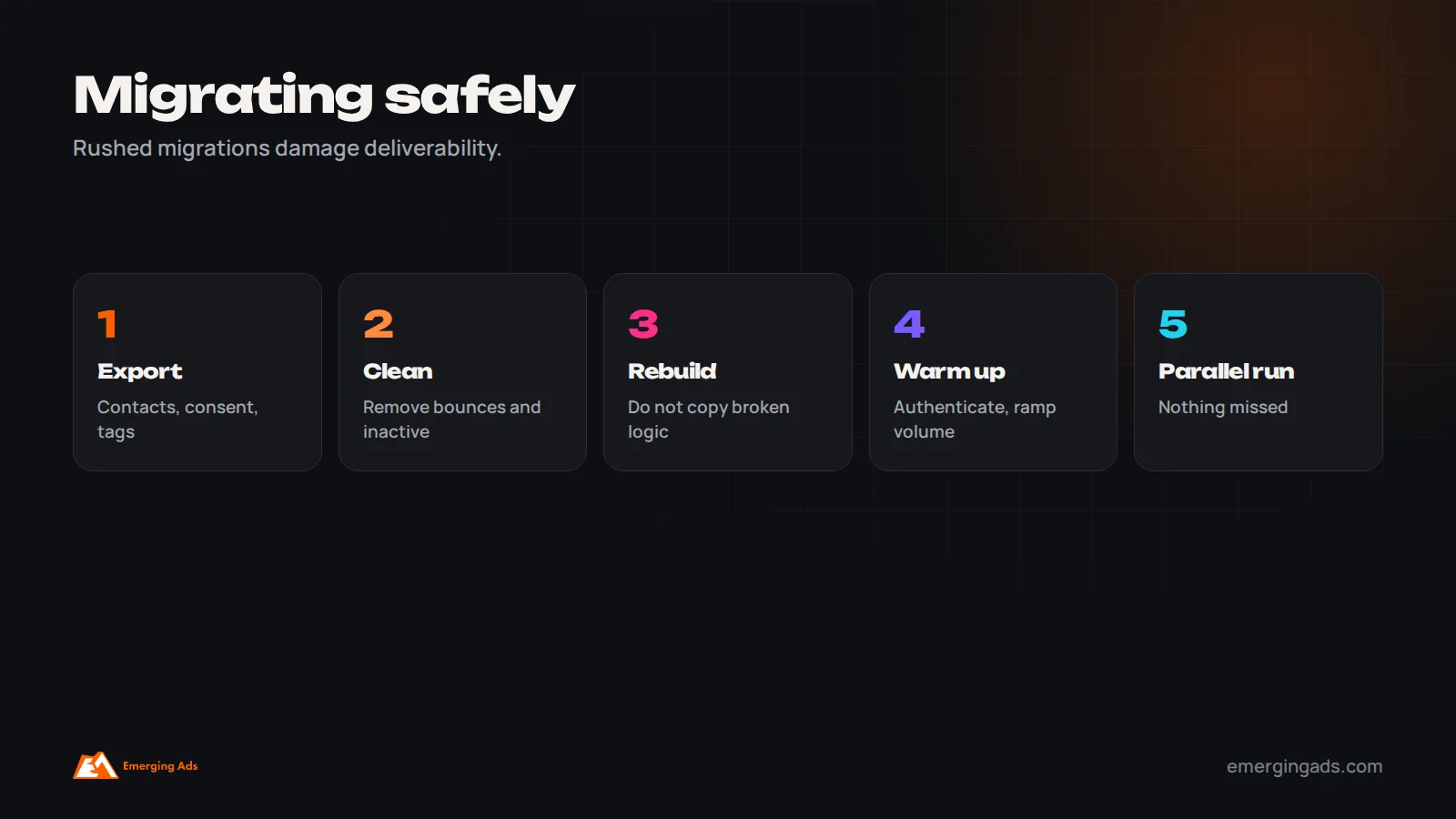
Migrations are a common reason to hire an agency. A safe migration exports contacts with consent records, tags and key fields; cleans the list, removing bounces, unsubscribes and long-inactive contacts; rebuilds automations rather than copying old, broken logic; sets up authentication and warms up sending volume gradually; reconnects forms, integrations and tracking; and runs old and new systems briefly in parallel so nothing is missed. Rushing a migration and immediately sending to a large cold list can damage deliverability for months.
Deliverability: protecting the inbox
Since 2024, Gmail and Yahoo have required bulk senders to authenticate email, provide easy unsubscribe and keep spam complaint rates low. A good agency sets up SPF, DKIM and DMARC on a branded domain, segments sends by engagement, sunsets inactive contacts, monitors bounces and complaints, and avoids sudden spikes in volume. Our guide on improving email results covers deliverability in more detail.
How ActiveCampaign agencies charge
Most agencies combine a setup project with an ongoing arrangement, so compare total cost over a year rather than a single fee.
- Project fees for setup, migration or specific automation builds.
- Monthly retainers for ongoing campaigns, optimization and support.
- Hourly or block-of-hours arrangements for ad hoc work.
The ActiveCampaign subscription itself is billed separately by ActiveCampaign and depends on plan and contact count. Our guide on agency pricing covers how to judge quotes.
What the first 90 days should look like
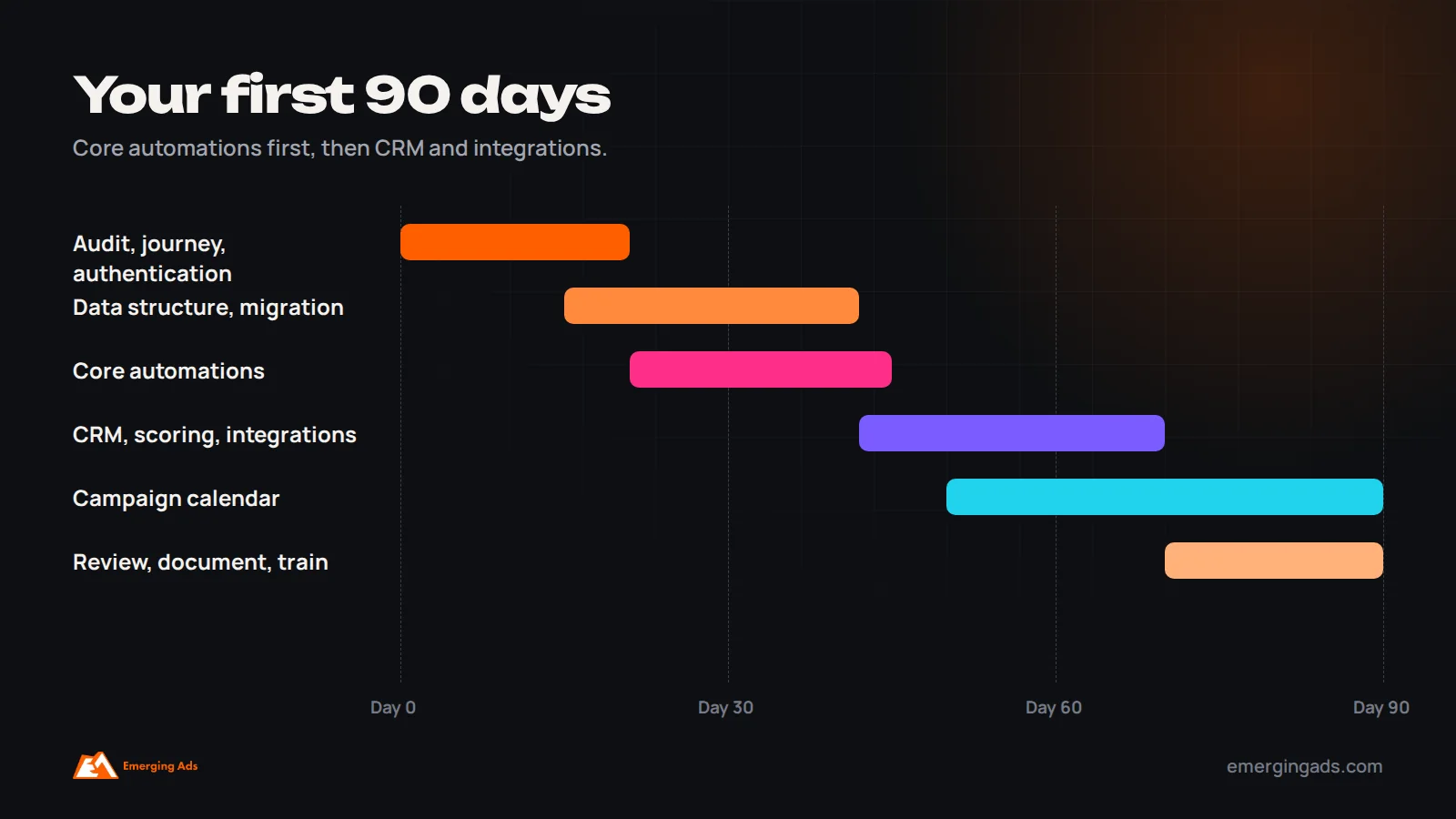
- Weeks 1 to 3: audit the current account or old platform, map the customer journey, agree goals and set up authentication.
- Weeks 3 to 6: clean data structure, migrate if needed, and build the highest-impact automations such as welcome and abandoned cart or lead nurture.
- Weeks 6 to 10: add CRM pipelines, lead scoring and sales handoff, connect integrations, and start a regular campaign calendar.
- Weeks 10 to 13: review results, test improvements, document everything and train your team.
Common mistakes
These are the patterns we find most often when auditing ActiveCampaign accounts that are not delivering.
- Choosing an agency on template design rather than strategy and automation skill.
- Building dozens of automations before the core ones work well.
- Messy tags and fields that nobody understands.
- Migrating without cleaning the list.
- Measuring success by open rates.
- No documentation, so the business depends on the agency.
- Sales not involved in lead scoring and handoff design.
Frequently asked questions
What does an ActiveCampaign agency do?
It sets up and migrates accounts, designs automations, builds CRM pipelines and lead scoring, connects integrations, protects deliverability and runs ongoing campaigns and optimization.
How do I choose the right ActiveCampaign agency?
Look for proven ActiveCampaign builds for similar businesses, a strategy-first approach, integration and deliverability skills, outcome-based reporting, documentation and your ownership of the account.
Should I use an ActiveCampaign certified partner?
Partner status can be a useful signal, but always ask to see real automations and results for businesses like yours.
What automations should I build first?
Usually a welcome series, lead nurture or abandoned cart, post-purchase or onboarding, sales handoff and re-engagement, depending on your business model.
How long does an ActiveCampaign setup take?
Core setup and key automations often take four to eight weeks. Complex migrations and CRM builds can take longer.
How do ActiveCampaign agencies charge?
Through project fees for setup and migration, monthly retainers for ongoing work, or hourly arrangements. The ActiveCampaign subscription is billed separately.
Can ActiveCampaign work for ecommerce?
Yes. It integrates with major ecommerce platforms and supports abandoned cart, purchase-based segmentation and post-purchase automations.
How do I measure ActiveCampaign success?
Track revenue and pipeline from automations, conversion rates, retention, click rates, deliverability health and list growth rather than opens alone.