The short answer
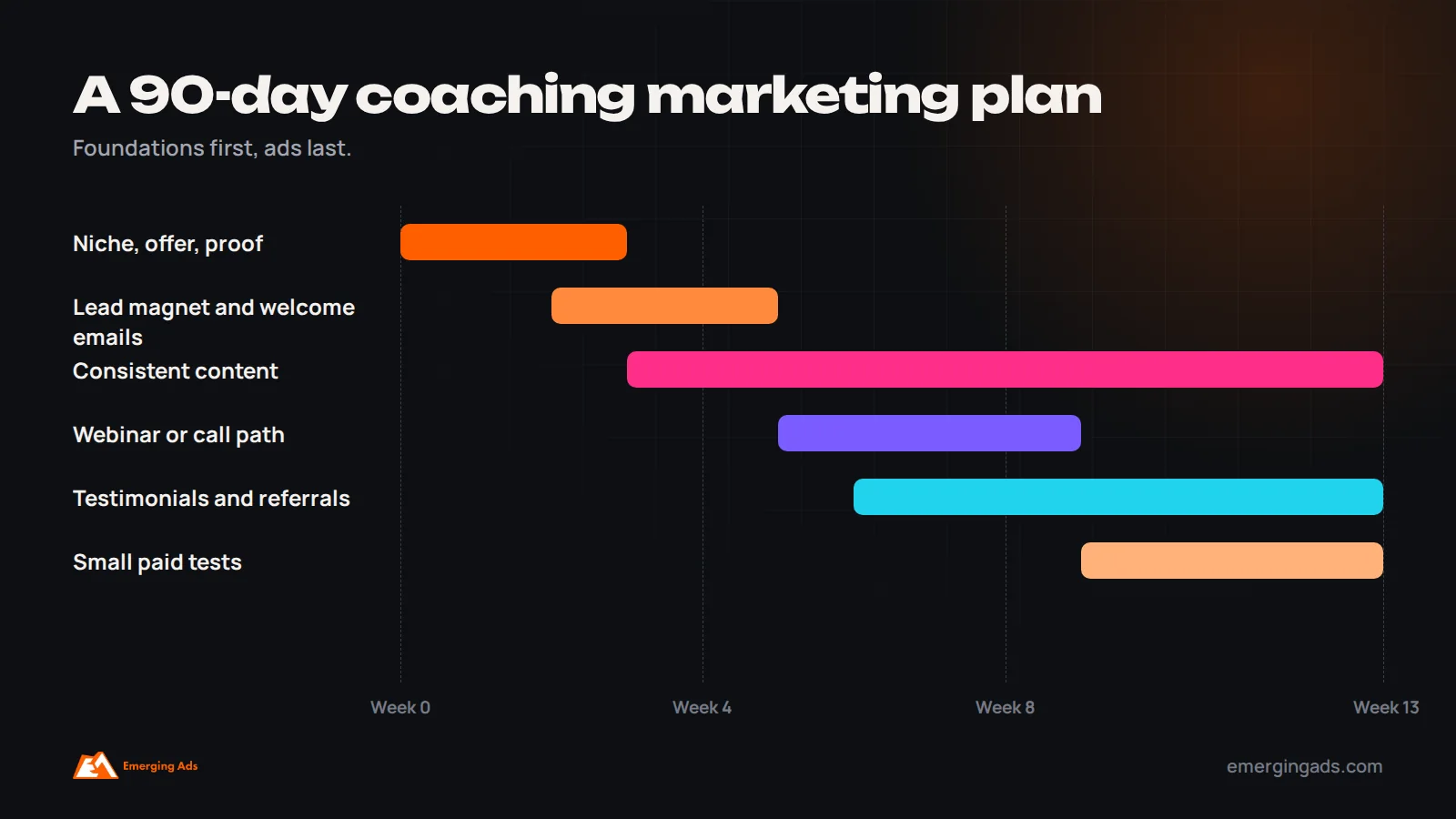
The best coaching business marketing strategy in 2026 starts with a specific niche and a clear transformation, builds trust through consistent, genuinely useful content on one or two platforms, grows an email list with a strong lead magnet, converts interest through webinars, challenges or discovery calls, and uses paid ads only once the offer and funnel already convert organically. Testimonials and results, referrals and a community keep the pipeline full. Measure cost per booked call, close rate and client lifetime value rather than followers.
Coaching is a crowded market. Business coaches, life coaches, health and fitness coaches, career coaches, executive coaches and relationship coaches all compete for attention on the same platforms, often with similar messages about transformation and freedom. Many coaches post daily, run ads and still struggle to fill their calendars.
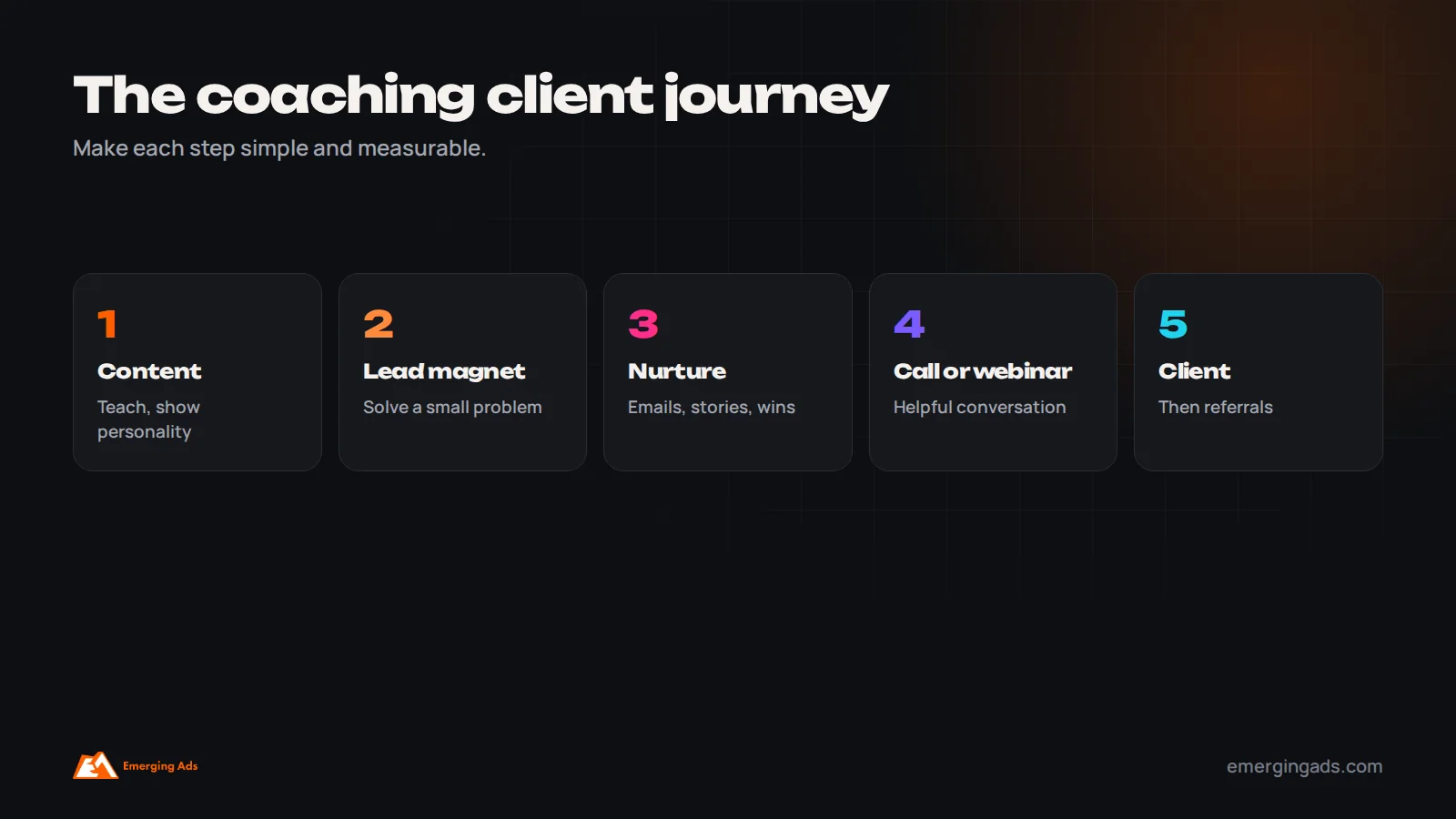
The coaches who grow consistently usually do a few things differently. They are specific about who they help and what changes. They build trust before asking for a sale. They have a simple, repeatable path from first contact to booked call. And they measure what matters. This guide sets out a practical marketing strategy for coaching businesses in 2026, from positioning to paid ads.
Start with a specific niche and transformation
“I help people live their best lives” is not a position anyone can remember or search for. “I help new managers in tech lead their first teams with confidence” is. A specific niche makes everything easier: you know where your audience spends time, what they search for, which problems keep them awake and which words they use. It makes content more relevant, ads more efficient and referrals easier, because people can describe exactly who you help.
Define your niche in terms of a person and a situation, then define the transformation: where clients start, where they end up and roughly how long it takes. Back it with proof, such as your own experience, credentials and client results. Our guide to building brand positioning from scratch explains how to find and test a position.
Build a simple offer ladder
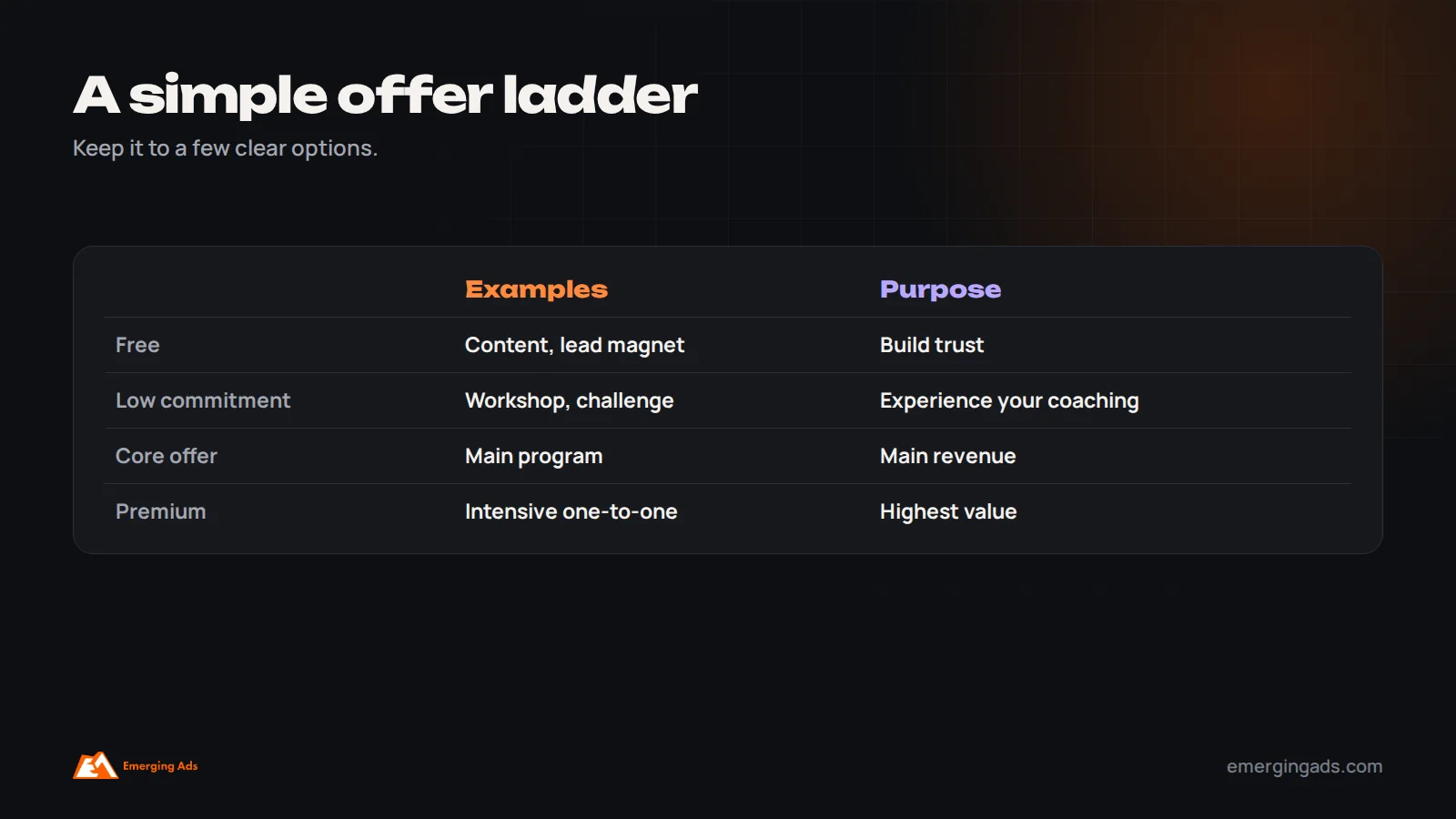
Most coaching businesses benefit from a small range of offers at different levels of commitment:
- Free: content, a lead magnet such as a guide, quiz or mini-course, and community access.
- Low commitment: a workshop, short course, group challenge or low-priced product.
- Core offer: your main coaching program, one-to-one or group.
- Premium: intensive one-to-one work, VIP days or ongoing advisory.
The ladder lets people start small, experience your value and move up when ready. Keep it simple: too many offers confuse buyers and dilute marketing.
Content: pick one or two platforms and go deep
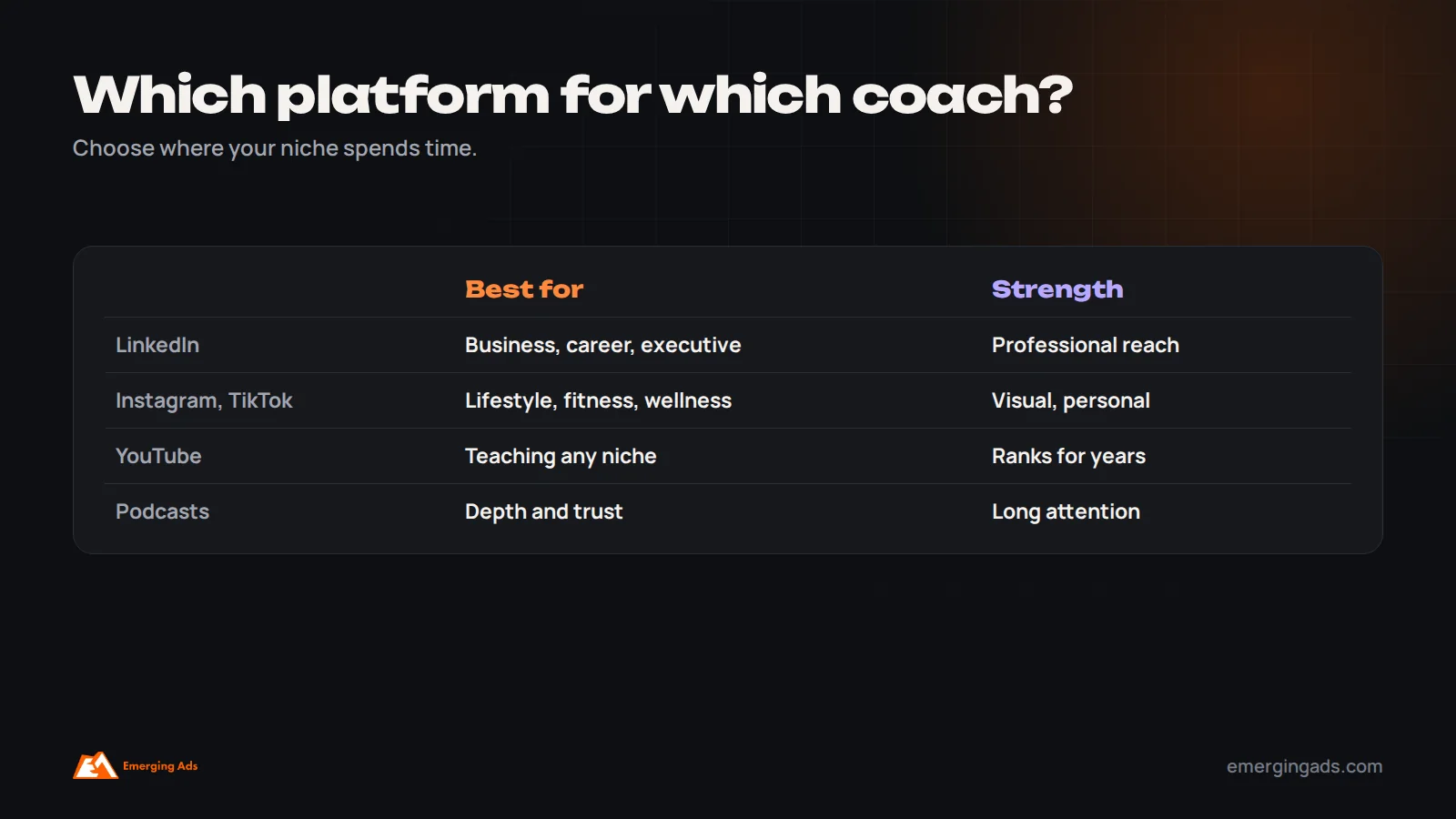
Content is the engine of most coaching businesses, because it lets potential clients experience how you think before they pay. Choose one or two platforms where your niche spends time: LinkedIn for business, career and executive coaching; Instagram or TikTok for lifestyle, fitness and personal development; YouTube for in-depth teaching that ranks in search for years; podcasts for depth and intimacy. Post consistently, teach real ideas, share client stories with permission, show your personality and invite conversation. Our guide to LinkedIn content strategy covers a practical approach.
How strategy differs by type of coaching
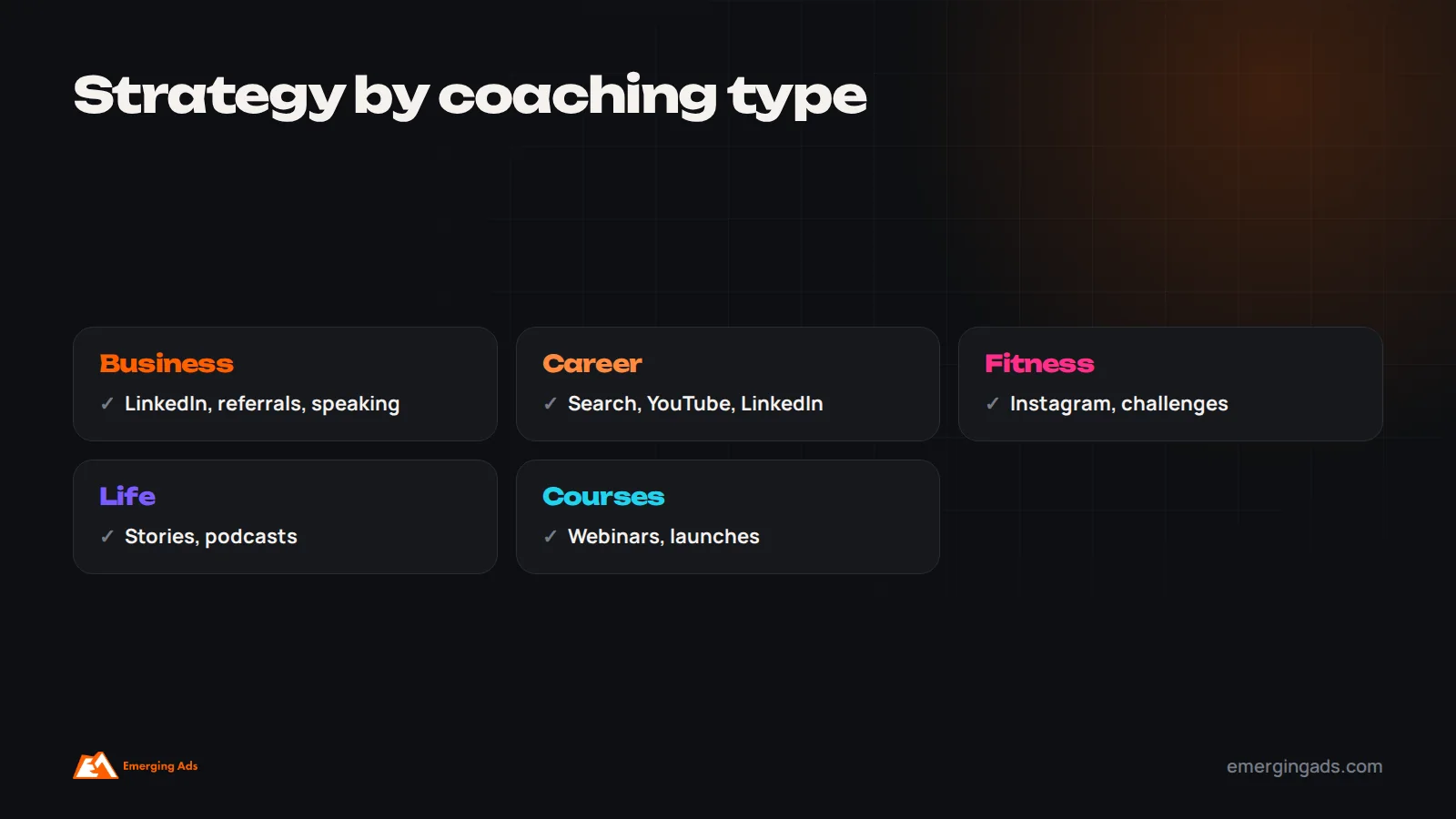
Business and executive coaches sell to professionals and companies, often at higher prices, with longer decisions. LinkedIn content, thought leadership, referrals, speaking and corporate partnerships usually matter more than consumer social media, and proposals may need to show return on investment for an employer paying the fee.
Career coaches reach people at moments of change, such as job searches, promotions and career pivots. Search, LinkedIn, YouTube and partnerships with communities and courses work well, often with clear packages tied to specific outcomes.
Health, fitness and wellness coaches rely on visual platforms such as Instagram, TikTok and YouTube, client transformations shared with consent, challenges and community. Claims about health outcomes must be careful and evidence-based.
Life and relationship coaches build trust through personal storytelling, podcasts, video and community, with a strong focus on empathy and a clear niche to stand out.
Coaches selling courses and group programs scale through webinars, launches, email and evergreen funnels. Our guide to online course marketing covers that model.
Grow an email list you own
Social platforms can change their algorithms overnight; your email list is yours. Offer a lead magnet that solves a small, specific problem for your niche, such as a checklist, template, short video training, assessment or quiz. Follow up with a welcome sequence that introduces you, delivers quick wins, shares client stories and invites the next step. Then email regularly with useful content and occasional offers. A modest, engaged list often generates more clients than a large social following. Our guide to lead nurture automation explains how to structure sequences.
Converting interest into clients
Attention only becomes income when there is a clear, easy next step. Most successful coaches use one main conversion path rather than several competing ones, and refine it over time based on what their data shows.
Discovery or strategy calls: short calls to understand a prospect’s situation and whether you can help. Use a booking page with a few qualifying questions, and follow a consistent, helpful call structure rather than a high-pressure script.
Webinars and masterclasses: teach something valuable for 45 to 60 minutes, then invite attendees to a call or program.
Challenges: five-day or similar challenges build momentum, community and trust before an offer.
Workshops and low-priced programs: let clients experience your coaching before committing to more.
Whatever path you choose, make it simple, measure each step and improve the weakest one.
Testimonials, results and case studies
Proof turns interest into confidence. Without it, even the best content struggles to convert.
Coaching is an intangible purchase, so proof matters enormously. Collect testimonials systematically at the end of programs and at milestones, ask for specific outcomes, and turn the best into short case studies showing where the client started, what you worked on and what changed. Video testimonials are especially powerful. Be careful with income or results claims: many regulators, including the US Federal Trade Commission and the UK’s advertising regulator, expect claims to be truthful, typical or clearly qualified, and evidence-based.
When to use paid ads
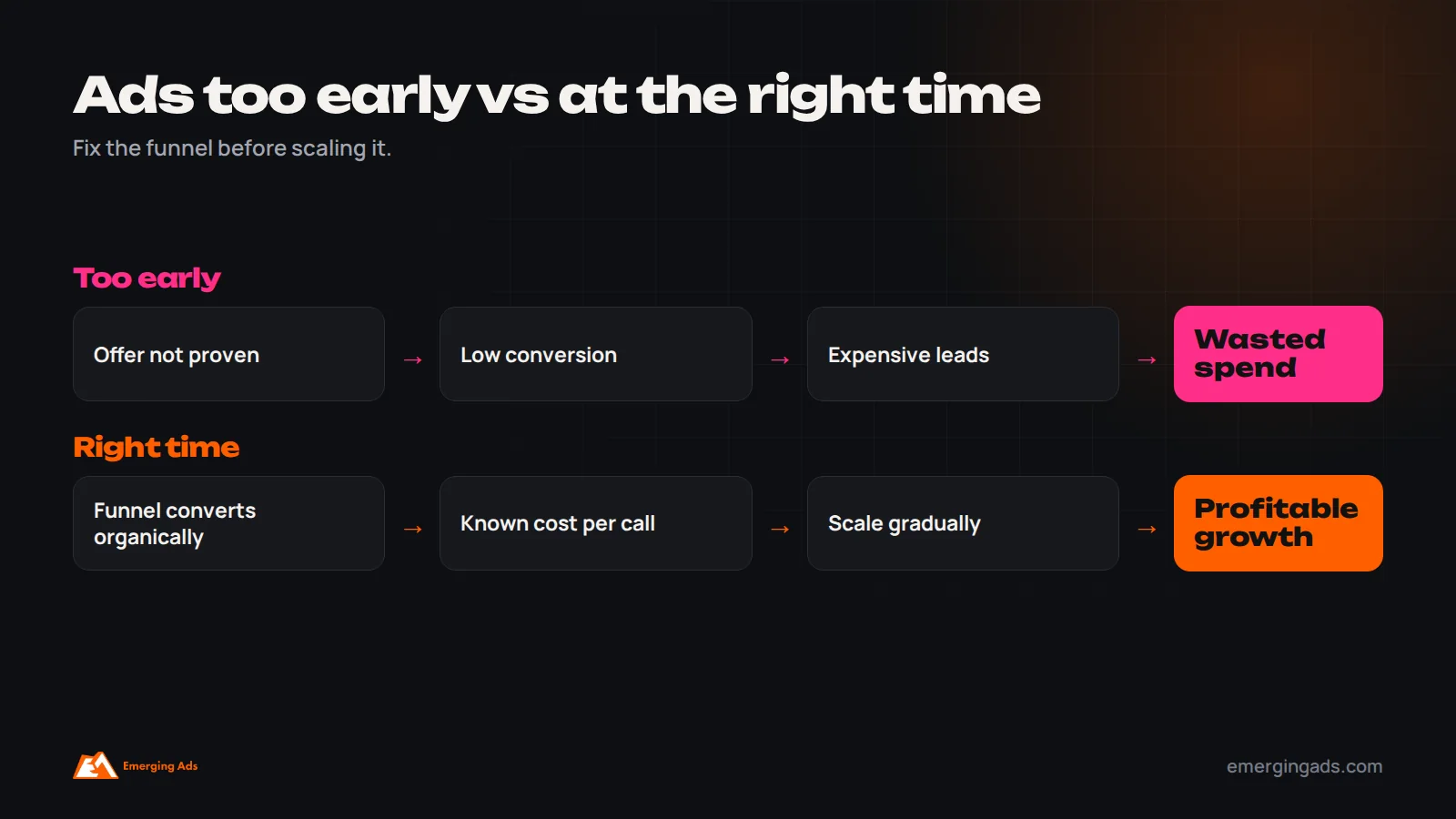
Ads speed up growth, but only for a funnel that already works.
Paid ads amplify what already works; they rarely fix an offer or funnel that does not convert. Once you know that your lead magnet, webinar or call path converts organically, ads on Meta, YouTube, LinkedIn or Google can scale it. Common approaches include promoting a lead magnet or webinar to a cold audience, retargeting engaged followers and website visitors with testimonials and offers, and search ads for coaching services people actively look for. Start with a modest budget, track cost per lead, cost per booked call and cost per client, and scale gradually. Our guide to scaling Meta ads explains how to grow spend without losing efficiency.
Community as a growth engine
Communities, such as a free group for your niche, a paid membership or an alumni network of past clients, create belonging, give prospects a low-risk way to experience your coaching and generate referrals and testimonials. They also keep past clients engaged, making renewals and upgrades more likely. Choose a platform your audience already uses, run regular rituals such as weekly prompts, live Q&A sessions and member wins, and show up consistently. Our guide to community-led growth explains how to build one that lasts.
Referrals and partnerships
Satisfied clients are a coach’s best marketing. Ask for referrals at moments of success, make introducing you easy with a short message or link, and thank referrers personally or with a simple reward. Partnerships multiply reach: guest appearances on podcasts, joint webinars with complementary experts, workshops for companies, associations or communities, and collaborations with other coaches who serve the same audience with a different focus. Speaking at events and conferences builds credibility quickly in business and executive coaching. Our guide to referral programs covers how to structure incentives.
Pricing and positioning together
Coaching prices send a signal. Very low prices can make a coach look inexperienced and attract clients who are less committed; higher prices need stronger proof and a clearer transformation. Price your core offer based on the value of the outcome to the client, your experience and evidence, and the level of access and support included. Show the transformation and process clearly so the price makes sense. Offering a payment plan can make higher-value programs accessible without discounting.
Running discovery calls that convert
Discovery calls should feel like a helpful conversation, not a pitch. A simple structure works well: understand where the person is now and what they want to change, explore what has held them back, share how you would approach their situation, check whether your program is a good fit, explain the investment and next steps, and answer questions honestly. If it is not a fit, say so and point them elsewhere; that integrity builds reputation and referrals. Follow up promptly after each call with a summary and next steps. Track show rates and close rates, and review calls that did not convert to improve both your messaging and the call itself.
Content ideas that attract the right clients
Content works best when it demonstrates how you think and helps your ideal client make progress before they ever pay you. Strong formats for coaches include teaching posts that break down a common problem and a practical way to approach it; client stories, shared with permission, that show a realistic transformation including the struggles along the way; myth-busting posts that challenge popular but unhelpful advice in your niche; behind-the-scenes content showing how you work, what a session looks like and what clients actually do between sessions; personal stories about why you do this work and what you have learned; answers to questions prospects ask on discovery calls; and short frameworks or checklists people can save and share. Mix formats across the week so your feed shows expertise, proof and personality. Keep a running list of ideas from client conversations, because the questions clients ask are almost always the questions your audience is searching for.
Search and YouTube for long-term demand
Social media content fades within days; search content can bring clients for years. Coaches can capture people actively looking for help through a simple website with clear pages for each offer, articles or videos answering the questions their niche searches for, and a strong profile on YouTube, which is itself a search engine. A video explaining how to prepare for a first management role, or how to plan a career change at forty, can attract viewers for a long time after it is published. Optimize titles, descriptions and thumbnails around the specific problems your audience types into search, and link videos to your lead magnet. For coaches serving a local area, such as fitness or wellness coaches, a Google Business Profile and local reviews also help people find you.
Running webinars and challenges that convert
Webinars and challenges work because they let prospects spend real time with you and experience a small version of your coaching. A good webinar promises one specific outcome in the title, teaches genuinely useful content for most of the session, shares one or two client stories, and ends with a clear, low-pressure invitation to the next step, such as booking a call or joining a program. Send reminders before the event, replays afterwards and a short follow-up sequence for attendees and registrants who missed it. Challenges run over several days, usually in a group or community, with a daily task, live session or prompt; they build momentum and relationships, and the final day naturally introduces your program. Track registrations, attendance, calls booked and clients won, and improve the weakest step before running the next one.
Retention, renewals and upgrades
Many coaching businesses focus almost entirely on finding new clients, while the easiest growth often comes from serving existing clients well. Clients who get results renew, upgrade to deeper work, join group programs or masterminds, and refer friends and colleagues. Build this into your business: set clear goals at the start of each engagement, track and celebrate progress, plan a review conversation before the end of a program to discuss what comes next, offer an alumni community or continued support option, and ask for testimonials and referrals at moments of success. A modest improvement in renewals and referrals can transform a coaching business’s economics, because it reduces how many new clients you need to find every month.
Systems that save time
As a coaching business grows, simple systems free time for coaching and content. Useful tools include a booking tool with qualifying questions and automatic reminders, an email platform with automated welcome and nurture sequences, a CRM or simple pipeline to track leads, calls and clients, templates for proposals, onboarding and follow-up messages, and a content calendar. Automate repetitive admin, but keep personal touches, such as call follow-ups and check-ins, genuinely personal. Our article on CRM automation mistakes explains how to automate without losing leads.
Marketing ethically
The coaching industry has a reputation problem, partly because of exaggerated income claims, fake scarcity and high-pressure sales tactics. Ethical marketing is both the right thing to do and a competitive advantage. Make claims you can support, describe typical results honestly, avoid false deadlines and pressure, be clear about what is included and what clients need to commit, respect people who decide not to buy, and follow advertising rules on testimonials and endorsements. Coaches who market with integrity build reputations that bring referrals for years.
An example coaching marketing plan
Consider a leadership coach who helps newly promoted managers in technology companies. She narrows her niche to first-time engineering managers, defines a twelve-week program that builds confidence in delegation, feedback and running a team, and collects testimonials from past clients with specific outcomes. She creates a free guide called “The first 90 days as an engineering manager” and a short welcome email sequence. She posts on LinkedIn four times a week, mixing practical advice, client stories and lessons from her own management experience, and comments daily on posts from engineering leaders. Once a month, she runs a free online workshop on a common challenge, such as giving difficult feedback, ending with an invitation to book a call. After two months, her workshop converts consistently, so she starts small LinkedIn and Meta campaigns promoting the guide to engineering managers, retargeting engaged visitors with workshop invitations. She tracks subscribers, workshop attendance, calls booked, close rate and cost per client, and adds a group program for clients who finish the one-to-one work. Within six months, she has a predictable flow of calls and a waiting list for her premium offer.
Coaching in different markets
Coaching markets differ around the world. In the US and UK, coaching is well established, competition is intense and niche positioning is essential. In the Gulf, demand for executive, leadership, wellness and career coaching has grown, with relationships, referrals, LinkedIn and Instagram central, and Arabic content can reach audiences that English-only coaches miss. In India, online coaching for careers, skills, fitness and personal development has expanded rapidly, with YouTube, Instagram and WhatsApp communities widely used and price sensitivity often higher. Adapt platforms, language, pricing and examples to the market you serve, rather than copying a strategy designed for another audience.
Using AI tools wisely
AI tools can help coaches draft content outlines, repurpose a long video into short posts, summarize client feedback and write first drafts of emails. They are less helpful for the things that make coaching marketing work: personal stories, real client results, strong opinions grounded in experience and a recognizable voice. Use AI to save time on structure and repurposing, then add the specific details only you know. Audiences quickly notice generic, AI-sounding content, and in a trust-based business like coaching, sounding like everyone else is costly.
Your website as a conversion hub
Social media brings attention, but a simple, focused website turns it into enquiries. A coaching website does not need many pages. It needs a homepage that states clearly who you help and what changes for them, with proof near the top; a page for each main offer explaining the process, what is included, who it is for and how to start; an about page that tells your story and shows credentials; a testimonials or results page; your lead magnet signup; and an easy way to book a call. Make sure every social profile links to it, every piece of content points somewhere useful on it, and it loads quickly on phones. Our landing page design team builds pages like this for service businesses.
Budgeting for paid acquisition
Set paid budgets from your numbers. If you know that a certain share of booked calls become clients and what a client is worth over their time with you, you can work out what you can afford to pay for a booked call. Start with a small daily budget, run it for several weeks to gather data, and compare cost per booked call and per client against that limit. Increase spend gradually while results hold. Ads for higher-priced programs can justify higher costs per call, but only if your close rate and delivery capacity can keep up with the additional demand.
Consistency beats intensity
Many coaches start marketing with bursts of energy, posting daily for a few weeks, launching a big campaign, then going quiet when client work fills their time. Demand then dries up, and the cycle repeats. A sustainable rhythm, such as three posts a week, one email a week and one workshop a month, maintained for a year, usually produces far more clients than intense bursts. Batch content creation, keep a list of ideas, and protect marketing time in your calendar even when you are busy with clients.
A quick coaching marketing checklist
Check that you can describe your niche and the transformation you deliver in one sentence; that you have a small, clear offer ladder; that you post consistently on one or two platforms where your audience spends time; that you have a useful lead magnet and an automated welcome sequence; that there is a simple path from interest to a booked call or webinar; that testimonials with specific outcomes appear on your website and in your content; that you ask clients for referrals at moments of success; that claims are honest and compliant; and that you track leads, calls, close rate and client value every month. Most coaches find two or three gaps in this list, and fixing them often matters more than any new tactic.
Measuring a coaching business
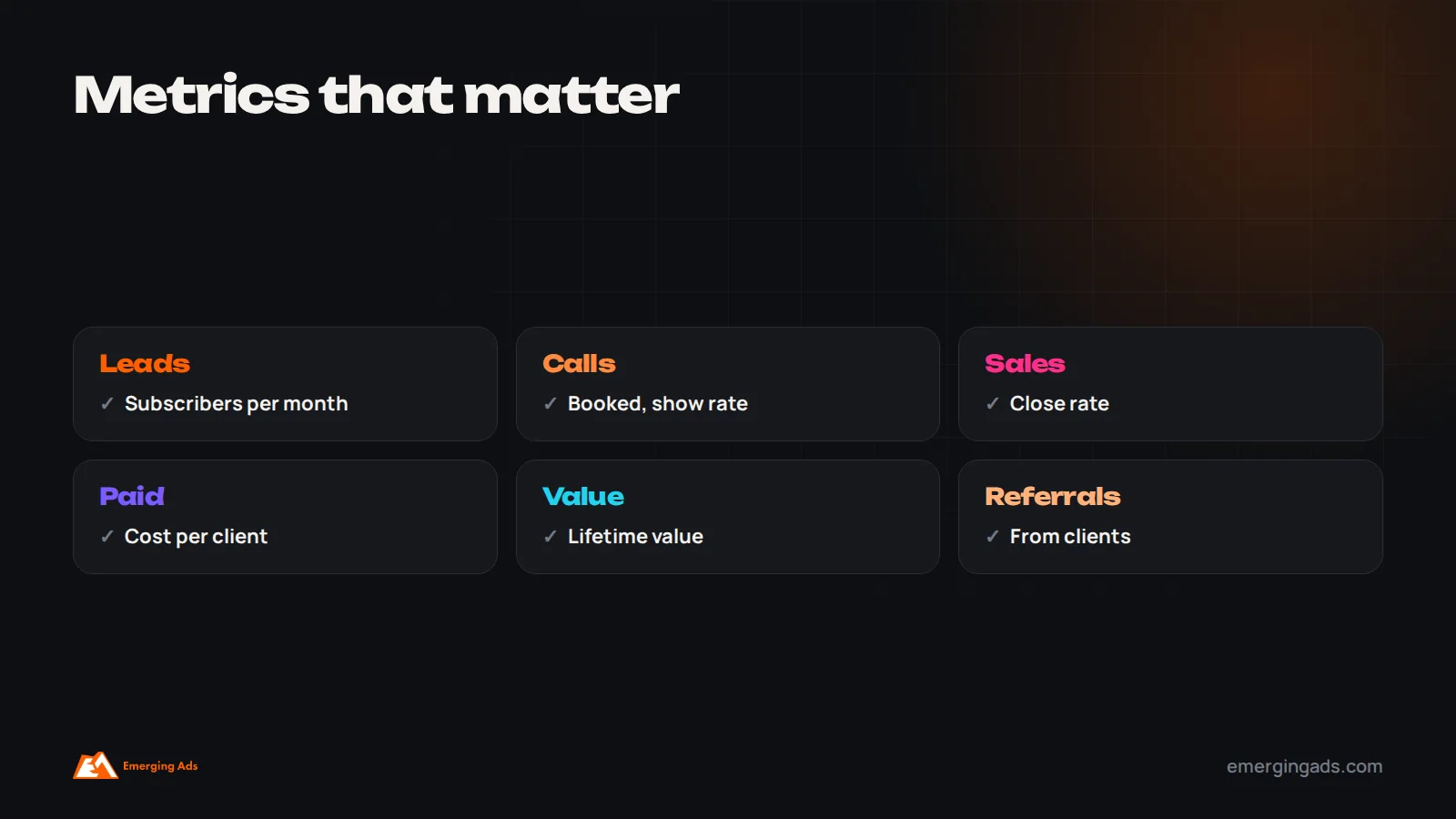
Track a few simple numbers every month, and judge your marketing on clients won rather than followers gained.
- Leads and email subscribers per month.
- Booked calls and show rate.
- Close rate from call to client.
- Cost per booked call and per client for paid channels.
- Client lifetime value, including renewals and upgrades.
- Referral rate from existing clients.
Common mistakes
These are the patterns that most often keep coaching businesses stuck, even when the coaching itself is excellent.
- A vague niche and generic messaging.
- Posting everywhere instead of going deep on one or two platforms.
- No email list.
- Running ads before the funnel converts.
- Too many offers.
- Exaggerated income or results claims.
- Measuring followers instead of booked calls and clients.
Frequently asked questions
What is the best marketing strategy for coaches?
A specific niche and transformation, consistent content on one or two platforms, an email list built with a strong lead magnet, a simple conversion path such as calls or webinars, strong testimonials and paid ads only once the funnel converts.
Which platform is best for coaches?
It depends on your niche: LinkedIn for business and career coaching, Instagram or TikTok for lifestyle and fitness, YouTube for teaching that ranks long term, podcasts for depth.
Should coaches run paid ads?
Yes, once the offer and funnel convert organically. Ads amplify a working funnel but rarely fix one that does not convert.
What lead magnet works best for coaches?
One that solves a small, specific problem for your niche, such as a checklist, template, assessment, quiz or short training.
How do coaches get more discovery calls?
Through consistent content, email nurture, webinars or challenges, clear calls to action and an easy booking page with a few qualifying questions.
How should coaches use testimonials?
Collect specific outcomes systematically, turn the best into case studies and video, and keep claims truthful and qualified.
What metrics matter for a coaching business?
Leads, booked calls, show rate, close rate, cost per client, client lifetime value and referral rate.
How long does it take to build a coaching business through marketing?
Usually several months of consistent content and list building before demand becomes predictable, faster with an existing network or proven offer.