
The short answer
The best DTC brand storytelling strategy in 2026 starts with a clear, true story about why the brand exists, who it serves and what changes for customers, then tells it consistently through the founder, the product, customers and the brand’s values. It shows rather than claims, using video, customer stories and behind-the-scenes content, and turns the story into ads, product pages, emails and packaging that convert. Good storytelling lowers acquisition costs, raises conversion and keeps customers coming back. Measure it through ad performance, conversion, repeat purchase and branded search.
Direct-to-consumer brands compete in crowded markets where products can be copied quickly and ad costs keep rising. What competitors cannot copy is a brand’s story: why it was started, what it believes, how its products are made and the people who love them. The DTC brands that grow sustainably are usually the ones whose story makes customers choose them, remember them and tell friends about them.
Storytelling is not decoration. Done well, it makes ads more persuasive, product pages more convincing, emails more engaging and customers more loyal. We have seen this with brands such as The Simple Seed Baby, where a clear brand story behind Meta and lifecycle campaigns supported $6.63M in Shopify sales, a 5.30x Meta return on ad spend, average order value growing from $70 to $83 and repeat purchase rate rising from 21% to 35%. This guide sets out a practical storytelling strategy for DTC brands in 2026.

Find your core story
Everything else in DTC storytelling depends on a clear, true core story that the whole team can tell the same way.
Every strong DTC brand story answers a few questions clearly. Why does the brand exist: what problem, frustration or gap did the founders see? Who is it for, specifically? What does the product do differently, and why does that matter to the customer? What does the brand believe in? And what changes for customers when they choose it? Write the answers in plain language, test them with customers and team members, and refine until the story is simple enough to repeat in a sentence. Our guide to brand positioning explains how to find and test a position.
Four stories every DTC brand should tell
The founder story
Why the founders started the brand, often from a personal experience. Founder stories create authenticity and connection, especially on social media and video.
The product story
How products are designed, sourced and made, what makes them better and the details customers would not notice otherwise. Product stories justify price and build trust in quality.
The customer story
Real customers and what changed for them. Customer stories provide social proof and help prospects picture themselves using the product.
The values story
What the brand stands for, such as sustainability, inclusivity, community or craftsmanship, shown through actions rather than slogans.

Make the customer the hero
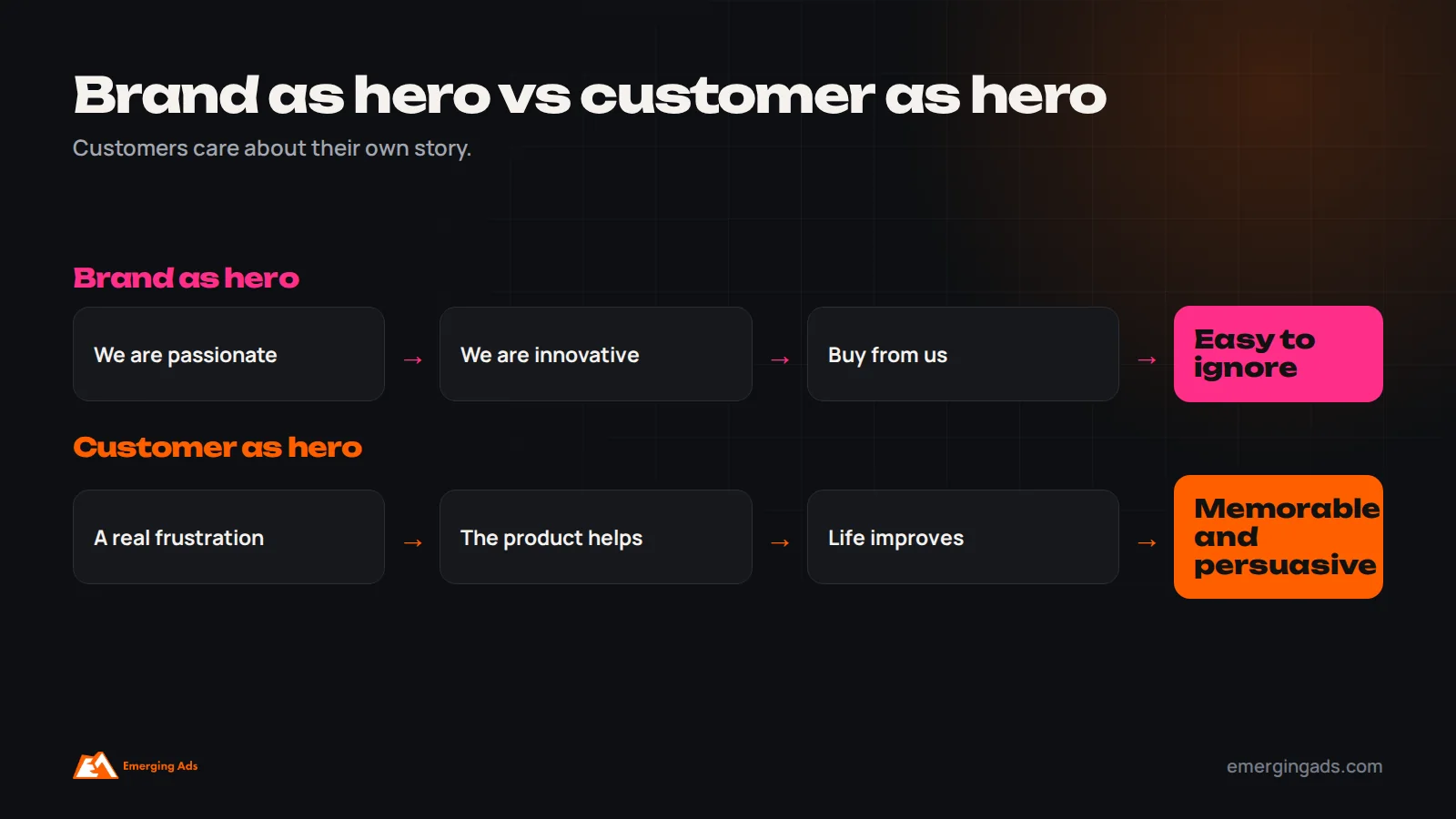
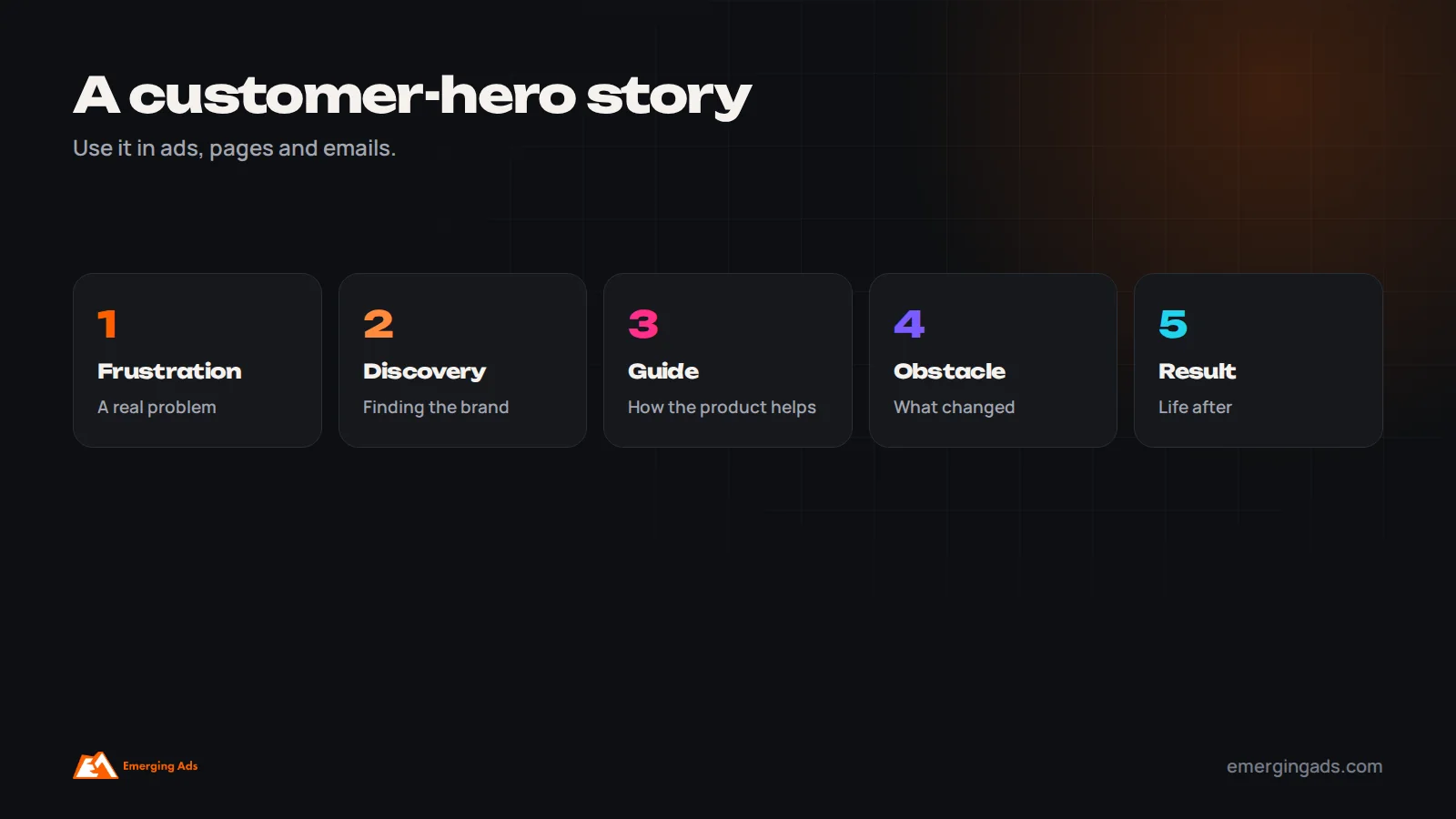
The most common storytelling mistake is making the brand the hero. Customers do not care how impressive a brand is; they care about their own problems and goals. Strong DTC stories cast the customer as the hero and the brand as the guide that helps them succeed. The structure is simple: a customer with a goal or frustration, a moment of discovery, the product helping them overcome the obstacle, and the result in their life. Founder and product stories still matter, but they work best when connected to what changes for the customer. A skincare brand’s story is not that its founders are passionate chemists; it is that a customer with sensitive skin finally found something that works, because those chemists refused to compromise on ingredients.
Developing a consistent brand voice
A brand story needs a recognizable voice: the way the brand speaks across ads, emails, product pages, packaging and social media. Define a few characteristics, such as warm and practical, witty and irreverent, or calm and expert, with examples of what the voice sounds like and what it avoids. Write a short guide with preferred words, phrases to avoid and examples of good and bad copy. Share it with everyone who writes for the brand, including agencies, creators and customer service. Consistency builds recognition; customers should be able to identify the brand from a caption without seeing the logo.
Video storytelling for DTC
Video is the strongest format for brand storytelling. Short founder videos explaining why the brand started, filmed simply and honestly, often outperform polished brand films in paid social. Behind-the-scenes footage of sourcing, design and production shows quality. Customer testimonial videos, ideally unscripted, provide credible proof. Product demonstration videos show how the product fits into daily life. Creator videos extend the story to new audiences in creators’ own words. Keep most videos short and vertical for social platforms, hook viewers in the first seconds, caption everything, and reuse the best footage across ads, product pages and email.
Collecting customer stories
Customer stories are the most persuasive storytelling asset, but they need a process to collect. Ask customers for reviews and photos after purchase, follow up with enthusiastic reviewers to request longer stories or videos, run campaigns inviting customers to share how they use the product, and feature customers in content with permission. Look for stories that show specific outcomes and represent the range of your customers. Reward participation with thanks, early access or small gifts, while avoiding incentives that influence the content of reviews. Over time, a library of real customer stories becomes one of the brand’s most valuable assets.
Show, do not just tell
Audiences are skeptical of claims. Instead of saying a product is high quality, show the materials, the testing and the craftsmanship. Instead of claiming customers love it, share their unedited reviews, videos and photos. Instead of declaring values, show the actions: suppliers visited, materials changed, communities supported. Video is especially powerful for showing: founders speaking candidly, factory and workshop footage, product demonstrations and customers in real life.
Telling the story across channels
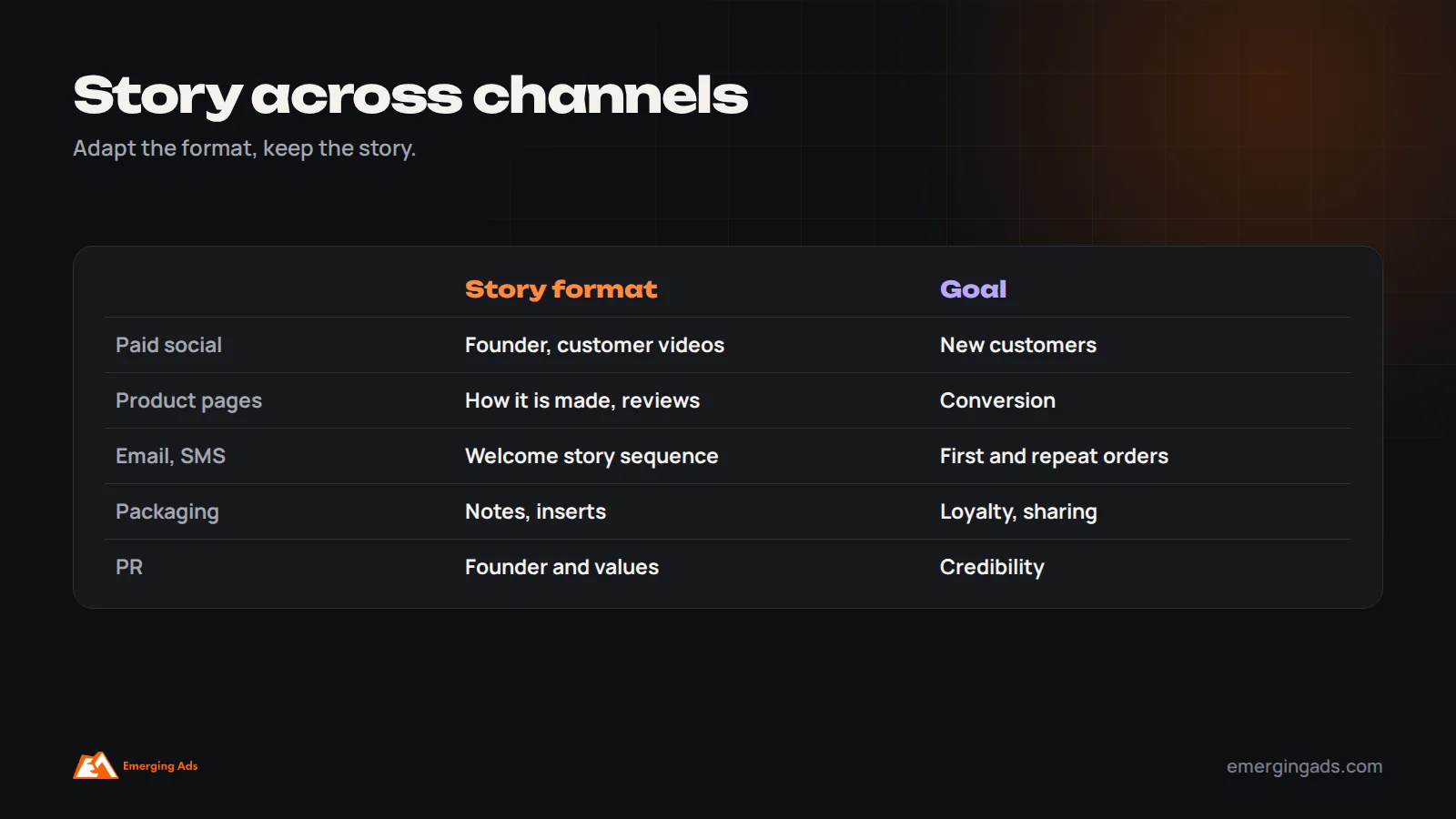
A story told only on the About page reaches very few customers. The most effective DTC brands carry the same story through every touchpoint, adapting the format to each channel while keeping the message consistent.
- Paid social: founder videos, customer testimonials and product stories often outperform polished brand ads.
- Product pages: the story behind each product, how it is made, who it is for and customer reviews.
- Email and SMS: welcome sequences that introduce the founders, values and product details.
- Packaging and unboxing: notes, inserts and design that continue the story at home.
- Organic social: behind-the-scenes, community and customer content.
- PR and partnerships: stories journalists and creators want to share.
Turning stories into ads that perform
Paid social is where many DTC brands first meet customers, and storytelling has a direct effect on ad performance. Story-led ads often beat product-only ads because they give people a reason to care before asking them to buy. Effective formats include a founder speaking to camera about why the product exists, a customer describing the problem they had and what changed, a quick behind-the-scenes sequence showing how the product is made, and creator videos telling the story in their own words. Hook viewers in the first seconds with a relatable problem or striking visual, keep the story tight, show the product clearly and end with a simple next step. Test several story angles against each other, since different audiences respond to different stories. Our guide to scaling Meta ads explains how to scale the winners.
Creators as storytellers
Creators can tell a brand’s story to audiences who trust them, often more convincingly than the brand can itself. The best creator partnerships give creators the core story, the key facts and the values, then let them explain it in their own way, using their own experience with the product. Overly scripted creator content sounds like an ad and loses the credibility that made the creator valuable. Long-term partnerships work best, because audiences see creators use the product over time, which reinforces the story. Our guide to influencer collaborations covers briefs and contracts.
Building a community around the story
The strongest DTC stories are eventually told by customers to each other. Communities, such as social groups, ambassador programs, events, user-generated content campaigns and loyalty programs, give customers a way to participate in the brand’s story. Feature community members, involve them in product decisions, celebrate their stories and create rituals that bring them together. A brand with an engaged community has a story that keeps growing, generates content and referrals, and becomes much harder for competitors to copy. Our guide to community-led growth explains how to build one.
PR and earned media
Journalists, podcasters and newsletter writers look for stories, not product announcements. A distinctive founder journey, an unusual production method, a meaningful values commitment, surprising customer data or a response to a wider trend can earn coverage that ads cannot buy. Prepare a short press kit with the core story, founder biographies, high-quality images, key facts and customer stories, and pitch it to writers who cover your category. Earned media builds credibility, improves search visibility and gives you material to share across your own channels.
Storytelling on product pages
Product pages are where storytelling most directly affects sales. Beyond specifications, a strong product page explains the problem the product solves, what makes it different and why that matters, how it is made and from what, who it is for, how customers use it and what they say about it. Short videos, close-up images of materials, comparison sections and reviews with photos all support the story. Keep the most important points visible near the add-to-cart button on mobile, and place deeper story content further down for customers who want to know more. Testing story-led product page sections against plain specifications often shows meaningful conversion improvements. Our guide to conversion rate optimization explains how to test changes.
Storytelling through email and SMS
Email gives DTC brands space to tell their story in depth to people who have shown interest. A welcome sequence might introduce the founders and why the brand exists, explain what makes the products different, share customer stories, show behind-the-scenes production and describe the brand’s values, before guiding subscribers to the right first purchase. Post-purchase emails can continue the story with care tips, product origins and community invitations, which increase repeat purchases. Stories in regular newsletters keep subscribers engaged between promotions. Our guide to ecommerce email flows covers the essential sequences.
Packaging and the unboxing moment
For DTC brands, packaging is one of the few physical touchpoints with customers. Thoughtful packaging continues the brand story: a note from the founders, information about materials and sourcing, care instructions written in the brand voice, an invitation to join the community or share a photo. Memorable unboxing experiences encourage social sharing and reinforce the decision to buy. Keep packaging consistent with the brand’s values; a sustainability story loses credibility if packaging is wasteful.
Authenticity and honesty
Audiences are increasingly skilled at spotting invented or exaggerated stories. A founder story that sounds too perfect, sustainability claims without evidence, or customer stories that feel staged can damage trust quickly, and misleading environmental or health claims can also break advertising rules. Keep stories true and specific. Acknowledge imperfections and what the brand is still working on. Use real customers, with permission, and real footage. Make sure the story matches the customer experience: if the story promises exceptional service, service must deliver. Authenticity is not a style; it is consistency between what a brand says and what it does.
Evolving the story as the brand grows
A DTC brand’s story evolves. Early on, the founder story often carries the brand, with founders visible everywhere. As the brand grows, customer stories, community and product innovation take more of the spotlight, and team members become part of the narrative. New product lines, markets and milestones add chapters. The core story, why the brand exists and who it serves, should stay recognizable while the details develop. Review the story each year: does it still reflect what the brand is and what customers value? Customer feedback and reviews show which parts of the story resonate most.
An example storytelling program
Consider a small DTC brand making natural baby skincare. The founder, a parent frustrated by products full of ingredients she could not pronounce, worked with a chemist to create a short-ingredient range. The brand defines its core story around giving parents confidence in what they put on their baby’s skin. It films the founder explaining the origin in a simple, honest video, shows the small-batch production process and collects stories from parents whose babies had sensitive skin. These become the main ad creative, alongside creator videos from parents. Product pages explain each ingredient in plain language with customer photos. A welcome email sequence introduces the founder, the ingredient philosophy and customer stories before recommending a starter set. Packaging includes a handwritten-style note and ingredient card. The brand compares story-led ads with product-only ads, tracks conversion on updated product pages and watches repeat purchase rates, which rise as customers connect with the story.
Running a storytelling workshop
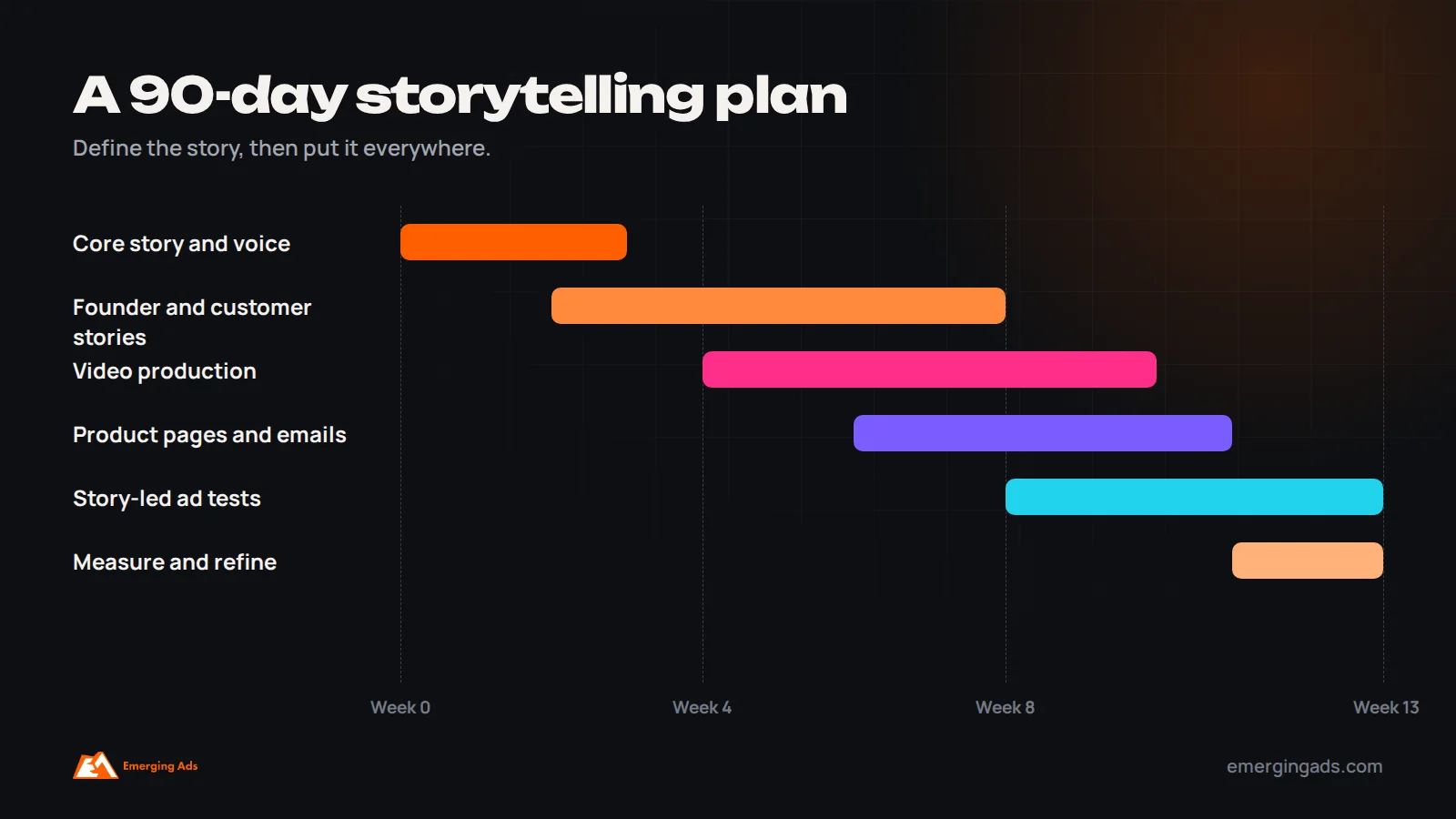
Many brands find their story by working through it together. A half-day workshop with founders, key team members and, ideally, a few loyal customers can uncover the material a strong story needs. Start with the founding moment: what problem or frustration started the brand, and what was the first version like? Then explore the product: what decisions were hard, what was refused, what details matter most? Gather customer evidence: which reviews, messages and stories come up repeatedly? Discuss values: what has the brand actually done, not just what it believes? Finally, draft the core story in a few sentences and test it on people outside the team. The output is a short story document with the core narrative, supporting stories, proof points and voice guidelines that everyone can use.
Building a story library
Storytelling becomes easier when stories are collected and organized. Keep a shared library of founder anecdotes, product development details, sourcing facts, customer stories with permissions, team member profiles, photos and video footage, press coverage and key statistics. Tag each item by theme, product and channel so teams can find material quickly when writing ads, emails or product pages. Add to it continuously as new reviews, customer messages and milestones arrive. A well-maintained library means every new campaign starts with real material rather than a blank page.
Storytelling across markets and cultures
DTC brands selling in several countries need to adapt their stories while keeping the core intact. Values, humor, family roles, religious and cultural references and even what counts as authentic vary between markets. In the Gulf, for example, family, hospitality and quality often resonate strongly, Arabic content reaches wider audiences, and Ramadan is a natural storytelling moment. In India, regional languages and cultural festivals offer rich storytelling opportunities. Work with local team members, creators or agencies to adapt stories, examples and visuals, rather than translating word for word. Our guide to Ramadan marketing covers seasonal storytelling in the Gulf.
AI and brand storytelling
AI tools can help draft copy variations, summarize customer reviews to find common themes, suggest headlines and repurpose long content into shorter formats. They are useful for speed, but they cannot supply what makes a brand story work: true founder experiences, real customer stories, specific production details and a distinctive voice. Use AI to organize and repurpose your real material, then edit everything carefully so it sounds like your brand rather than generic marketing copy. Audiences quickly notice when content sounds like everyone else.
How storytelling drives repeat purchases
Stories do not stop mattering after the first sale. Customers who understand and share a brand’s values, know the people behind it and feel part of its community are more likely to buy again and recommend it. Post-purchase storytelling, through care guides, origin stories for each product, behind-the-scenes updates, community features and early access to new launches, keeps that connection alive. Loyalty programs framed around the brand’s values, such as recycling schemes for a sustainable brand or exclusive workshops for a craft brand, reinforce the story while rewarding repeat customers. For many DTC brands, the biggest financial return from storytelling comes through retention rather than acquisition, because repeat customers cost little to reach and buy more over time.
The team as part of the story
As DTC brands grow, the people behind them become an important part of the story. Designers, makers, customer service staff and warehouse teams all have stories that humanize the brand and show its values in action. Featuring team members in content, letting customers know who packed their order or who designed a product, and sharing how the team works builds connection and trust. It also helps with recruitment, since people want to work for brands whose stories they believe in.
Budgeting for storytelling
Storytelling does not require large budgets, but it does require consistent investment of time and some production. Typical costs include video production, whether in-house with simple equipment or with freelancers; photography of products, production and customers; copywriting for pages, emails and ads; creator partnerships; and packaging design. Many brands start with founder-filmed video and customer content, then invest more in production as results prove the value. Judge the investment through improvements in ad performance, conversion and retention rather than treating storytelling as a separate brand expense.
A quick storytelling checklist
Check that you can state your core story in a sentence; that founder, product, customer and values stories are documented with proof; that the customer is the hero; that a voice guide exists; that the story appears in ads, product pages, emails, packaging and social media; that video shows rather than tells; that customer stories are collected continuously; that claims are true and supported; and that you measure the effect on ads, conversion and repeat purchases.
Storytelling, search and AI visibility
Brand stories also help with search and AI visibility. Detailed About, sourcing and product story pages give search engines and AI assistants clear information about what makes the brand different, which can influence how it is described when shoppers ask for recommendations. Press coverage, creator content and reviews that repeat the brand’s story reinforce it across the web. Make sure key facts, such as materials, sourcing, certifications and founder background, are stated clearly and consistently on your website. Our guide to generative engine optimization explains how clear, consistent information earns AI citations.
Advice for small and new DTC brands
New brands often think storytelling requires big budgets, but small brands usually have their best stories at the start: the founder’s original frustration, the first prototypes, early customers who believed in the product, and every decision made by hand. Capture these now, with simple video and photos, before the details fade. Show up as founders, talk to customers directly, share the process openly and invite early customers into the story. Many of today’s best-known DTC brands built loyal audiences this way before spending heavily on advertising.
Measuring storytelling
Good storytelling shows up clearly in the numbers. Compare story-led work against what came before, and track these measures every month across ads, pages and email.
- Ad performance of story-led creative compared with product-only ads.
- Conversion rate on pages with stronger story content.
- Repeat purchase rate and customer lifetime value.
- Branded search volume and direct traffic.
- Email engagement with story-led sequences.
- Reviews and customer comments that repeat the story.

Common mistakes
These are the storytelling mistakes we see most often in DTC brands, and each one weakens trust or wastes good material.
- A vague or invented story customers do not believe.
- Telling the story only on the About page.
- Claims without proof.
- Values statements without actions.
- Inconsistent stories across channels.
- Making the brand the hero instead of the customer.
Frequently asked questions
What is DTC brand storytelling?
Communicating why a direct-to-consumer brand exists, who it serves, how its products are made and what changes for customers, consistently across every channel.
Why does storytelling matter for DTC brands?
It differentiates brands in crowded markets, makes ads more persuasive, improves conversion and builds loyalty.
What stories should a DTC brand tell?
Founder, product, customer and values stories, each shown with real evidence.
Where should brand stories appear?
In ads, product pages, emails, packaging, social media and PR, not just the About page.
How do I measure brand storytelling?
Compare story-led ad and page performance, track repeat purchase rate, lifetime value, branded search and email engagement.
Should founders appear in content?
Often yes. Founder content builds authenticity, especially for young brands, though the customer should remain the hero.
What makes a brand story believable?
Specific, true details, proof such as footage and customer stories, and actions consistent with stated values.
Is storytelling only for big brands?
No. Small DTC brands often have more authentic, personal stories than large brands, which is an advantage.