The short answer
The best Leadpages agency for a small business builds landing pages around one clear offer and audience, writes persuasive copy rather than just designing templates, connects pages to your email platform or CRM so every lead is followed up, sets up tracking for ads and analytics, and tests headlines, offers and forms to raise conversion rates over time. Location matters less than evidence: ask for examples of pages with conversion results, how they match pages to ads, and how they measure cost per lead and customer.
Leadpages is a landing page builder designed for small businesses that want to capture leads and sell without relying on developers. It offers templates, a drag-and-drop editor, pop-ups and alert bars, forms, integrations with email and CRM tools, and testing features on higher plans. Many small businesses buy it, publish a template with their logo, and wonder why pages do not convert.
The tool is rarely the problem. Conversion depends on the offer, the message, the match between ad and page, the form, the proof and the follow-up. That is where a good Leadpages agency or specialist adds value. This guide explains what to expect from one, how to evaluate agencies, what good landing pages include, pricing and the mistakes to avoid. If you are still deciding whether Leadpages suits you, read our guide to what Leadpages is and how it converts leads.

What a Leadpages agency does
- Offer and page strategy: deciding what each page should offer, to whom and why.
- Copywriting: headlines, benefits, proof and calls to action that persuade your target audience.
- Design and build: customizing templates or designing pages that are clear, fast and mobile-friendly.
- Forms and lead magnets: form design, lead magnet delivery and thank-you pages.
- Integrations: connecting Leadpages to email platforms, CRMs, booking tools and payment systems.
- Tracking: analytics, ad pixels and conversion tracking.
- Testing and optimization: A/B tests on headlines, offers, forms and layouts.
- Ad alignment: matching pages to the ads and keywords that send traffic.
What a high-converting landing page includes
- One goal: a single action, such as booking a call, downloading a guide or buying.
- A clear headline that states the main benefit for the visitor, matching the ad they clicked.
- A short explanation of what they get and why it matters.
- Proof: reviews, testimonials, client logos, results or credentials, placed near the call to action.
- A simple form asking only for what you need at this stage.
- Answers to objections: price, risk, time, what happens next.
- Fast loading and mobile-first design.
- Minimal distractions: no full navigation menu pulling visitors away.
Our guide to conversion rate optimization explains why each element matters.
Choosing the right offer for each page
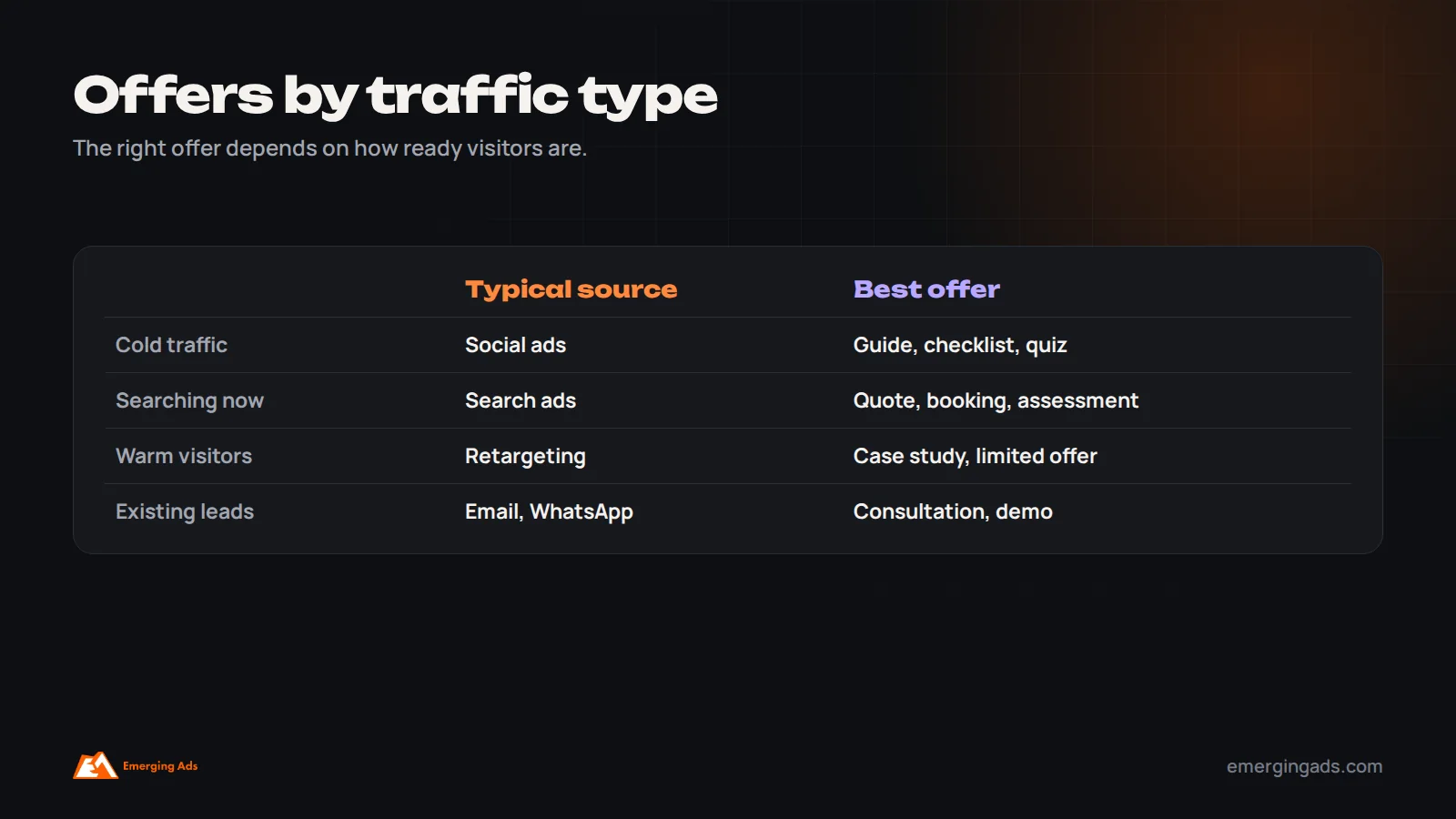
The offer is the most important part of a landing page, and the part most often left to chance. A strong offer gives visitors something they genuinely want, at a level of commitment that matches how ready they are. Cold traffic from social ads may respond better to a free guide, checklist, quiz or short video than to “book a consultation”. Search traffic from people looking for a specific service may be ready for a quote, booking or free assessment. Returning visitors and retargeted audiences may respond to a limited-time offer or case study. A good agency helps you build a small range of offers for different stages and matches each page to the right one. Our guide to lead nurture automation explains how lower-commitment offers feed into follow-up.
Why copy matters more than design
Many small business landing pages look professional but say little. Visitors decide in seconds whether a page is relevant to them, mostly from the headline and first lines. Good landing page copy speaks to a specific problem in the customer’s own words, states the outcome clearly, explains what happens next, and removes doubt with proof and specifics. It is usually written from customer research: reviews, sales calls, common questions and objections. When comparing agencies, ask to see copy they have written and how they research it. A plain page with excellent copy usually outperforms a beautiful page with vague copy.
Speed and mobile experience
Most landing page visitors arrive on phones, often from social media or search ads. Pages should load quickly on a mobile connection, with compressed images, minimal scripts and no heavy videos above the fold. Buttons should be large and easy to tap, forms short and easy to complete with a thumb, and key information visible without long scrolling. Test every page on a real mid-range phone before sending paid traffic. Slow, awkward mobile pages waste ad budget on visitors who leave before seeing the offer.
Tracking every lead to its source
To know which campaigns and pages produce customers, track every lead back to its source. Install analytics and ad pixels on every page, fire conversion events on genuine submissions rather than page loads, capture UTM parameters and click identifiers in hidden form fields, and pass them into your CRM with the lead. Then compare not just cost per lead but cost per qualified lead and customer by page and campaign. Our guide on Meta pixel tracking setup covers the essentials for social ads.
Types of landing page small businesses need
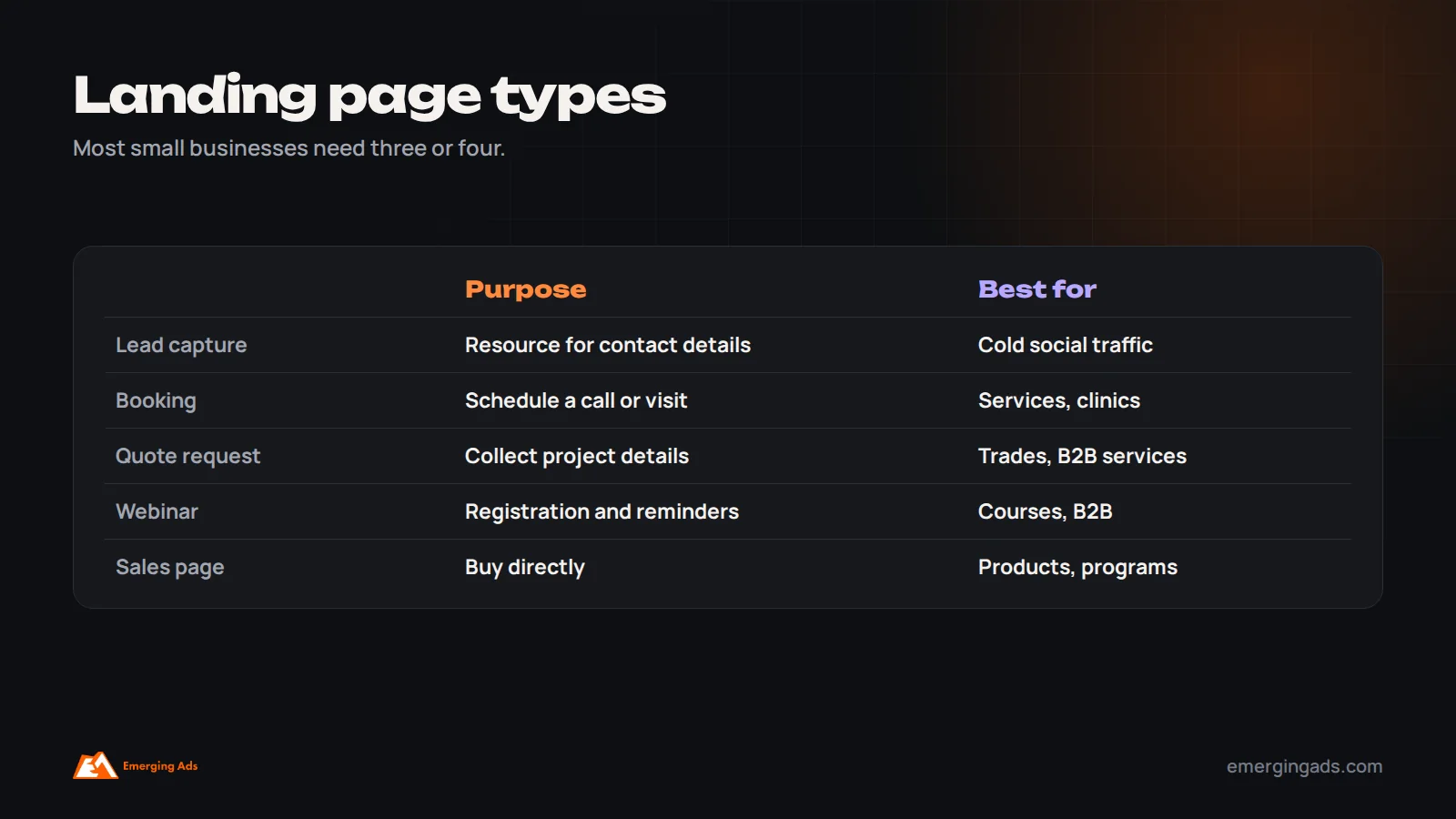
Lead capture pages exchange a useful resource, such as a guide, checklist or quiz result, for contact details. Consultation or booking pages invite visitors to schedule a call, visit or assessment, often with an embedded calendar. Quote request pages collect project details for service businesses. Webinar and event pages handle registration and reminders. Sales pages sell a product, course or package directly, sometimes with checkout built in. Thank-you pages confirm the action and suggest a next step, such as booking a call or following on social media. A good agency builds the right mix for your funnel rather than one generic page.
Landing pages for different small businesses
Clinics and health practices need pages that explain treatments clearly, introduce practitioners with credentials, show reviews, address cost and insurance questions, and make booking easy, while following healthcare advertising rules on claims and testimonials.
Home services and trades need pages that show the service area, response times, pricing guidance or free quotes, before-and-after photos, licenses and guarantees, with click-to-call buttons for urgent jobs.
Coaches, consultants and course creators need pages that tell a story, explain the transformation, show testimonials and results, and move visitors toward a call, webinar or purchase. Our guide to coaching business marketing covers the wider strategy.
Real estate and property services need project or service-specific pages with key facts, visuals, location details and quick enquiry options. See our guide to real estate marketing.
B2B service providers need pages that address business problems, show case studies with numbers, explain the process and invite a consultation or demo.
Local retail and hospitality businesses use landing pages for promotions, events, reservations and loyalty signups, often linked from social ads and Google Business Profile posts.
Leadpages compared with other landing page options
Leadpages is one of several ways to build landing pages. Others include website builders such as WordPress page builders, Shopify and Wix; dedicated landing page tools such as Unbounce and Instapage; funnel tools such as ClickFunnels and the builders inside all-in-one platforms such as GoHighLevel; and custom-coded pages. Leadpages suits small businesses that want an affordable, easy builder with useful templates and integrations. A good agency will tell you honestly whether Leadpages is the right tool for your needs, or whether your existing website platform or another tool would serve you better, rather than defaulting to whatever it knows best.
Using proof effectively
Visitors arriving from ads are skeptical, especially if they have never heard of your business. Proof reduces that skepticism. The most persuasive forms are specific: reviews that describe a result or experience, testimonials with names and photos where permitted, short case studies with numbers, client logos for B2B, ratings from review platforms, certifications and awards, and photos or videos of real work. Place proof close to the call to action, where visitors decide whether to act, rather than only at the bottom of the page. Generic statements such as “trusted by hundreds of clients” carry far less weight than one specific story.
Designing forms that convert
Forms are where many landing pages lose visitors. Every extra field reduces completion, so ask only for what you need at this stage: often name, email or phone, and one or two qualifying questions. Use clear labels, mobile-friendly field types, and a button that says what happens, such as “Get my free quote” rather than “Submit”. For longer forms, multi-step designs that start with an easy question often perform better than one long form. Explain what happens after submission and how quickly you will respond. If lead quality is a problem, a well-chosen qualifying question usually works better than adding many fields.
An example Leadpages project
Consider a small physiotherapy clinic running Google search ads and Instagram ads. The agency builds two landing pages. The search page targets people looking for sports injury treatment nearby, with a headline about getting back to training, practitioner credentials, patient reviews, insurance information and an embedded booking calendar. The Instagram page targets people who are not yet searching, with a free guide to managing back pain at work and a short form. Both pages connect to the clinic’s email platform: bookings receive confirmations and reminders, and guide downloads start a short nurture sequence ending with a booking invitation. Ad pixels and conversion tracking report bookings and guide downloads separately, so the clinic can see the cost per booked appointment from each channel. Over the following months, the agency tests headlines and form length, and the clinic shifts budget toward the combination that produces the most appointments.
What the first 60 days should look like
A good engagement starts with research into your customers, offers and current pages, followed by copy and design for the highest-priority pages, integration with your email platform or CRM, tracking setup and testing, and launch alongside your ad campaigns. The second month focuses on reviewing results, running the first tests and refining follow-up. By the end of two months, you should know your conversion rates, cost per lead and, ideally, cost per customer for each page and channel.
Pop-ups, alert bars and on-site capture
Leadpages also offers pop-ups and alert bars that can be added to existing websites. Used carefully, they capture visitors who would otherwise leave without acting: an exit pop-up offering a guide, a timed pop-up on a blog post inviting newsletter signup, or an alert bar promoting a limited offer. Used badly, they annoy visitors and hurt conversion. Show them at sensible moments, such as after some scrolling or on exit intent rather than immediately, make them easy to close on mobile, offer something genuinely useful, and avoid stacking several at once. Measure their effect on overall conversion, not just sign-ups.
Selling directly from landing pages
For small businesses selling digital products, courses, consultations or simple product packages, landing pages can include payment options so visitors buy without leaving the page. This shortens the path from ad to purchase. Sales pages need more detail than lead capture pages: a clear description of what is included, who it is for, outcomes, proof, pricing, guarantees and answers to common questions. Make sure payment confirmation emails, access delivery and receipts are set up and tested. For larger catalogs, a proper ecommerce platform is usually better.
Red flags when hiring a landing page agency
Be cautious of agencies that show only design mockups without conversion data, never ask about your customers or offer, reuse the same template copy for every client, do not set up tracking, build pages in their own account rather than yours, promise specific conversion rates before seeing your traffic, or treat the project as finished at launch with no testing. These signs usually mean you will get attractive pages that do not move your numbers.
Working well with your agency
Agencies build better pages when you share what you know. Provide details of your best customers and why they buy, common questions and objections from sales calls, existing reviews and case studies, your pricing and offers, and access to your ad accounts and analytics. Respond quickly to drafts, and judge them on whether they would persuade your customers rather than on personal taste. After launch, share lead quality feedback so the agency can adjust pages and offers. Our landing page design team works this way with small businesses, and we often combine pages with ad management so both sides of the funnel improve together.
AI tools and landing pages
AI tools can now draft landing page copy and layouts quickly, and Leadpages and similar platforms include AI features. They are useful for generating variations to test and speeding up first drafts. They do not replace understanding of your customers, offer strategy, proof and follow-up, which are what make pages convert. A good agency uses AI to work faster while grounding copy in real customer research and testing results.
Message match in practice
Message match means the landing page continues the exact conversation the ad started. If a Google ad promises “same-day boiler repair in Leeds”, the page headline should repeat that promise, show the Leeds service area and make calling easy. If a Facebook ad shows a specific product with a discount, the page should show the same product and offer immediately. Mismatches, such as an ad about one service leading to a general homepage, make visitors work to find what they came for, and most will not bother. For small businesses running several campaigns, this usually means a handful of focused pages rather than one page for everything. Leadpages makes it straightforward to duplicate a page and adjust the headline, images and offer for each campaign.
Measuring lead quality, not just quantity
A page that doubles form submissions is only a success if the extra leads become customers. Shorter forms, softer offers and aggressive pop-ups can all increase submissions while lowering quality. Track what happens to leads after they arrive: how many answer the phone or reply, how many book, and how many buy. Compare cost per customer, not cost per lead, when judging pages and tests. Sending these outcomes back to ad platforms, where possible, also helps campaigns find more people like your real customers rather than people who simply fill in forms.
Accessibility and trust
Accessible pages work better for everyone. Use readable font sizes and strong color contrast, descriptive button labels, alt text on important images, form labels that screen readers can understand and layouts that work when zoomed. Include basic trust information, such as your business name, contact details, privacy policy and, where relevant, licenses or registration numbers. Small details like a real address or phone number reassure visitors who have never heard of you, especially on pages reached from social media ads.
Making the decision
When comparing agencies or freelancers for Leadpages work, look past the portfolio. Ask which one understood your customers and offer best, which showed real conversion results rather than just designs, which will connect every page to follow-up and tracking, and which plans to keep testing after launch. A partner who does well on those points will usually turn Leadpages from a page builder into a dependable source of customers.
Keeping pages current
Landing pages need upkeep. Offers expire, prices change, testimonials age, integrations break and seasonal campaigns end. Review live pages every month: check that forms still deliver leads to the right place, that offers and dates are current, that tracking still fires, and that pages still load quickly. Retire pages that no longer receive traffic, and update the best performers with fresh proof and improvements from testing. Pages that stay accurate and current keep converting long after launch.
How to evaluate a Leadpages agency
- Conversion results: examples of pages with before-and-after conversion rates or cost per lead, not just screenshots.
- Copywriting skill: many page builders design well but write weakly. Ask who writes the copy.
- Understanding of your customers: do they ask about your audience, offer and objections?
- Integration experience with your email platform, CRM and booking tools.
- Tracking setup: analytics, ad pixels and conversions configured and tested.
- Testing approach: how they decide what to test and how they measure results.
- Ownership: pages built in your Leadpages account, which you own.

Does a local agency matter?
Many small businesses search for a Leadpages agency near them, but proximity is rarely the deciding factor.
Landing page work is almost entirely remote, so expertise matters more than location. A local agency can help if you serve a specific area and want pages that reflect local language, landmarks and customer expectations, or if you value in-person workshops. For most small businesses, a specialist with strong conversion results and clear communication is the better choice, wherever they are based.
Matching pages to your ads
Landing pages and ads work as a pair. A page built for people who searched “emergency plumber” should talk about fast response and availability; a page for people who clicked a Facebook ad about bathroom renovations should show finished bathrooms and explain the process. When the headline and offer match the ad, visitors stay; when they do not, they leave. Good agencies build separate pages, or dynamic variations, for each major campaign or keyword group. On Google Ads, better landing page experience can also improve Quality Score and lower costs. Our guides to lowering Google Ads CPA and lowering cost per click explain the connection.
Follow-up decides results
A landing page that captures leads but sends them to an inbox nobody checks is a waste. Make sure every form submission goes into your email platform or CRM, triggers an immediate confirmation, notifies the right person, and starts a follow-up sequence. For service businesses, a quick call or WhatsApp message within minutes dramatically improves conversion to appointments. Our article on CRM automation mistakes covers the details.

How Leadpages agencies charge
Pricing usually reflects how much strategy, copywriting and testing is included, not just the number of pages built. A cheaper quote that skips research, copy and tracking often costs more in wasted ad spend.
- Per page: a fee for each landing page, often with tiers for complexity.
- Project packages: several pages, integrations and tracking together.
- Monthly retainers: ongoing page creation, testing and optimization, often alongside ad management.
The Leadpages subscription is billed separately. Compare quotes on what is included, especially copywriting, integrations, tracking and testing. Our guide on agency pricing covers how to judge value.
Testing to improve conversion
Even small improvements in conversion rate lower your cost per lead across every campaign that sends traffic to the page.
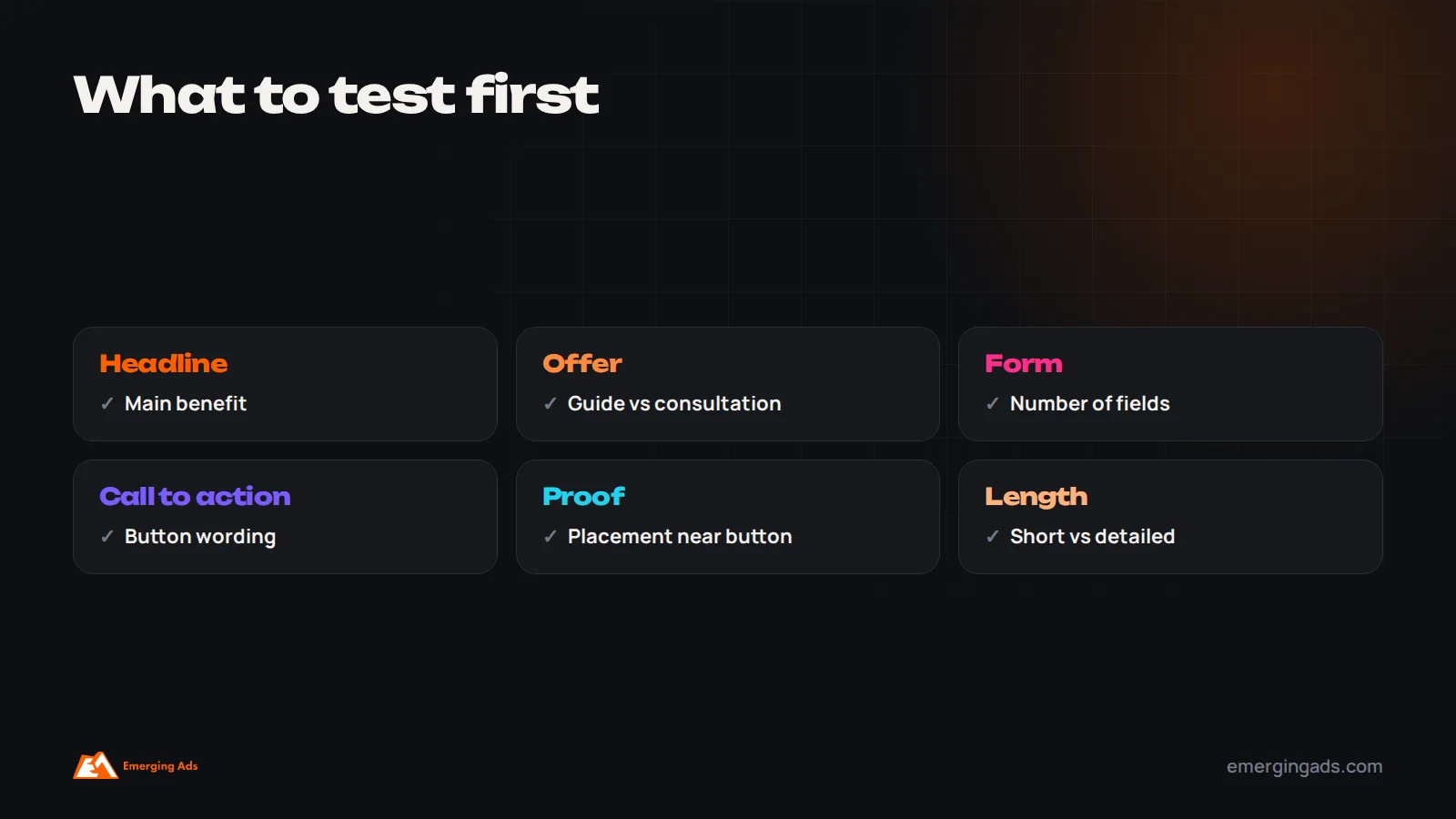
The first version of a page is a starting point. Test the elements most likely to change results: headline and main benefit, offer, such as a free consultation versus a guide, form length and fields, call to action wording, proof placement and page length. Leadpages supports split testing on some plans. Run one test at a time with enough traffic to reach a clear result, and judge on leads and, ideally, customers rather than form submissions alone.

Common mistakes
These are the problems we see most often on small business landing pages.
- Using a template unchanged, with generic copy.
- One page for every ad and audience.
- Long forms that ask for everything at once.
- No proof near the call to action.
- Leads not connected to follow-up.
- No conversion tracking for ads.
- Never testing after launch.
Frequently asked questions
What does a Leadpages agency do?
It plans offers, writes copy, designs and builds landing pages, connects forms to email and CRM tools, sets up tracking and tests pages to raise conversion rates.
How do I choose a Leadpages agency for my small business?
Look for conversion results, strong copywriting, understanding of your customers, integration and tracking experience, a testing approach and pages built in your own account.
Does the agency need to be local?
Not usually. Conversion expertise matters more than location, though local knowledge helps for area-based businesses.
How much does a Leadpages agency cost?
Agencies charge per page, per project or monthly. The Leadpages subscription is separate. Compare quotes on copy, integrations, tracking and testing included.
What makes a landing page convert?
One clear goal, a headline matching the ad, a short explanation, proof near the call to action, a simple form, answers to objections and fast mobile loading.
Should I have different pages for different ads?
Yes, for major campaigns and keyword groups. Pages that match the ad’s message convert better and can improve ad quality scores.
Can Leadpages connect to my CRM?
Leadpages integrates with many email platforms and CRMs directly or through integration tools. Make sure every lead triggers follow-up.
How do I measure landing page success?
Track conversion rate, cost per lead, lead quality and, ideally, cost per customer from each page and campaign.