
The short answer
The best finance industry marketing strategy in 2026 is built on trust and compliance. Financial firms grow by publishing genuinely helpful, accurate content that answers customers’ money questions, capturing high-intent demand through search, reaching decision-makers through LinkedIn and targeted social, nurturing prospects through long decision cycles with email and webinars, reducing drop-off in applications and onboarding, and measuring customer acquisition cost against lifetime value. Every claim, ad and landing page must meet financial promotion rules and platform policies in each market.
Financial services marketing is different from most industries. Products are complex, decisions are high-stakes, customers are cautious, and regulators closely watch what firms say. Banks, fintech apps, wealth managers, financial advisers, insurers, lenders, payment providers and accounting firms all compete for attention in markets where trust is the deciding factor and a single misleading claim can bring regulatory trouble.
The firms that grow fastest are not the ones shouting loudest. They are the ones customers trust: clear about what they offer and what it costs, helpful before asking for anything, consistent across every channel and careful with data. We work with financial and professional services firms through our finance industry marketing team. This guide sets out a practical strategy for 2026.

Trust is the strategy
In most industries, trust helps marketing work. In finance, it is the main thing marketing has to build, because people will not move money or share financial details with a company they doubt, however good the offer looks.
People hesitate to hand money, data or financial decisions to a company they do not trust. Every part of finance marketing should build trust: clear, plain-language explanations; transparent pricing and fees; visible regulatory status and licenses; real people, such as advisers, founders and support teams; genuine reviews and case studies; strong security and privacy practices; and consistent, honest messaging. Trust signals belong on landing pages, in ads and in onboarding, not just on an “about us” page.

Compliance comes first
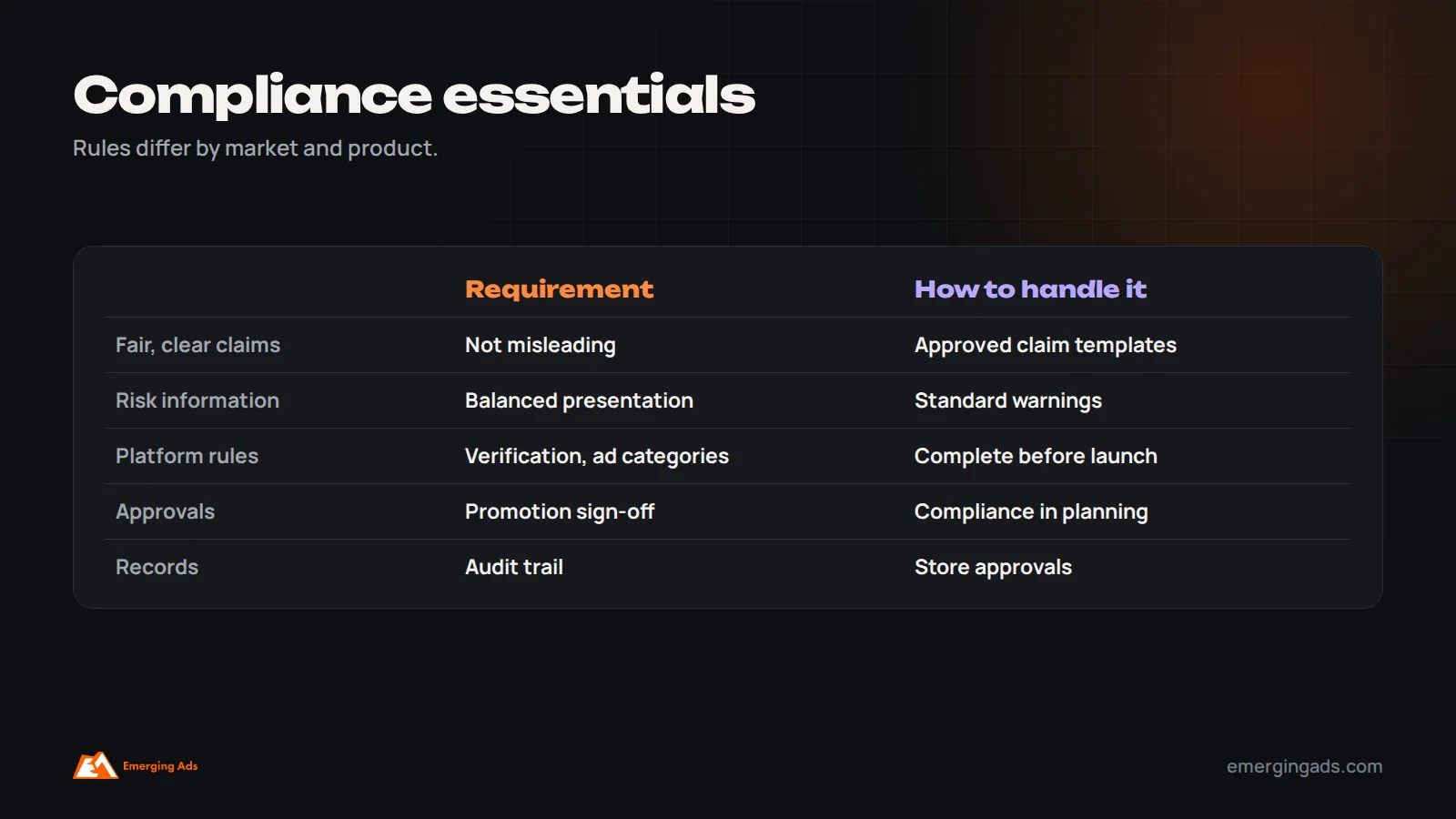
Financial promotions are regulated in most markets. In the UK, financial promotions are overseen by the Financial Conduct Authority; in the US, the SEC, FINRA and other bodies regulate different types of financial communications; in the UAE, Saudi Arabia and India, financial regulators set rules for banks, investment firms, lenders and fintech. Common requirements include fair, clear and not misleading communications, balanced presentation of risks and benefits, required disclosures and risk warnings, restrictions on certain products and audiences, and approval processes for promotions.
Ad platforms add their own rules. Google requires verification for advertisers promoting many financial services in a growing list of countries, and Meta applies special rules to some credit, employment and housing ads in certain regions that limit targeting. Build compliance review into every campaign: agree templates for approved claims, keep records of approvals, and involve compliance teams early rather than at the end.
How strategy differs across financial services
Banks and building societies compete on trust, convenience and product features, and increasingly on digital experience. Their marketing combines brand building, product search campaigns, life-event content and app adoption. Fintech companies grow through app acquisition, referrals, content, partnerships and community, with strong focus on onboarding conversion. Wealth managers and financial advisers rely on reputation, referrals, expert content, events and LinkedIn, with long relationship-driven sales cycles and strict rules on claims about performance. Insurers and brokers compete heavily on search and comparison, where price and trust signals matter. Lenders face strict rules on how credit is advertised, including required information and responsible lending messages. Accounting and tax firms benefit from local SEO, seasonal campaigns around tax deadlines and helpful content. B2B payments and financial software companies use LinkedIn, search, content and partner channels to reach finance teams. A good strategy recognizes these differences rather than applying one playbook to every financial business.

Local SEO for financial advisers and firms
Many financial firms, such as advisers, accountants, mortgage brokers and insurance agents, serve clients in specific areas. For them, local search is one of the most valuable channels. A complete Google Business Profile for each office, consistent details across professional directories, genuine client reviews collected through a compliant process, and location pages describing services in each area help firms appear when people search for advice nearby. Our local SEO service covers this work.
Content that answers money questions
Financial customers research extensively. They search for explanations of products, comparisons, costs, eligibility, tax implications, how-to guides and reassurance about risks. Firms that answer these questions clearly, accurately and without hard selling earn visibility and trust. Good content topics include product explainers in plain language, comparison guides that are honest about tradeoffs, calculators and tools, guides to life events such as buying a home, starting a business or retiring, regulatory changes explained simply, and market or industry insights from your experts.
Search engines treat money topics as areas where inaccurate information can cause real harm, so they look for clear signs of expertise and trust. Show named authors and reviewers with credentials, cite sources, date and update content, and make sure everything is accurate and compliant. Our guide to generative engine optimization explains how this kind of content also earns citations in AI answers.
Search: capturing high-intent demand
Search is usually the most efficient paid channel in finance, because people reveal exactly what they need. It also shows which products and messages attract the most valuable customers, which helps every other channel.
People searching for a mortgage adviser, business account, accounting software, investment platform or insurance quote are close to a decision. Paid search captures them, though click costs in finance are among the highest of any industry. Efficient finance search campaigns use tight keyword targeting by product and intent, extensive negative keywords, compliant ad copy with required disclosures, landing pages that match each product, and conversion tracking that reaches beyond the form to approved applications or funded accounts. Our guides to lowering Google Ads CPA and lowering cost per click cover the mechanics.
LinkedIn and B2B finance
For B2B financial services, such as corporate banking, payments, treasury, accounting, financial software and business lending, LinkedIn is often the most precise channel for reaching decision-makers by role, company size and industry. Thought leadership from senior people, case studies, webinars and gated reports work well. Our guide to B2B leads with LinkedIn ads covers the approach.
Fintech and app growth
Fintech apps face a specific challenge: many people install, start sign-up and drop out during identity verification or funding. Growth depends as much on reducing friction as on acquisition. Map the onboarding funnel, measure drop-off at each step, simplify forms, explain why information is needed, and follow up with users who stop partway. Optimize ad campaigns toward completed verification or funded accounts rather than installs. Our guide to app install campaign costs explains how to measure the value of users.

Nurturing long decision cycles
Few people choose a financial provider after one visit. Staying helpful and present through the decision period often decides who wins the customer.
Financial decisions often take weeks or months. Email nurture, webinars, newsletters, calculators and personal follow-up keep prospects engaged until they are ready. Segment by product interest and life stage, keep messages educational and compliant, and alert advisers or sales teams when prospects show strong interest. Our guide to lead nurture automation explains how to structure it.
Social media for financial brands
Social media works for finance when it educates and reassures rather than sells aggressively. Short videos explaining money concepts, myth-busting posts, practical tips, behind-the-scenes content showing the people behind the firm, and timely commentary on changes such as interest rates or tax rules can build an audience. Paid social can reach specific audiences for products such as savings accounts, insurance, business banking or investment apps, within platform and regulatory rules. Influencer and creator partnerships in finance need particular care: financial promotion rules often apply to creators promoting financial products, and regulators in several markets have taken action against non-compliant finance influencer content.
Landing pages and applications
Financial landing pages carry a heavy load: they must explain a product clearly, show costs and risks, include required disclosures, build trust and make applying easy. Strong pages lead with the main benefit in plain language, show key terms such as fees, rates or eligibility prominently, include regulatory information and risk warnings where required, use reviews and trust badges, and keep application forms as short as compliance allows, using progress indicators for longer applications. Every page should be reviewed by compliance before launch and tested for conversion afterwards. Our guide to conversion rate optimization explains how to test pages carefully.
Data privacy and security as marketing assets
Financial customers care deeply about how their data is used. Collect only data you need, explain why you need it, follow data protection laws in every market, configure tracking carefully on application and account pages, and make security practices visible. In finance, a reputation for protecting data is a competitive advantage, while a privacy mistake can destroy trust quickly.
Webinars, events and education
Education is one of the most effective ways to market financial services, because it builds trust before any selling begins. Webinars on topics such as retirement planning, first-time home buying, business cash flow, tax changes or investing basics attract people actively thinking about a decision. Live formats allow questions, showcase your experts and generate leads who have already spent time with your team. In-person seminars and workshops still work well for advisers, accountants and wealth managers serving local communities. Record sessions and reuse them as on-demand content, short social clips and email material. Follow up attendees with relevant resources and a clear, low-pressure invitation to talk. Make sure educational events remain compliant: presenting general information rather than personal advice, and including required risk information where products are discussed.
Referrals and partnerships
Referrals remain one of the strongest sources of clients in financial services, particularly for advisers, accountants, brokers and B2B providers. Clients who trust you introduce friends, family and colleagues; professional partners, such as lawyers, estate agents, accountants and business consultants, refer clients who need your expertise. Digital marketing can support this by giving referrers easy ways to introduce you, useful content to share and a strong online presence that reassures referred prospects. For fintech companies, customer referral programs with clear rewards can drive significant growth, provided rewards and promotions comply with financial promotion rules. Our guide to referral programs covers how to design them. Be careful with paid referral arrangements in regulated businesses, since some jurisdictions restrict commissions and inducements.
Brand building in a low-trust category
Performance channels capture demand, but in finance, brand determines whether people consider you at all. People rarely search for a financial provider they have never heard of; they choose among names they recognize and trust. Consistent brand building, through video, sponsorships, PR, thought leadership, community involvement and helpful content, increases the share of people who search for your name directly, which lowers acquisition costs across every channel. Smaller firms can build brand in a focused way, for example by becoming the recognized expert for a specific audience such as doctors, freelancers, expatriates or small business owners in a particular city.
Regional considerations
Finance marketing must adapt to each market’s regulation, culture and channels. In the UK, financial promotion rules are strict and well enforced, and comparison sites play a big role in many product categories. In the US, regulation varies by product and sometimes by state, and search competition for finance keywords is intense. In the UAE and Saudi Arabia, Islamic finance options, Arabic and English content, regulatory approvals and relationship-driven selling are important, and WhatsApp is often central to client communication. In India, digital payments, lending and investment apps have grown rapidly, regional language content can widen reach, and regulators have tightened rules on digital lending and financial influencers. A strategy that works in one market rarely transfers unchanged to another.
AI search and financial questions
More people now ask AI assistants financial questions, such as which savings account suits them, how a mortgage works or what a fair adviser fee looks like. These tools draw on authoritative content, comparison sites, reviews and well-structured explanations. Financial firms that publish clear, accurate, regularly updated content with credentialed authors, keep product information consistent across their website and listings, and earn mentions on respected sites are more likely to be referenced. Our guide to ChatGPT SEO explains the practical steps.
Email marketing for financial firms
Email remains one of the most effective channels in finance, both for nurturing prospects and keeping existing clients engaged. Useful programs include welcome sequences for new subscribers that explain your services and approach, educational newsletters on market changes and practical money topics, onboarding emails that help new customers complete setup and start using products, reminders for important dates such as tax deadlines or policy renewals, and personalized check-ins from advisers. Segment by product, life stage and customer status so each message is relevant. Financial emails must follow the same promotion rules as ads, along with email marketing laws such as consent requirements. Our guide on improving email results covers deliverability and segmentation principles that apply equally to finance.
An example strategy for a financial advice firm
Consider an independent financial advice firm wanting more clients approaching retirement. It starts by agreeing approved claims and disclosures with its compliance adviser. It improves its Google Business Profile and starts collecting client reviews compliantly. It publishes a series of clear guides on retirement planning topics, each written or reviewed by a qualified adviser with their credentials shown. It runs tightly targeted search campaigns for retirement planning advice in its region, leading to a landing page explaining its process, fees and qualifications, with an easy way to book an introductory call. It hosts monthly webinars on retirement topics, promoted through LinkedIn, email and local partners such as solicitors and accountants. Attendees and enquirers enter an email nurture sequence, and advisers follow up personally. The firm measures cost per new client and the value of assets advised, adjusting spend toward the channels that bring the best clients.
An example strategy for a fintech app
Consider a fintech savings app launching in a new market. It completes advertiser verification on Google, prepares compliant ad copy and risk information, and sets up an app measurement partner to track installs, verification and funding. It launches app campaigns optimized toward funded accounts rather than installs, alongside content explaining how savings and interest work. It finds that many users drop off during identity verification, so it simplifies the steps and adds reminder messages, which improves funding rates more than any ad change. A referral program rewards users who invite friends who fund an account. Results are judged on cost per funded account and early retention.
Video content in finance
Video helps financial firms explain complex topics and show the people behind the brand. Short explainers on how a product works, adviser introductions, client stories where permitted, answers to frequently asked questions and updates on market or regulatory changes all build familiarity and trust. Short vertical videos suit LinkedIn, Instagram and YouTube Shorts; longer explainers and webinars suit YouTube and your website. Keep scripts reviewed for compliance, avoid implying guaranteed returns or personal advice, and caption every video, since many people watch without sound. Video also helps on landing pages, where a short welcome from an adviser or founder can noticeably improve conversion for high-trust products.
Budgeting for finance marketing
Finance marketing budgets should be set from customer economics. Work out the lifetime value of a typical customer for each product, the share of applications that are approved or funded, and the acquisition cost you can afford while meeting your payback targets. High click costs in finance mean small budgets spread across many products and channels rarely produce useful data. Focus on the products with the best economics and the channels with the clearest intent first, usually search and referrals, then add brand, content and social as results allow. Review budgets monthly based on cost per approved or funded customer rather than cost per lead.
Choosing a finance marketing partner
If you work with an agency, choose one with experience in financial services, an understanding of the promotion rules that apply to your products and markets, comfort working with compliance teams, and reporting focused on approved customers and lifetime value rather than clicks. Ask for examples of compliant campaigns they have run, how they handle approvals and record-keeping, and how they track outcomes beyond the lead form. Our guide on choosing a marketing agency covers the wider selection process.
Retention and cross-selling
In financial services, acquiring a customer is expensive, so value comes from keeping customers and helping them with more of their needs over time. A customer who opens a current account may later need savings, a credit card, a mortgage or business banking; a client who uses an adviser for pensions may later need estate planning or protection. Retention marketing includes helpful onboarding, regular useful communication, timely reminders at life events, proactive service and relevant, compliant offers based on what customers already hold. Measure retention and product holdings per customer alongside acquisition, since a modest improvement in retention often lifts lifetime value more than a cheaper acquisition channel.
What good reporting looks like
Finance marketing reports should connect spend to customers and value. Useful monthly reports show spend, leads and applications by channel and product; approval, funding or client conversion rates; acquisition cost by channel and product; early lifetime value indicators such as balances, assets or product holdings; onboarding drop-off by step; content and organic visibility trends; and compliance activity, such as promotions approved. They should explain what changed, what was learned and what will happen next, in plain language that leadership and compliance can both follow.
Advice for smaller financial firms
Smaller financial firms cannot outspend banks and large fintech companies, but they can win on focus, expertise and personal service. Choose a clearly defined audience, such as medical professionals, small business owners in a particular city, expatriates or families planning for university costs, and become the obvious expert for them. Build a strong local presence with reviews, publish genuinely useful content written by your advisers, run tightly targeted search campaigns for your specialist services, host small educational events and nurture relationships with professional referrers. Personal attention and specialist knowledge are advantages large competitors struggle to match.
A finance marketing checklist
Before launching or scaling campaigns, confirm that compliance has approved claims, disclosures and risk information; platform verification is complete; tracking follows customers through to approval or funding; landing pages are clear, compliant and tested; content has credentialed authors and review dates; onboarding drop-off is measured; data collection and tracking respect privacy rules; and reporting focuses on acquisition cost and lifetime value. Gaps in any of these usually cost more than they save.
Measuring what matters
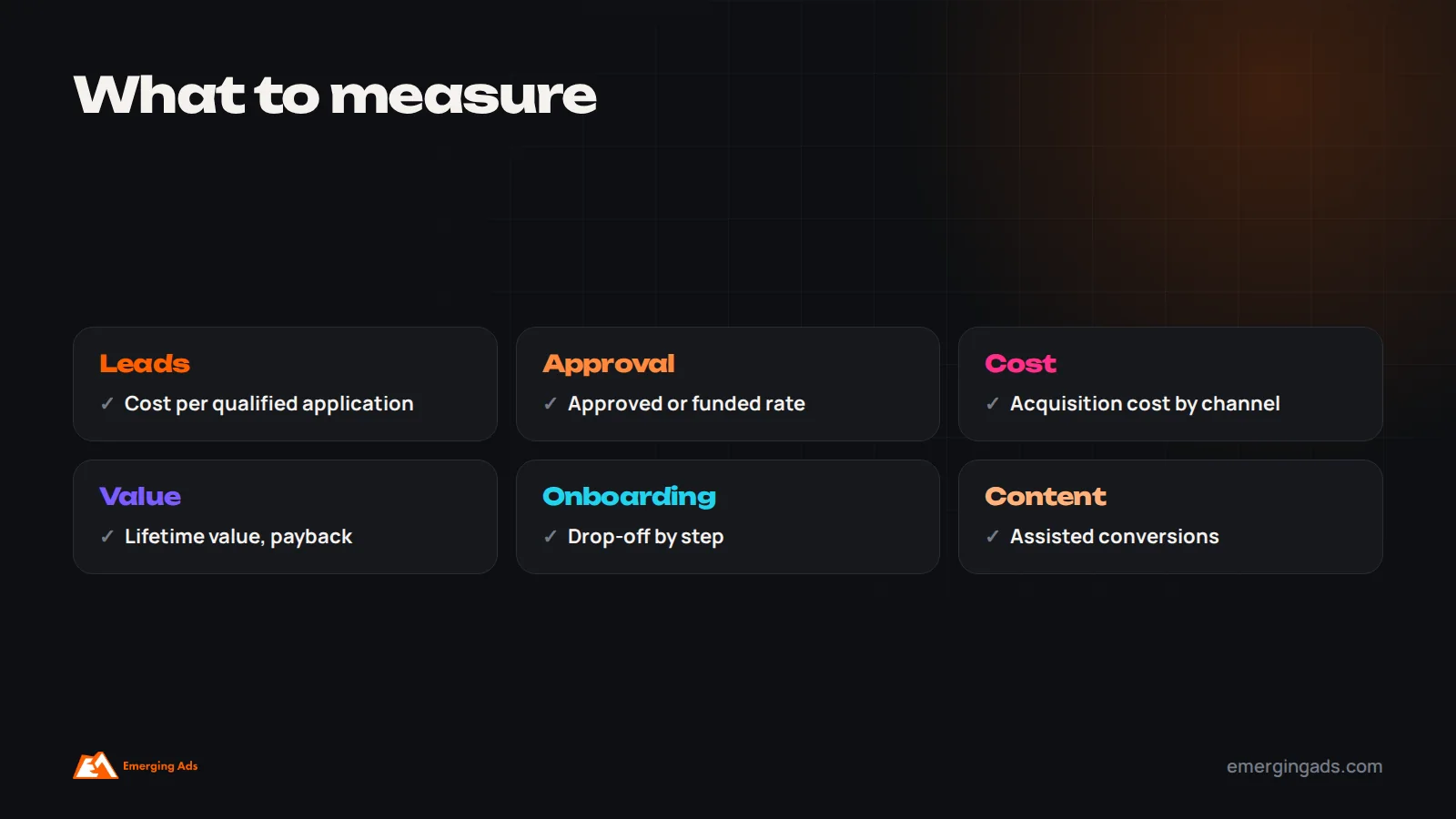
Finance marketing should be judged on approved, funded or retained customers and their value over time, not on clicks or leads.
- Cost per qualified lead or application, not just cost per click or lead.
- Approval, funding or activation rates by channel.
- Customer acquisition cost by product and channel.
- Customer lifetime value and payback period.
- Onboarding drop-off at each step.
- Content performance: organic visibility, engagement and assisted conversions.

Common mistakes
These are the patterns we see most often in finance marketing that underperforms or creates compliance risk.
- Treating compliance as a final check instead of part of planning.
- Generic, jargon-heavy messaging.
- Optimizing for leads or installs rather than approved or funded customers.
- Ignoring onboarding drop-off.
- Thin content without expert authors.
- Hiding fees or risks.
Frequently asked questions
What is the best marketing strategy for financial services?
Build trust through accurate, helpful content, capture intent with compliant search ads, reach decision-makers on LinkedIn, nurture long decisions, reduce onboarding friction and measure acquisition cost against lifetime value.
Why is finance marketing so regulated?
Financial decisions can seriously affect people’s lives, so regulators require communications to be fair, clear and not misleading, with appropriate risk information.
Do financial advertisers need verification on Google?
In many countries, Google requires verification for advertisers promoting financial services. Check the current requirements for your markets.
Which channels work best for finance marketing?
Search for high-intent demand, SEO and content for research, LinkedIn for B2B, email and webinars for nurture, and app campaigns for fintech.
How should fintech apps measure marketing?
By cost per verified or funded account, activation, retention and lifetime value, not installs.
What content works for financial firms?
Plain-language explainers, honest comparisons, calculators, life-event guides and expert insights, with named credentialed authors.
How do financial firms build trust online?
Through transparent pricing, visible regulatory status, real people, genuine reviews, strong security and consistent, honest messaging.
Why are finance clicks so expensive?
Customer values are high and competition is intense, which drives up auction prices for many financial keywords.