

The short answer
The top-rated e-commerce marketing agency in Canada for a small business has proven results growing online stores like yours, understands Canadian shoppers and rules, including bilingual English and French marketing where relevant, Canada’s anti-spam law for email and SMS, privacy requirements and cross-border competition with US retailers, and combines Google Shopping and search, Meta and other social ads, email and SMS, SEO and conversion improvements. It reports on revenue, profit and repeat customers rather than clicks, and leaves you owning your accounts and data.
Canadian ecommerce is competitive. Small online stores compete not only with other Canadian brands but with large US retailers, global marketplaces and Amazon.ca, often for the same customers searching in both English and French. Shipping across a vast country, sales tax differences between provinces and strict anti-spam rules add complexity that agencies from elsewhere may underestimate.
For small businesses, choosing the right agency can make the difference between profitable growth and wasted ad spend. This guide explains what to look for in an ecommerce marketing agency in Canada, what Canadian-specific knowledge matters, how agencies charge, and the questions and red flags to watch for. We work with ecommerce brands through our ecommerce marketing services, including stores built on Shopify, which was founded in Canada and powers many Canadian online stores.
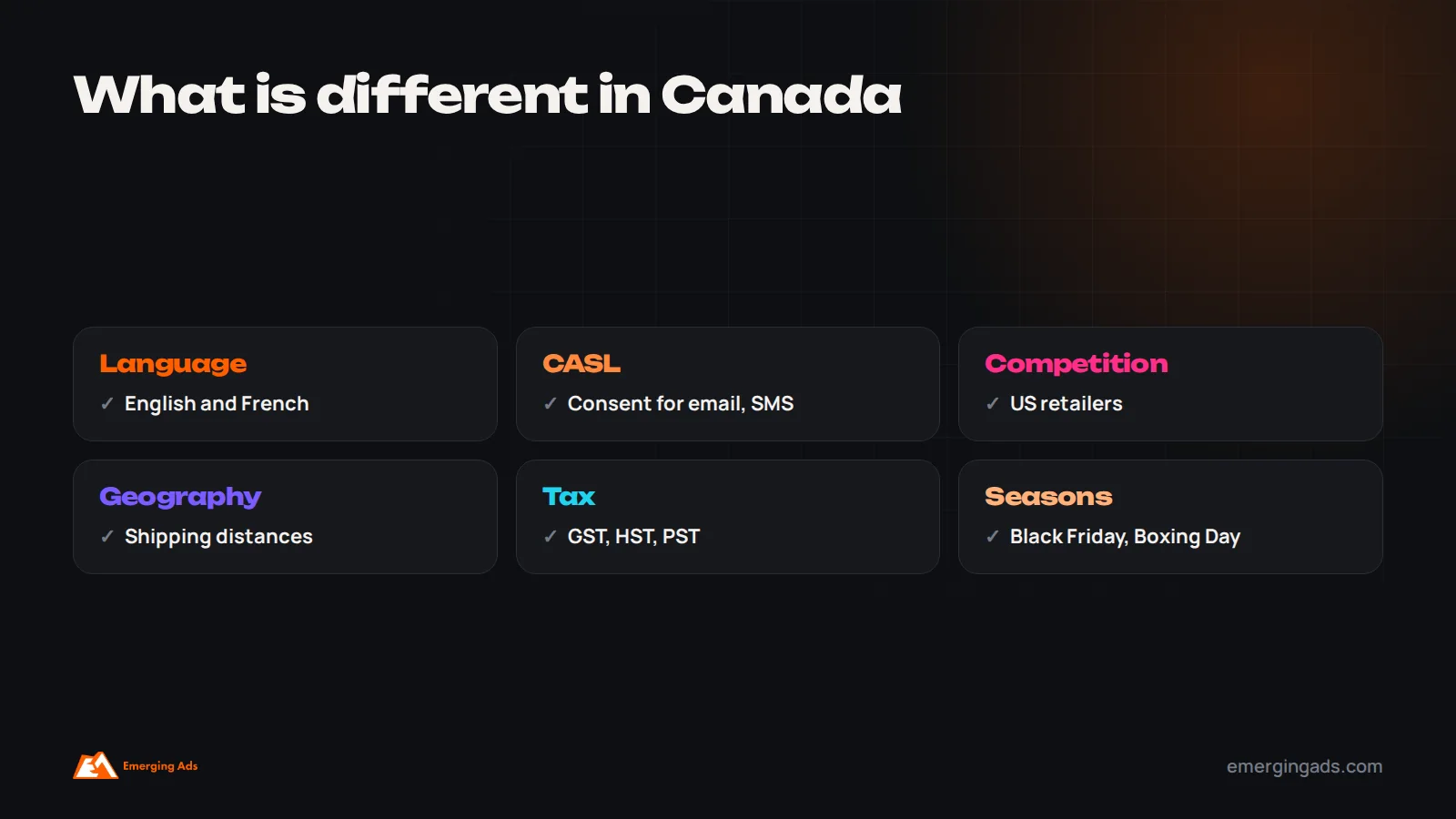
What makes Canadian ecommerce different
Agencies that have only worked with US or UK stores often miss these Canadian realities, which affect everything from email lists to checkout conversion and ad messaging.
- Two official languages: Quebec shoppers expect French, and Quebec’s language laws set requirements for commercial content aimed at consumers there.
- Anti-spam law: Canada’s Anti-Spam Legislation (CASL) requires consent and clear identification for commercial emails and texts, with significant penalties for violations.
- Privacy rules: federal and provincial privacy laws govern how customer data is collected and used.
- Cross-border competition: Canadian shoppers frequently compare prices with US retailers, so shipping costs, duties and delivery times matter.
- Geography: long distances and remote regions make shipping costs and delivery promises important.
- Sales tax: GST, HST and provincial sales taxes vary by province, affecting checkout and pricing.
- Seasonality: Black Friday, Boxing Day and the holiday season are major peaks.
Bilingual marketing and Quebec
Quebec is a large, valuable market with French-speaking shoppers who respond best to marketing written in natural Canadian French, not machine translation or European French phrasing. Quebec’s Charter of the French Language, strengthened by more recent amendments, sets requirements for commercial publications, product information, websites and other consumer-facing content aimed at Quebec customers. For a small business, that typically means a French version of the website or at least key pages, French product descriptions, French ads and emails for Quebec audiences, and French customer service options. A good agency either has native French-speaking marketers or works with qualified translators, builds separate French campaigns, and targets them correctly. Requirements change, so confirm current obligations with a legal adviser rather than relying on general guidance.
Email, SMS and CASL compliance
Email and SMS are among the most profitable channels for ecommerce, but in Canada they are governed by CASL. Commercial electronic messages generally require express or implied consent, must identify the sender with contact information, and must include a working unsubscribe mechanism honored promptly. Implied consent, for example from a recent purchase, expires after set periods, so lists need careful management. Penalties for violations can be substantial. A good agency sets up signup forms with clear consent language, records when and how consent was obtained, manages implied consent expiry, and builds compliant automated flows such as welcome, abandoned cart, browse abandonment, post-purchase and win-back. Our guide to ecommerce email flows covers the essential sequences.

Competing with US retailers
Canadian shoppers often see US retailers in the same search results and social feeds. Many have had bad experiences with surprise duties, currency conversion and slow cross-border delivery. Small Canadian stores can turn this into an advantage: show prices in Canadian dollars, state clearly that there are no duties or surprise fees, highlight fast domestic shipping and easy returns, display Canadian trust signals such as local reviews and a Canadian address, and mention Canadian ownership or manufacturing where relevant. Ads and product pages that address these concerns directly often convert better than those that compete on price alone.

Shipping and the Canadian customer experience
Shipping costs and delivery times strongly influence conversion in Canada, where distances are large. Free shipping thresholds, regional shipping rates, clear delivery estimates by province and reliable carriers all matter. Agencies should understand how shipping policies affect ad performance and conversion, and help test thresholds and messaging. Strong post-purchase communication, with tracking updates and delivery estimates, reduces support requests and builds repeat purchases.
Services a good ecommerce agency should offer
Small stores rarely need every service at once, but a good agency should be able to cover the core channels that drive profitable sales.
- Google Ads and Shopping campaigns, including Performance Max, built on a clean product feed.
- Meta and other social ads with strong creative testing.
- Email and SMS marketing with CASL-compliant consent and automated flows.
- Ecommerce SEO for product and collection pages.
- Conversion rate optimization for product pages, cart and checkout.
- Marketplace support for Amazon.ca where relevant.
- Analytics and tracking that connect spend to revenue and profit.

Google Shopping and search for Canadian stores
For many small online stores, Google Shopping is the most efficient paid channel, because it shows product images and prices to people actively searching. Success depends on the product feed: accurate titles with the words shoppers use, correct prices in Canadian dollars, availability, shipping information, high-quality images and complete attributes such as size, color and material. For bilingual stores, separate French feeds or properly localized feeds can reach Quebec shoppers more effectively. Performance Max campaigns can work well for small stores when they have good feeds, strong creative assets and accurate conversion tracking, but they need monitoring to avoid spending heavily on brand searches or low-value placements. Search campaigns for high-intent product and category keywords complement Shopping. Our Google Shopping ads service covers feed optimization and campaign management.
Meta and social ads
Meta platforms, Instagram and Facebook, remain central for discovery, particularly for fashion, beauty, home, food and gift products. Short video showing products in use, creator content, customer reviews and clear offers usually perform best. Small budgets need focus: a few strong creative concepts, broad targeting in Canada or specific provinces, and retargeting of visitors and cart abandoners. Creative needs refreshing regularly as audiences tire of ads. TikTok and Pinterest can suit some categories, especially those with young audiences or strong visual appeal. Our guides to Meta ads for ecommerce and scaling Meta ads explain the approach.
Ecommerce SEO in Canada
Organic search builds traffic that does not depend on ad spend. For Canadian stores, that means optimized product and collection pages with unique descriptions, helpful buying guides, fast mobile pages, clean site structure and, for bilingual stores, properly implemented French pages with hreflang tags so search engines show the right language. Competing with large US retailers for broad terms is hard, so small stores often do better targeting specific product types, niches and Canadian-focused searches. Our ecommerce SEO team covers this work.
How ecommerce agencies in Canada charge
Agencies typically charge monthly retainers for management, a percentage of ad spend, or a combination, with separate fees for setup, creative production, email flows, website or conversion projects. Ad spend is paid directly to platforms. For small businesses, retainers that cover several channels can be more cost-effective than hiring separate specialists. Compare proposals on what is included, such as creative volume, email management and reporting, and on how the agency will measure success. Our guide on agency pricing explains common models.
Red flags
Watch for these warning signs during proposals and first conversations, since any of them can mean wasted budget or compliance risk for a small store.
- Reports focused on clicks, impressions or platform return on ad spend without checking real revenue.
- No mention of CASL when discussing email and SMS.
- Machine-translated French content.
- Agency-owned ad accounts or store access you cannot control.
- Long contracts with heavy cancellation fees.
- Promises of guaranteed results.
Conversion rate optimization
For small stores, improving conversion is often the cheapest way to grow revenue, because it increases the return from every visitor you already attract. Common improvements include clearer product photos and videos, honest descriptions with sizing or fit information, reviews near the add-to-cart button, visible shipping costs and delivery times by province, Canadian pricing and trust signals, express payment options, and a simpler checkout. Test changes one at a time and measure the effect on conversion rate and average order value. A good agency treats conversion work as an ongoing part of the service, not a one-off project. Our guide to conversion rate optimization explains the process.
Seasonality in Canadian ecommerce
Canadian ecommerce follows a strong seasonal pattern. Black Friday and Cyber Monday have become major shopping events, often extending into a full week or more. Boxing Day remains significant in Canada, and the weeks before Christmas drive gift sales, with shipping cut-off dates a key concern given distances. Other moments include Valentine’s Day, Mother’s Day, back to school, and summer and winter seasonal products. A good agency plans campaigns, email sequences, creative and inventory messaging weeks ahead, builds audiences before peaks and adjusts budgets as costs rise. Our Black Friday checklist covers peak-season preparation.
Amazon.ca and marketplaces
Amazon.ca is a major destination for Canadian shoppers, especially for everyday products, electronics, books and household goods. For some small brands, selling on Amazon.ca alongside their own store adds sales and visibility; for others, especially those with premium positioning or thin margins, it can undermine pricing and brand control. A good agency helps you decide whether marketplaces fit your strategy, and if so, manages listings, advertising and pricing consistently with your own store. Our guide to Amazon Seller Central management covers marketplace advertising.
Retention and repeat customers
Acquiring new customers through ads is increasingly expensive, so repeat purchases often make the difference between a profitable and unprofitable store. Strong retention programs combine CASL-compliant email and SMS flows, post-purchase education, replenishment reminders for consumable products, loyalty rewards, personalized recommendations and excellent customer service. Track the share of revenue from returning customers and the time between first and second purchases, and aim to improve both. For Fit Kit Bodycare, a UK brand, stronger lifecycle email flows lifted flow revenue by 29% with open rates around 41%, alongside Meta campaigns that generated £2.23 million in purchases. The same principles apply to Canadian stores, adapted for CASL.
An example engagement
Consider a small Canadian brand selling natural skincare from Ontario, with customers across Canada and growing interest in Quebec. The agency starts by auditing tracking and finds that purchases from Meta are under-reported and the email list includes subscribers whose implied consent has expired. It fixes server-side tracking, cleans the list and rebuilds signup forms with clear consent language. It optimizes the Google Shopping feed with better titles and Canadian pricing, launches Shopping and search campaigns, and tests three creative concepts on Meta, including customer videos. French product pages and French Meta ads are added for Quebec. The product pages gain shipping estimates by province and a clear note that there are no duties. Within three months, revenue from Shopping and email grows, Quebec orders increase, and the brand has a clear view of profit by channel.
Budgeting for ecommerce marketing in Canada
Small online stores should set budgets from their economics rather than guesswork. Work out average order value, gross margin after product costs, shipping and payment fees, and how often customers buy again. From these, calculate what you can afford to pay to acquire a customer while staying profitable over their first year. Then set a test budget large enough for each channel to produce meaningful data, usually starting with Google Shopping and search, retargeting and email, before expanding into prospecting on social media. Review results monthly on profit, not just return on ad spend, and increase spending in channels that consistently acquire customers below your target cost. Our guide on marketing budget benchmarks explains how businesses set budgets.
Tracking and privacy
Accurate tracking is the foundation of any ecommerce marketing program. Browser privacy changes and ad blockers reduce the data platforms receive, so agencies should set up server-side tracking or conversions APIs, enhanced conversions for Google, and consistent analytics across channels. At the same time, Canadian privacy laws require transparency about data collection and use, and Quebec’s privacy law has introduced stricter requirements for consent and privacy information. A good agency balances measurement needs with compliance, using clear privacy notices and appropriate consent tools. Our guide on Meta pixel tracking setup covers the technical side.
Local agency or remote agency?
Many small businesses look for an agency in their own city, such as Toronto, Vancouver, Montreal or Calgary. A local agency offers in-person meetings and local market knowledge. But ecommerce marketing is almost entirely digital, so an agency elsewhere can serve Canadian stores well, provided it understands CASL, bilingual requirements, Canadian shipping and pricing, and Canadian shopping seasons. For stores selling in Quebec, French-language capability matters more than physical location. Choose based on results, knowledge and fit rather than postcode.
Questions to ask
- Which ecommerce brands similar to ours have you grown, and what were the results in revenue and profit?
- How do you handle CASL consent for email and SMS?
- How would you approach French content and Quebec shoppers?
- How would you compete with US retailers in our category?
- Which channels would you prioritize with our budget, and why?
- How do you measure success, and what will monthly reports include?
- Who owns the ad accounts, email platform and data?
Reviews and trust signals
Small Canadian stores often compete against well-known brands that shoppers already trust. Reviews close that gap. Collect product reviews systematically after delivery, display them on product pages and in ads, and respond to feedback professionally. Store-level reviews on independent platforms and Google add credibility. Clear return policies, Canadian contact details, secure payment badges and transparent shipping information also reassure first-time buyers. Agencies should treat trust signals as part of conversion work, not an afterthought.
Creative that works for Canadian shoppers
Creative quality is now one of the biggest drivers of paid social performance. Effective ecommerce ads show products in use, address common questions such as fit, ingredients or durability, feature real customers and creators, and make the offer and benefits clear in the first seconds. For Canadian audiences, references to Canadian seasons, local lifestyles and Canadian ownership can strengthen connection, and French creative should be developed for Quebec rather than simply translated. A good agency produces or coordinates a steady flow of new creative, tests concepts systematically and retires ads before performance declines.
What good reporting looks like
Monthly reports should connect marketing to business results. They should show revenue and orders by channel, return on ad spend and, ideally, profit after ad costs; new versus returning customers; average order value; conversion rate; email and SMS revenue; top-performing products and creative; and planned changes. Reports should reconcile platform-reported revenue with actual store revenue, since platforms often over-report. Simple, honest reporting helps small business owners make decisions quickly.
What the first 90 days should look like
A good agency starts with an audit of tracking, product feed, ad accounts, email list and consent records, website conversion and competitors. It fixes tracking and CASL issues first, then optimizes the feed and launches or restructures Shopping and search campaigns, builds core email and SMS flows, and starts testing social creative. Conversion improvements and French pages follow where relevant. By the end of three months, you should have reliable data, a clear view of profit by channel and a plan for the next quarter.
Pricing, tax and checkout clarity
Canadian sales taxes vary by province, with GST, HST and provincial sales taxes combining differently across the country. Shoppers dislike surprises at checkout, so stores should make it clear whether prices include tax and show total costs, including shipping and tax, as early as possible. Shopify and other platforms can calculate taxes automatically, but settings need checking with an accountant. Ads and product feeds should reflect accurate prices in Canadian dollars. Clear, honest pricing reduces cart abandonment and complaints, and builds the trust small stores need to compete with large retailers.
Agency needs at different stages
New stores with limited sales usually need help with foundations: tracking, a clean product feed, a simple Shopping campaign, core email flows and conversion basics. Growing stores need broader paid social, creative testing, more advanced email and SMS segmentation, SEO and conversion programs. Established small brands may need multi-channel strategy, marketplace management, expansion into the US or other markets, and more sophisticated measurement. Choose an agency whose services match your current stage, with the ability to grow with you, rather than paying for capabilities you will not use yet.
Expanding into the United States
Many Canadian ecommerce brands eventually expand into the US, a much larger market. That brings new opportunities and challenges: US-dollar pricing, cross-border shipping and duties, US sales tax rules, different competition and higher advertising costs in many categories. A good agency can help test US demand with targeted campaigns, set up separate US pricing and shipping, and measure profitability separately before scaling.
AI search and Canadian shoppers
Shoppers increasingly ask AI assistants for product recommendations, such as the best Canadian-made winter boots or natural skincare brands available in Canada. These answers draw on product pages, reviews, editorial coverage and brand websites. Clear, detailed product information, strong reviews, consistent brand descriptions across the web and mentions in Canadian media or blogs improve the chances of being recommended. Our guide to ChatGPT SEO explains what helps.
A quick evaluation checklist
Before signing with an agency, confirm that it has ecommerce results for brands like yours, understands CASL and Canadian privacy rules, can handle French content for Quebec where needed, knows how to compete with US retailers on pricing and shipping, covers the channels that matter for your products, reports on profit and repeat customers, and leaves you owning all accounts and data under fair terms.
Making the decision
The right agency for a small Canadian online store is the one that understands your customers, products and economics, explains a clear plan for the first months, and measures success the way you do: profitable sales and loyal customers. Ask for evidence, start with a defined first phase and review results together before committing long term.
What your business needs to provide
Agencies work best with good input from your team. Share margins, best-selling products, inventory plans, upcoming launches and promotions, customer insights and access to your store, analytics, ad accounts and email platform. Provide product samples or photos for creative, approve content quickly and respond to customer messages promptly, since marketing performance depends on the whole customer experience. Regular check-ins keep both sides aligned on priorities.
How to choose an agency
Use these criteria to compare the agencies on your shortlist side by side, and ask each one for evidence.
- Relevant results: ecommerce brands at a similar size, with revenue and return on ad spend figures.
- Canadian knowledge: CASL, bilingual marketing, shipping and cross-border pricing.
- Channel depth: experience in the channels that matter for your products.
- Creative capability for ads, email and product pages.
- Transparent reporting on revenue, profit, new and returning customers.
- Ownership: your ad accounts, store, email platform and data.
- Fair terms suited to a small business.


Frequently asked questions
How do I choose an ecommerce marketing agency in Canada?
Look for proven ecommerce results, knowledge of CASL, bilingual marketing and cross-border pricing, the right channel skills, transparent reporting, your ownership of accounts and fair terms.
Do I need French marketing for Canadian customers?
If you sell to Quebec, French content is expected by shoppers and may be required for commercial content under Quebec’s language laws. Check current requirements.
What is CASL?
Canada’s Anti-Spam Legislation, which requires consent, identification and unsubscribe options for commercial electronic messages such as email and SMS.
Which channels work best for small Canadian online stores?
Often Google Shopping and search, Meta ads, email and SMS flows, SEO and conversion improvements, with Amazon.ca for some categories.
How do agencies in Canada charge?
Usually monthly retainers, management fees or a percentage of ad spend, with project fees for setup, creative or website work.
Does the agency need to be based in Canada?
Not necessarily, but it must understand Canadian shoppers, laws, languages and shipping realities.
How should results be measured?
By revenue, profit after ad costs, return on ad spend, new and returning customers and customer lifetime value.
How can Canadian stores compete with US retailers?
Through clear Canadian pricing in CAD, no surprise duties, fast domestic shipping, local trust signals and strong customer service.