
The short answer
The top-rated digital marketing agency in the USA for a small business is one with proven results for US small businesses like yours, deep skill in the channels that drive your sales, an understanding of US rules on privacy, email, texting, reviews and endorsements, transparent pricing and reporting, and fair contract terms. Ratings and “best agency” lists are a starting point, not proof. Ask for named case studies with numbers, meet the people who will run your account, compare proposals on scope, and start with a defined first phase of around 90 days.
The United States has the largest digital marketing industry in the world. Small business owners can choose from local agencies in their own town, national specialists, offshore teams and countless freelancers. Every one of them can find a way to call itself top-rated, and many “best agency” lists in search results are paid directories. For a small business with a limited budget, choosing badly costs months of fees and wasted ad spend.
We work with US brands including The Simple Seed Baby, where Meta produced 22,606 purchases at a 5.30x return, NetNutri, a supplement store with an average cost per click of $0.46 across 10,271 purchases, and Recov Athlete, where Google Ads returns 6.07x on spend for high-ticket recovery equipment. This guide is our honest view of how US small businesses should choose an agency, including how to judge us.

What “top-rated” should mean for a small business
Ratings tell you whether past clients were happy; they do not tell you whether an agency can grow your business. For a US small business, a top-rated agency should show:
- Relevant results: named US small business clients in similar industries, with specific numbers.
- Channel depth: genuine expertise in the one or two channels that matter most for you.
- Small business fit: experience working with budgets like yours, rather than mainly large brands.
- Compliance knowledge: US privacy, email, SMS, endorsement and review rules.
- Transparency: clear pricing, reporting and account ownership.
- Responsiveness: clear communication, ideally in your time zone.
The US agency landscape
US small businesses typically choose between local agencies, which know the area and can meet in person; national specialists, which focus on one channel or industry and serve clients anywhere; full-service agencies, which handle several channels together; offshore or nearshore teams, which often cost less but vary widely in quality and communication; and freelancers, who can offer excellent value for focused work. Each can be right. What matters is evidence of results, the people involved and fit with your needs.
Local or national agency?
A local agency makes sense if you serve a specific town or region, value in-person meetings, or need deep local knowledge for local search, community marketing or events. A national specialist often makes more sense if you sell online across the country, need deep expertise in a particular platform such as Google Ads, Meta or Amazon, or work in a niche industry where specialist experience matters more than geography. Many small businesses get the best of both: a specialist for paid media and a local partner for local SEO and community work.

Channels that matter for US small businesses
Google Search and Maps: essential for local services and anyone whose customers search before buying. Local businesses depend heavily on their Google Business Profile and reviews. Our guide to lowering Google Ads CPA explains the paid side.
Google Shopping and Performance Max: central for online stores. See our guide to performance marketing in 2026.
Meta (Facebook and Instagram): strong for consumer brands, local businesses and lead generation. See our guide to scaling Meta ads.
Amazon: critical for many product brands. See our guide on improving Amazon ROAS.
Short-form video platforms: reach younger audiences and support discovery for consumer brands.
LinkedIn: for B2B targeting by job role and industry.
Email and SMS: high-return retention channels, within US consent rules.
SEO and content: long-term visibility, including AI-generated answers.
US rules a good agency understands
- State privacy laws: California’s CCPA and CPRA and similar laws in a growing number of states affect how personal data is collected, shared and used for advertising.
- CAN-SPAM: rules for commercial email, including clear identification, accurate subject lines, a physical address and working unsubscribe.
- TCPA and texting rules: marketing texts and automated calls generally require prior express written consent, and violations can be costly.
- FTC endorsement and review rules: influencer and testimonial disclosures, and federal rules against fake or misleading reviews.
- Industry rules: healthcare, finance, legal, alcohol, cannabis and other sectors face extra advertising restrictions on platforms and in law.
- Website accessibility: accessibility of websites has been the subject of many US legal claims, so accessible design and content matter.
Ask agencies how they collect consent for email and SMS, how they handle state privacy requirements in tracking, and how they keep influencer and review practices compliant.

How US agencies price their work
US agencies typically charge a percentage of ad spend for paid media management, often with a monthly minimum; flat monthly retainers for SEO, content, social and email; project fees for websites, audits and setups; hourly rates for consulting; and sometimes performance-based or hybrid arrangements. Agencies in major cities usually charge more than those in smaller markets, and specialists with strong results charge more than generalists. Ad spend is paid separately to the platforms and should ideally be billed to your own accounts. Our guide on how much to pay a digital marketing agency covers pricing models and hidden costs.
For small businesses, a common trap is a management fee that is large relative to the ad budget. If the fee is most of what you spend, there may be too little ad budget for the work to succeed.
US seasonality to plan around
US small businesses should plan around major moments: New Year and January promotions, Valentine’s Day, tax season, spring and Easter, Mother’s Day and Father’s Day, Memorial Day, the Fourth of July, back to school, Labor Day, Halloween, Thanksgiving, Black Friday, Cyber Monday and the December holidays. Local businesses also plan around local events, weather and tourism. Our Black Friday checklist covers the biggest retail moment.
Local SEO for US small businesses
For US businesses that serve local customers, such as dentists, contractors, restaurants, salons, law firms and gyms, local search is often the most valuable channel. Google Maps results usually appear above organic listings for “near me” and service searches, and the businesses that win them typically have complete, accurate Google Business Profiles, consistent name, address and phone details across directories, a steady flow of genuine reviews with responses, and website pages for each service and location. Many agencies offer local SEO, but results vary widely. Ask for examples of local rankings and enquiries they have improved, not just reports of profile views. Our local SEO service covers this work.
Making a small budget work
US advertising costs can be high in competitive categories such as legal, insurance, home services and finance. Small businesses get the most from limited budgets by focusing on one or two channels with the highest intent, such as Google search for services people actively look for, tight geographic targeting for local businesses, strong landing pages that convert, and fast follow-up on every lead. Spreading a small budget across many channels usually means none of them gathers enough data to perform. Our guide to lowering cost per click in Google Ads covers practical ways to stretch a search budget.
What US ecommerce brands should look for
US ecommerce is intensely competitive, with Amazon, large retailers and thousands of direct-to-consumer brands competing for the same customers. Ecommerce brands should look for agencies with strength in Meta and short-form video creative, Google Shopping and Performance Max, product feeds, email and SMS retention, Amazon where relevant, and conversion rate optimization. Ask how they would grow new customers profitably, how they plan for the holiday season, and how they use margin and inventory data. The best ecommerce agencies treat ads, email and the website as one system.
What US service businesses should look for
Service businesses, from home services to clinics to professional firms, depend on leads that turn into booked appointments. Look for agencies that combine Google search, Local Services Ads where available, local SEO, Meta lead generation and fast follow-up through calls, texts and CRM automation. Ask how they track calls and form submissions, how quickly leads are contacted, and whether they measure cost per booked job rather than cost per lead. Our article on CRM automation mistakes explains why follow-up speed often matters more than the ads.
Working with offshore or remote agencies
Many US small businesses work with agencies outside the US, often at lower cost. This can work very well when the agency has proven results with US clients, understands US customers and regulations, communicates clearly and overlaps enough with your working hours for timely responses. Judge offshore agencies on the same evidence as local ones: named US case studies, the people doing the work, transparency, account ownership and contract terms. Be cautious of offers that seem too cheap to cover the time real expertise requires.

Judge evidence, not ratings
Ask every agency for named case studies with specific numbers, such as cost per lead or acquisition before and after, revenue growth, return on ad spend or booked appointments, with context on what changed and how long it took. Ask for references from current small business clients. Partner badges from Google, Meta or other platforms show an agency meets certain requirements, but they are a baseline rather than proof of results.
Building a shortlist
Start with three to five agencies. Good sources include recommendations from business owners in your industry or area, agencies whose content you have found genuinely useful, independent review platforms such as Clutch and Google reviews, platform partner directories for Google, Meta, Amazon and Klaviyo, and case studies that match your industry and size. Be careful with “best agencies in America” lists in search results, since many rank agencies by how much they pay for placement rather than by client results.
Filter quickly using public evidence. Do they show named US case studies with real numbers? Do they work with businesses of your size, or mostly with large brands? Do they explain their thinking in specific, useful content? Do their reviews describe results and communication rather than just friendliness? Agencies that pass these checks are worth a conversation.
Comparing proposals fairly
Send every shortlisted agency the same brief: your goals, current results, monthly budget for fees and ad spend, channels of interest and timeline. Then compare proposals on the same factors: relevance of their evidence, seniority of the people assigned, quality of their diagnosis of your business, approach to tracking and measurement, reporting, scope included for the fee, compliance knowledge and contract terms. Score each factor from one to five, weighted by what matters most to you. Scoring forces clearer thinking than comparing headline prices and reduces the pull of the most polished pitch.
How a good agency measures success
Strong agencies start with business outcomes such as revenue, booked appointments, qualified leads and cost per customer, then work back to channel metrics. They check that conversion tracking is accurate before reporting results, track phone calls and form submissions for service businesses, compare platform-reported conversions with your real sales or bookings, and look at blended results across channels rather than letting each platform claim the same customer. They also agree early signs of progress, such as fixed tracking, lower cost per click or rising impressions for key searches, so you can see movement before final results. Our guide on attribution modeling explains why this matters.
Specialist or full-service?
If one channel drives most of your results, such as Google search for a plumbing company or Meta for a direct-to-consumer brand, a specialist with deep experience in that channel often delivers more than a full-service agency spreading attention across many services. If you need several channels working together, a full-service agency or a small group of coordinated specialists makes more sense. Many US small businesses start with a specialist for their main channel and add others as they grow, with one person inside the business coordinating them.
AI search and US small businesses
US customers increasingly ask Google’s AI Overviews, ChatGPT and other assistants for recommendations, such as the best dentist nearby or the most reliable roofing company in a city. These answers draw on business listings, reviews, websites and mentions across the web. Consistent business details, a complete Google Business Profile, steady genuine reviews and clear service pages all help. Ask agencies how they approach AI visibility as well as traditional search. Our guide to ChatGPT SEO explains what helps.
Contract terms to look for
Good US agency agreements include an initial phase of around 90 days with clear deliverables and a review point, a reasonable cancellation notice period afterwards, clear ownership of ad accounts, analytics, website, domain and content by your business, ad spend billed directly to you by the platforms where possible, a defined scope with a process for changes, and appropriate data handling terms. Be wary of contracts with long minimum terms and heavy early termination fees, particularly before the agency has shown any results.
Switching agencies safely
If you already have an agency and are considering a change, first make sure you have admin access to every account: Google Ads, Meta Business Manager, Google Analytics, Search Console, Tag Manager, Google Business Profile, email and SMS platforms, your website and your domain registrar. Request exports of reports, audiences and creative. Plan a handover so campaigns are not paused or rebuilt unnecessarily, and ask the new agency to audit the existing setup before making major changes. A careful transition protects the performance history that ad platforms rely on.
Making the relationship work
The best agency relationships are partnerships. Share real business data, such as margins, average job or order value and customer lifetime value, so the agency optimizes for profit. Tell them about promotions, new services, price changes and capacity limits in advance. Approve work quickly. Answer leads fast, because no campaign can fix slow follow-up. Hold a monthly review focused on business outcomes and a quarterly review of strategy. Agencies do their best work for clients who treat them as part of the team.
What different US small businesses need
Home services such as plumbing, HVAC, roofing and cleaning depend on Google search, Local Services Ads where available, Google Business Profile, reviews and fast call handling. Cost per booked job is the metric that matters.
Healthcare and dental practices need local search, reputation management and careful compliance with healthcare advertising and privacy rules, including how patient data is handled in tracking.
Legal and financial services face high click costs and strict advertising rules, so landing pages, call tracking and lead qualification matter as much as the ads.
Restaurants and hospitality rely on Google Maps, reviews, Instagram and local events, with offers timed to busy periods.
Ecommerce brands need paid social creative, Shopping campaigns, email and SMS retention and conversion optimization working together.
B2B companies need search, LinkedIn, content and nurture, measured on qualified pipeline. Our guide to B2B leads with LinkedIn ads covers what good looks like.
Email and SMS for US small businesses
Email and SMS are among the highest-return channels for US small businesses, especially for repeat customers, appointment reminders and promotions. They are also the channels where compliance matters most. Commercial emails must follow CAN-SPAM, including a working unsubscribe link and a physical address. Marketing texts generally require clear prior written consent, honored opt-outs and attention to quiet hours and carrier rules. A good agency sets up consent capture properly, keeps records, and builds automated flows such as welcome, abandoned cart and post-purchase or post-appointment follow-up. Our guide to ecommerce email flows covers the essentials.
Your website and landing pages
Many small businesses spend on ads while sending traffic to slow, unclear websites. A good agency looks at the website as part of the campaign. Pages should load quickly on phones, state clearly what you offer and where, show reviews and credentials near the call to action, make booking or contacting you easy, and match the promise in each ad. For service businesses, click-to-call and short forms matter. For online stores, clear shipping costs, returns policies and trusted payment options matter. Improving the landing page often lowers cost per customer more than any change in the ad account. Our guide to conversion rate optimization explains the approach.
An example plan for a local service business
Imagine a family-owned HVAC company serving one metro area. In the first month, the agency audits the Google Ads account, sets up call tracking and conversion tracking for form submissions and booked jobs, cleans up the Google Business Profile and starts a review request process. In the second month, it restructures search campaigns around high-intent services such as emergency repairs and installations, adds Local Services Ads if available, and improves landing pages with clear pricing ranges, reviews and click-to-call. In the third month, it tests Meta ads for seasonal maintenance offers to homeowners in the service area and sets up text follow-up for leads, with proper consent. Success is measured on cost per booked job, not clicks or impressions.
Questions to ask any US agency
Use the same questions with every agency on your shortlist, and compare the answers side by side.
- Which US small businesses like ours have you grown, and by how much?
- Who will manage our account, and how many accounts do they handle?
- What would you look at first, and what is holding us back?
- Which channel would you prioritize for our budget, and why?
- How do you handle email and SMS consent and state privacy rules?
- What does the first 90 days look like?
- How will you report, and which metrics will you focus on?
- Who owns the ad accounts, analytics and content?
- What are the contract length and cancellation terms?

Red flags
These warning signs come up again and again when US small business owners describe agency relationships that went wrong. Any one of them is worth a direct question before signing.
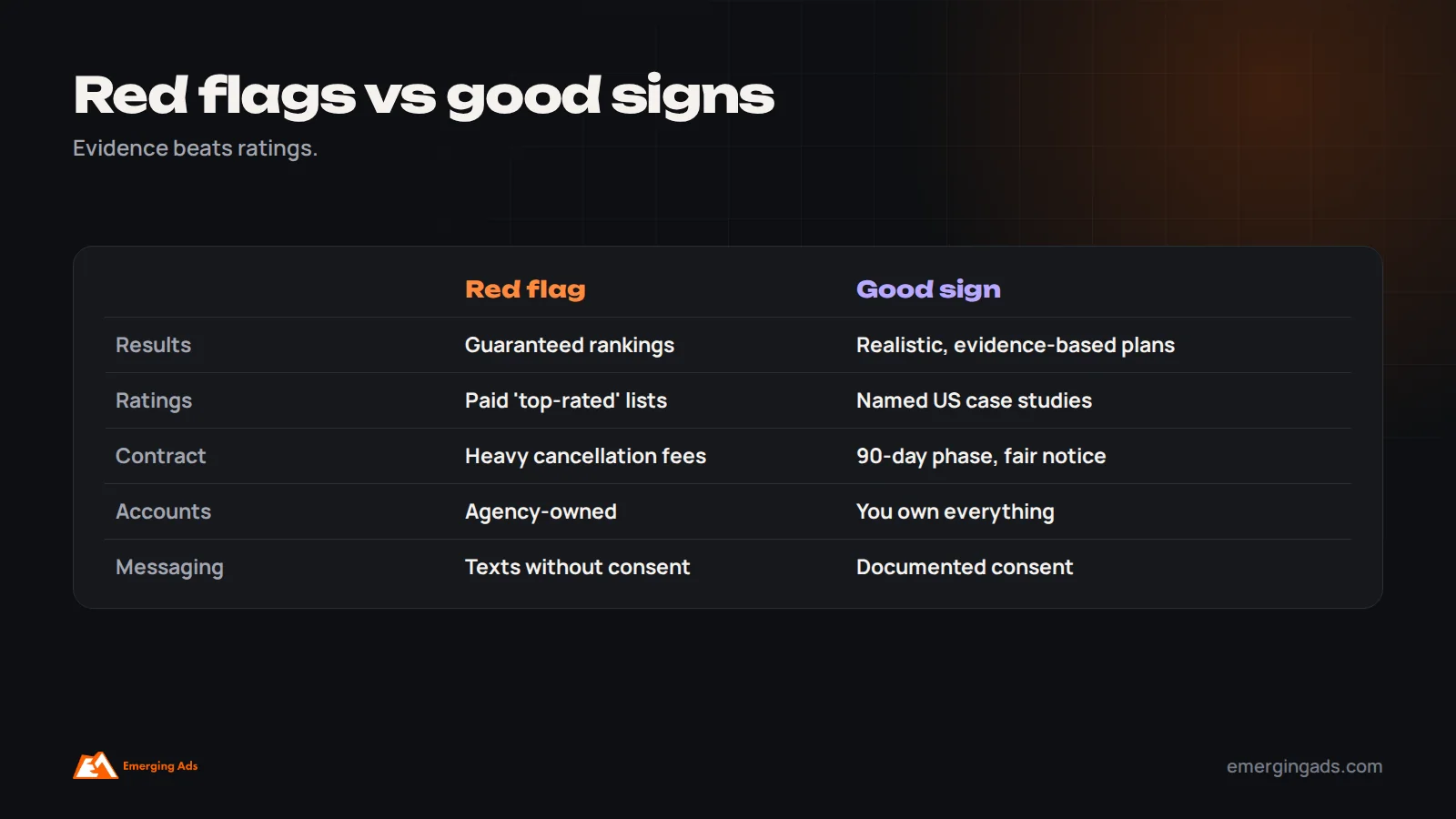
- Guaranteed first-page rankings or guaranteed returns.
- “Top-rated” claims based only on paid lists.
- Long contracts with heavy cancellation penalties.
- Agency-owned ad accounts, websites or domains.
- Vague deliverables and reports without business results.
- Hidden markups on ad spend.
- Texting or emailing your customers without proper consent.
What the first 90 days should look like
A good agency starts with an audit of your accounts, website, tracking and Google Business Profile, fixes tracking and foundations, then launches or restructures campaigns, tests creative and offers, and reviews results against your starting point. Paid media often shows meaningful changes within one to three months; SEO and content usually take several months.

For a broader decision framework, see our guide on how to choose a digital marketing agency. If you would like us to be one of the agencies you compare, our Google Ads, Meta ads, Amazon and SEO teams work with US businesses, and our free ad audit is a good place to start.
Frequently asked questions
How do I find the best digital marketing agency in the USA for my small business?
Shortlist agencies with named results for US small businesses like yours, strength in your key channels, knowledge of US marketing rules and transparent pricing, then compare proposals and start with a defined first phase.
How much does a US digital marketing agency cost for a small business?
It depends on services, scope, location and experience. Paid media is often priced as a percentage of ad spend with a minimum, and SEO, content and social as monthly retainers. Compare what each proposal includes.
Should I hire a local or national agency?
Local agencies suit businesses serving a specific area or needing in-person collaboration. National specialists suit online businesses or those needing deep expertise in a specific channel or industry.
What US rules affect digital marketing?
State privacy laws such as CCPA and CPRA, CAN-SPAM for email, TCPA and related rules for texting, FTC rules on endorsements and reviews, and industry-specific advertising restrictions.
Are agency ratings reliable?
They are a starting point, but named case studies with specific results for businesses like yours are much better evidence.
How long before I see results?
Paid media often shows meaningful changes within one to three months. SEO and content usually take several months.
Who should own my ad accounts?
Your business should own its ad accounts, analytics, website, domain and content, with the agency given access.
Is an offshore agency a good option?
It can be, if the agency has proven US results, strong communication and time zone overlap. Evaluate it on the same evidence as any other agency.