Best Online Course Marketing Platform Growth Strategy in 2026
Key Takeaways
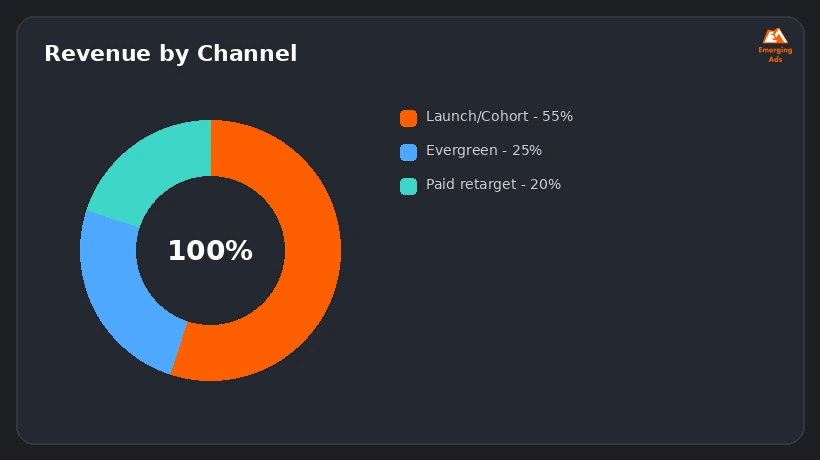
- Course platforms grow through a repeatable launch cadence, not constant evergreen selling, cohort and launch-based promotion still outperforms always-on funnels for most course creators
- Email remains the highest-converting channel for course sales, a warm list converts at multiples of cold paid traffic
- Free lead magnets (mini-courses, workshops, challenges) are the most reliable way to build the list that launches sell to
- Paid ads work best filling the top of a launch funnel, not as a direct-to-checkout channel for higher-priced courses
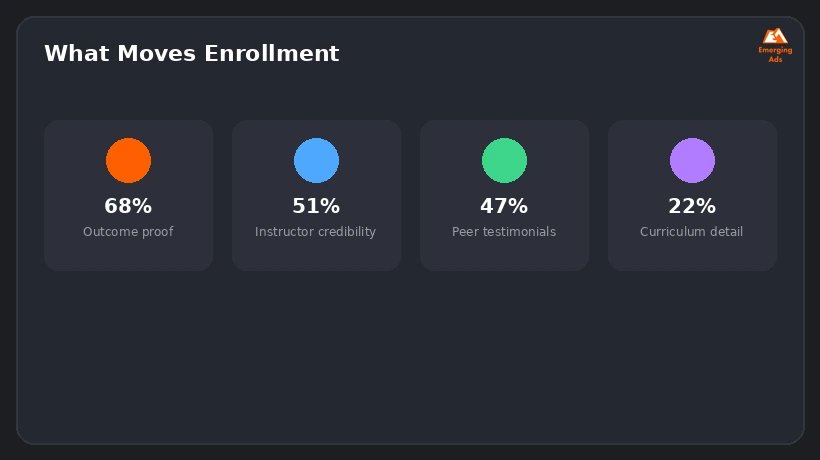
- Testimonials and outcome-based proof, not curriculum detail, are what actually move enrollment decisions
Why Course Growth Is a Launch Problem, Not Just an Ads Problem
The biggest misconception we see from course creators moving from organic growth to paid marketing is assuming the fix is simply “run more ads.” In practice, most course businesses grow through launches, concentrated periods of promotion around an open enrollment window, and ads work best as fuel for that launch, not as a standalone always-on funnel.
This matters because it changes where you should spend effort first. Before scaling ad spend, a course business needs three things in place: a warm email list to launch to, a proven sales sequence that converts that list, and clear evidence (testimonials, results, case studies) that the paid traffic funnel can lean on. Skipping straight to ads without these in place is the single most common reason course launches underperform.
The List-Building Engine Behind Every Successful Launch
Every high-performing course launch we’ve been part of was preceded by months of consistent, low-pressure list building. The goal isn’t to sell during this phase, it’s to earn attention and trust with free value that’s directly adjacent to the paid course topic.
Lead magnet formats that consistently convert to buyers
- A short, live or recorded workshop that solves one specific problem the course also solves, at a smaller scale
- A multi-day email challenge that delivers a quick, visible win
- A template, checklist, or worksheet tied directly to the course’s core transformation
- A quiz or assessment that segments the audience and personalizes the follow-up email sequence
Whichever format you choose, the lead magnet should feel like a genuine preview of how you teach, not a generic freebie. The email list built from a workshop attendee converts noticeably better at launch than a list built from a low-effort checklist download, because the workshop demonstrates teaching style and expertise directly.
Structuring a Launch Sequence That Converts
A well-structured launch sequence follows a predictable arc: build anticipation, deliver value that also builds desire, open the cart with urgency, and close with a clear final deadline.
| Phase | Duration | Primary Goal |
|---|---|---|
| Pre-launch | 1-2 weeks | Build anticipation, grow the list, tease the offer |
| Open cart | 5-7 days | Convert warm leads with proof, FAQs, bonuses |
| Urgency close | 48-72 hours | Final push, address objections, deadline reminders |
| Post-launch | 1-2 weeks | Onboard students, gather early testimonials for next launch |
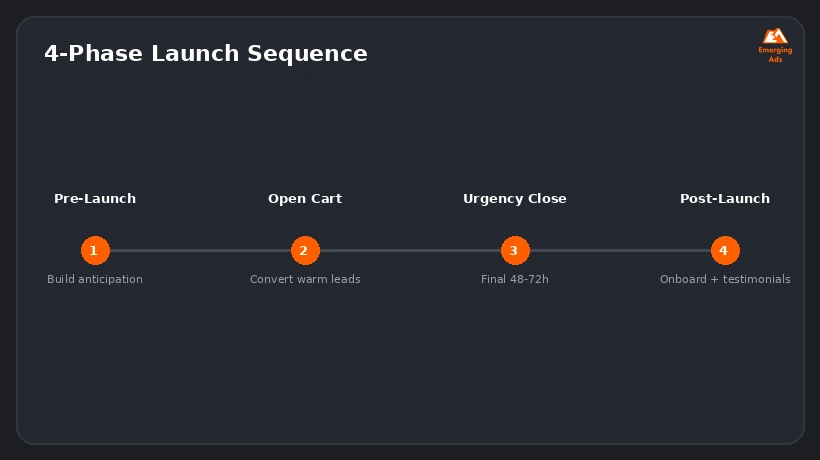
The open cart phase is where most of the actual revenue lands, but the pre-launch phase is what determines how big that revenue number is. Skipping or rushing pre-launch content is the most common reason a launch underperforms projections.
Where Paid Media Fits In
Paid ads are most effective in two specific spots in the course growth model: filling the top of the funnel with new lead-magnet signups between launches, and retargeting warm leads (webinar attendees, email openers, page visitors) during the open-cart window.
- Cold traffic to lead magnets: Meta and TikTok ads driving signups to a workshop or challenge, optimized for cost per qualified lead, not direct sales
- Retargeting during launch: showing testimonial and urgency-driven ads to warm audiences who’ve engaged but not yet enrolled
- Search ads for branded and high-intent terms: capturing people already searching for your course by name or close variants
Sending cold paid traffic straight to a checkout page for a mid-to-high-ticket course is one of the least efficient ways to spend a course marketing budget. The exception is very low-priced (under roughly $50) tripwire-style courses, where a direct-to-checkout funnel can work without the full nurture sequence.
Evergreen vs. Cohort: Choosing Your Growth Model
Course businesses tend to land on one of two growth models, and the choice affects nearly every marketing decision downstream:
| Model | Best For | Marketing Implication |
|---|---|---|
| Cohort/launch-based | Live components, community, higher price points | Concentrated promotion windows, urgency-driven |
| Evergreen | Self-paced, lower-touch, scalable | Always-on funnel, more reliant on consistent paid traffic |
Many course businesses actually run a hybrid: 2-4 launch windows a year for a flagship cohort course, with a smaller evergreen product available year-round to capture demand between launches. This hybrid model tends to produce steadier monthly revenue while still capturing the higher conversion rates that launch urgency creates.
Proof and Positioning: What Actually Sells a Course
Curriculum detail rarely closes a sale on its own. What moves the enrollment decision is proof that the transformation is real and achievable, specifically for someone in the buyer’s situation.
- Named, specific testimonials with a before/after result, not generic praise
- Instructor credibility signals relevant to the outcome, not just credentials in general
- A clear picture of who the course is and isn’t for, which builds trust more than a course positioned as being for everyone
- Social proof at scale where available (total students, completion rate, aggregate outcomes)
Retaining Students to Fuel the Next Launch
Growth marketing for course businesses often stops at the enrollment button, but the most sustainable growth loop actually starts after that point. A student who completes the course, gets a real result, and feels good about the experience becomes the raw material for the next launch’s testimonials, referrals, and often a next-tier course offer.
This means retention and completion rate deserve real marketing attention, not just instructional design attention. A course with a high completion rate produces a steady stream of fresh, specific testimonials every cohort, while a course with a low completion rate quietly starves future launches of the proof that drives new enrollment.
- Build a structured check-in sequence during the course, not just at the start and end, to catch students falling behind before they disengage entirely
- Create a simple, low-friction way for students to share wins as they happen (a community channel, a tagged social post prompt) rather than only collecting testimonials at the very end
- Follow up with non-completers specifically to understand why, this feedback is some of the most valuable input for improving the next cohort’s design and marketing
- Consider a referral incentive for graduates, a satisfied student’s referral typically converts at a meaningfully higher rate than a cold paid lead
Want us to look at your account?
We’ll audit your setup and tell you exactly where the budget is leaking, free.
Get Your Free Ad AuditFrequently Asked Questions
Should a new course creator start with paid ads or organic content?
Organic content and list building should come first for most new course creators. Paid ads work best once you have a warm list and a proven launch sequence to point that traffic toward, rather than as the very first growth channel.
How big does an email list need to be before launching a course?
There’s no strict minimum, but a list in the low thousands with genuine engagement typically produces a meaningful first launch. Quality and engagement of the list matters more than raw size.
What’s the difference between evergreen and cohort-based course marketing?
Cohort marketing concentrates promotion into launch windows with urgency and often a live component, while evergreen marketing runs an always-on funnel for a self-paced course, relying more heavily on consistent paid traffic.
How long should a course launch sequence run?
Most effective launches run a 1-2 week pre-launch phase, a 5-7 day open cart, and a 48-72 hour urgency close, for a total launch window of roughly 2-3 weeks.
Do paid ads work for high-ticket courses?
Yes, but rarely as a direct-to-checkout funnel. Paid ads work best filling the top of funnel with lead-magnet signups and retargeting warm audiences during the open-cart window, not selling cold traffic directly.
What kind of lead magnet converts best for course businesses?
A short live or recorded workshop that previews your teaching style and delivers a real, if smaller, win tends to convert to paid students better than a low-effort checklist or PDF download.
How many launches should a course business run per year?
Many successful course businesses run 2-4 flagship launches a year, sometimes paired with a smaller evergreen offer to capture demand in between.
What matters more for course sales, curriculum or testimonials?
Testimonials and outcome-based proof typically move the enrollment decision more than curriculum detail. Buyers want evidence the transformation is achievable for someone like them.
Should course creators use retargeting ads during a launch?
Yes, retargeting warm audiences (webinar attendees, email openers, page visitors) with testimonial and urgency-driven ads during the open-cart window is one of the highest-converting paid tactics in a course launch.
What platform should online course marketing run on?
The platform matters less than the sequence. Most course businesses combine email (for the launch sequence), Meta or TikTok ads (for list building and retargeting), and a course hosting platform with checkout and student delivery built in.
Ready to fix what’s costing you conversions?
Book a free, no-pressure audit of your ad account or website.
Get Your Free Ad Audit