
Best DTC Brand Storytelling Strategy in 2026

Key Takeaways
- In a crowded DTC category, product specs alone rarely differentiate, the brands winning attention in 2026 lead with a clear, specific origin or mission story
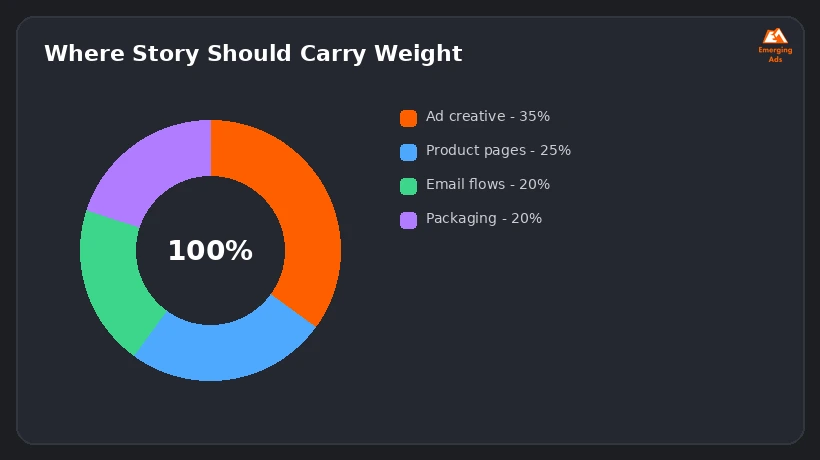
- Storytelling works best woven through every touchpoint, product pages, ads, packaging, email, not confined to a single About page nobody visits
- Founder-led content consistently outperforms polished brand-voice content on trust and engagement metrics for DTC brands under a certain scale
- A strong brand story should answer one clear question: why does this brand exist, and why should the customer care right now
- Story-driven ad creative typically holds attention longer than pure product-benefit creative, which directly improves paid media efficiency
Why Storytelling Matters More in a Crowded DTC Market
Most DTC categories in 2026 are saturated with functionally similar products competing almost entirely on price and paid media efficiency. In that environment, product features stop being a differentiator, because a competitor can usually match or claim the same features within a quarter. What’s much harder to copy is a specific, credible brand story.
Story does real commercial work, not just brand-building fluff. It gives a customer a reason to choose you over a near-identical alternative, it justifies a price point above the cheapest option in the category, and it gives paid media creative something more compelling to say than “buy now, 20% off.”
This matters even more once a category matures. In a brand-new product category, being first is enough of a story on its own, but most DTC categories in 2026 are well past that stage, with a handful of established players and a steady stream of new entrants all competing for the same customer attention. In that later stage, price competition alone tends to compress margins for everyone, while brands with a genuinely differentiated story retain more pricing power and, often, a more loyal, less price-sensitive customer base that’s harder for a competitor to poach with a discount alone.
Finding Your Brand’s Real Story
The most common mistake DTC brands make with storytelling is manufacturing a story that sounds good but isn’t specific or true, generic language about “passion” and “quality” that could describe any competitor. The strongest brand stories answer a genuinely specific question.
Questions worth answering honestly before writing any brand copy
- What specific problem or frustration led to this product existing, told with real detail, not a vague origin myth
- What would be lost if this brand disappeared tomorrow, what does it actually stand for that a competitor doesn’t
- Who is this brand explicitly not for, clarity here sharpens the story more than trying to appeal to everyone
- What’s one uncomfortable or unconventional truth about your industry your brand is willing to say out loud
A story built from honest, specific answers to these questions is far harder for a competitor to replicate than a story built from category-standard brand language.
Where Story Should Show Up Across the Customer Journey
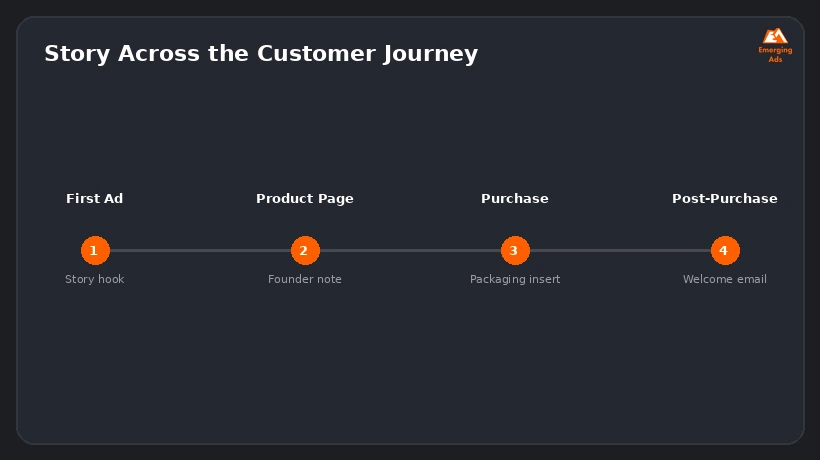
Storytelling shouldn’t live only on an About page most visitors never see. The brands that use story most effectively weave it into nearly every touchpoint, in doses appropriate to that moment.
| Touchpoint | How Story Shows Up |
|---|---|
| Product pages | A short founder note or origin detail near the product description, not a separate page |
| Paid ad creative | Story-driven hooks in the first 3 seconds, before the product pitch |
| Packaging & unboxing | A card or insert reinforcing the mission or origin, reinforcing the story post-purchase |
| Email flows | Welcome series told partly through founder or brand story, not just discount codes |
Turning Story Into Ad Creative That Performs
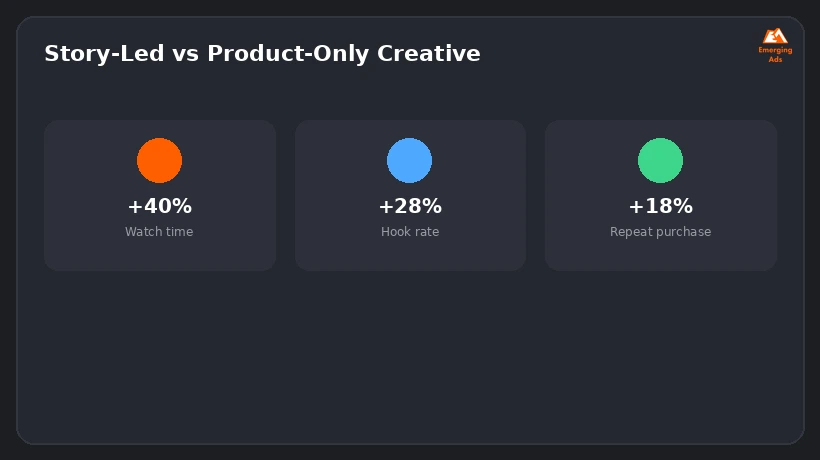
Story-driven ad creative isn’t just a brand-building nicety, it has a measurable performance benefit: content that opens with a genuine narrative hook typically holds attention longer than content that opens with a direct product pitch, and watch time is a strong input into paid media algorithms’ delivery efficiency.
- Open with the problem or moment that sparked the brand, not the product itself, in the first few seconds
- Use a real person (founder, team member, genuine customer) rather than pure text-on-screen or stock-style visuals
- Land on the product and offer only after the story hook has earned attention, not before
- Test story-led creative against pure product-benefit creative on the same audience to quantify the lift for your specific brand
Founder-Led Content: When and How to Use It
For DTC brands still under a certain revenue scale, founder-led content, the founder speaking directly to camera or writing in their own voice, tends to build trust and engagement faster than polished, agency-produced brand content. It reads as more credible precisely because it’s less polished.
This has diminishing returns as a brand scales and the founder becomes less of a daily, visible presence, at which point brands typically shift toward a broader cast of team members and customers carrying the story instead of relying solely on one person. Planning for that transition early, rather than building a brand entirely dependent on one founder’s presence, avoids a difficult pivot later.
Keeping the Story Consistent as the Brand Scales
As a DTC brand grows, more people touch the brand voice, new hires writing ad copy, a growing customer service team, freelance content creators, and without a clear reference point, the story that once felt sharp and specific tends to drift into generic category language over time.
The fix isn’t more oversight on every piece of content, it’s a short, living brand story document, not a rigid style guide, that captures the core narrative, the specific language and phrases that carry it well, and a few examples of what “on-story” versus “off-story” content actually looks like. Anyone writing customer-facing copy should be able to reference it in under five minutes.
- Keep the core story document short, one page is usually enough, longer documents get skimmed once and ignored afterward
- Include a few real examples of ad copy, product descriptions, or social captions that nail the story, alongside one or two that miss it and why
- Revisit the document quarterly, not to rewrite the core story, but to check whether recent content has quietly drifted from it
- Give new team members and freelancers the document before their first piece of content, not after a first draft needs correcting
Measuring Whether Storytelling Is Actually Working
Storytelling can feel soft to measure, but there are concrete signals worth tracking rather than treating brand narrative as unmeasurable.
- Watch time and hook rate on story-led versus product-led ad creative, a direct performance comparison
- Branded search volume growth over time, a strong signal that story-driven content is building recall beyond paid reach
- Repeat purchase and email engagement rates among customers acquired through story-driven versus discount-driven campaigns
- Qualitative signals: comments, DMs, and reviews that reference the brand’s mission or story specifically, not just the product
Want us to look at your account?
We’ll audit your setup and tell you exactly where the budget is leaking, free.
Get Your Free Ad AuditFrequently Asked Questions
Does brand storytelling actually improve DTC sales, or is it just branding?
It does measurable commercial work: story-driven ad creative typically holds attention longer than pure product-pitch creative, which improves paid media efficiency, and it also supports pricing power and repeat purchase behavior over time.
Where should a DTC brand’s story appear beyond the About page?
Across product pages, ad creative, packaging inserts, and email flows, in doses appropriate to each touchpoint, rather than confined to a single page most visitors never see.
Should founders appear on camera for DTC brand content?
For earlier-stage DTC brands, founder-led content often builds trust faster than polished, agency-style content, since it reads as more authentic. This becomes less central as the brand scales.
How do you find a genuine brand story instead of a generic one?
Start from specific, honest questions: what real problem led to the product, what would be lost if the brand disappeared, and who the brand is explicitly not for. Specificity is what makes a story hard for competitors to copy.
Does storytelling help with paid ad performance?
Yes, ads that open with a genuine story hook before the product pitch tend to hold attention longer, which is a strong input into how efficiently ad platforms deliver that creative.
How do you measure the ROI of brand storytelling?
Track watch time and hook rate on story-led versus product-led creative, branded search volume growth, and repeat purchase or email engagement among customers acquired through story-driven campaigns.
Is founder-led content sustainable long-term for a growing DTC brand?
Not indefinitely as the sole voice. Brands typically transition toward a broader cast, team members and real customers, as they scale beyond what one founder’s presence can sustain.
What’s the biggest mistake DTC brands make with storytelling?
Manufacturing a generic-sounding story using category-standard language about passion and quality, rather than answering specific, honest questions that produce a story a competitor can’t easily replicate.
Should storytelling replace performance-focused ad creative entirely?
No, the strongest approach tests story-led creative against pure product-benefit creative on the same audience, then uses whichever performs better, or blends both depending on funnel stage.
How often should a DTC brand refresh its core story?
The core story (why the brand exists) should stay fairly stable, but the way it’s told, specific proof points, seasonal framing, creative formats, should evolve regularly to avoid creative fatigue.
Ready to fix what’s costing you conversions?
Book a free, no-pressure audit of your ad account or website.
Get Your Free Ad Audit