Best E-commerce SEO Agency: What to Actually Look For
Key Takeaways
- “Near me” barely matters for SEO agency selection anymore, most good e-commerce SEO teams work remotely across time zones.
- The agencies worth hiring lead with a technical audit before they pitch you a retainer, not after.
- Ask how they handle faceted navigation and duplicate product URLs, that single question filters out most resellers.
- Reporting should tie to revenue and assisted conversions, not just keyword rank screenshots.
- A 90-day pilot with clear deliverables beats a 12-month contract with vague promises.
Why “Near Me” Isn’t the Filter It Used to Be
Ten years ago, hiring a local SEO agency made sense because SEO work often meant meeting in person and coordinating with an in-house developer down the hall. That’s not how e-commerce SEO works anymore. Your store runs on Shopify, WooCommerce, or a headless setup, your team is on Slack, and the agency doing your technical crawls doesn’t need to be in your city, it needs to understand faceted navigation, canonical tags, and how Google treats out-of-stock product pages.
What actually matters is whether the agency has shipped results for stores with a similar catalog size and platform to yours. A team that’s only ever worked with 50-SKU boutique brands is going to struggle with a 20,000-SKU marketplace, and vice versa.
What a Real E-commerce SEO Agency Does Differently
They Start With a Crawl, Not a Sales Deck
Before any agency worth hiring talks pricing, they should be able to tell you something specific about your site: how many product pages are indexed versus how many exist, whether your category pages are cannibalizing each other, and where your Core Web Vitals stand on mobile. If the first call is entirely about their process and case studies with no mention of your site, that’s a sales-led shop, not an SEO-led one.
They Separate Technical, On-Page, and Content Work
E-commerce SEO breaks into three distinct workstreams: technical health (crawl budget, indexation, site speed, structured data), on-page optimization (title tags, product descriptions, internal linking between category and product pages), and content (buying guides, comparison pages, and the blog content that captures top-of-funnel search intent). A good agency scopes and prices these separately instead of bundling everything into one vague “SEO retainer.”
- Technical audits covering crawlability, indexation, canonicalization, and page speed
- Category and product page templates optimized for both users and search intent
- Structured data (Product, Review, BreadcrumbList schema) implemented correctly, not just pasted in
- A content plan built around actual keyword gaps, not generic blog topics
- Internal linking that connects blog content to the commercial pages it should support
Red Flags We See Constantly
Some patterns show up again and again when we audit accounts that came from a previous agency:
- Keyword rank tracking is the only metric in the monthly report, with no mention of organic traffic, conversions, or revenue
- The agency can’t explain why specific pages were built or which keyword each one targets
- Backlinks were built at volume with no regard for relevance, this is the kind of link profile that eventually needs a disavow file
- Duplicate content across product variants was never addressed, so Google is indexing near-identical pages and diluting authority
- There’s no mention of Core Web Vitals or mobile page speed anywhere in past reporting
Questions to Ask Before You Sign
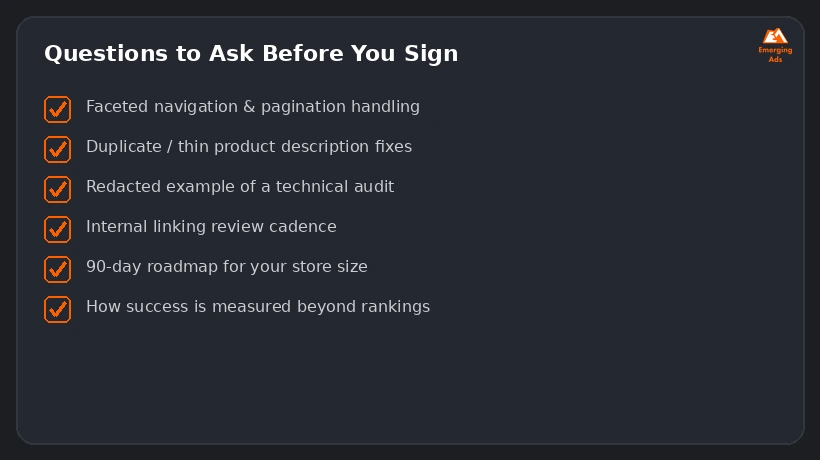
These are the questions that separate a genuine e-commerce SEO partner from a reseller running a templated process:
- How do you handle pagination and faceted navigation on category pages?
- What’s your process for identifying and fixing duplicate or thin product descriptions?
- Can you show me an example of a technical audit you’ve delivered, with names redacted?
- How do you decide which pages get internal links, and how often is that revisited?
- What does a 90-day roadmap look like for a store our size?
- How do you measure success beyond keyword rankings?
A team that answers these specifically, with real examples, is worth a conversation. A team that answers in generalities about “proven strategies” is not.
What to Expect in the First 90 Days
The first month is almost entirely audit and prioritization: crawling the site, fixing the technical issues blocking indexation, and mapping which category and product pages have the most revenue potential relative to their current rankings. Months two and three should show the first wave of on-page fixes going live, along with the start of a content calendar that targets keyword gaps competitors are winning.
You shouldn’t expect a dramatic traffic spike in 90 days, organic growth on an established domain moves in a curve, not a cliff. What you should see is a clear list of what changed, why, and what’s queued next.
Want us to look at your account?
We’ll audit your setup and tell you exactly where the budget is leaking, free.
Get Your Free Ad AuditFrequently Asked Questions
Does hiring a local SEO agency actually help my rankings?
No, Google doesn’t rank your store higher because your agency is in the same city. What matters is whether the agency understands your platform, catalog structure, and the technical issues specific to e-commerce.
How much does e-commerce SEO cost?
Retainers for established e-commerce SEO work typically scale with catalog size and competitiveness of the niche, ranging from a few thousand dollars a month for a smaller store to well into five figures for large, competitive catalogs. Get a scoped proposal rather than a flat rate quoted before an audit.
How long before e-commerce SEO shows results?
Most stores start seeing measurable movement in rankings and organic traffic within three to six months, with compounding growth after that. Highly competitive niches take longer.
Should I use the same agency for SEO and paid ads?
Not necessarily, but the two should coordinate closely. Paid search data on which keywords convert is genuinely useful for prioritizing SEO content, so at minimum your SEO and PPC teams need to share reporting access.
What’s the difference between category page SEO and product page SEO?
Category pages typically target broader, higher-volume commercial keywords and need unique intro copy plus solid internal linking. Product pages target long-tail, high-intent searches and need unique descriptions, structured data, and fast load times.
Can SEO work alongside a Shopify or WooCommerce theme without a rebuild?
In most cases yes. Technical SEO fixes rarely require a full rebuild, they’re usually template edits, app installations, or backend configuration changes.
How do I know if my product pages have duplicate content issues?
Run a site crawl and compare product descriptions across variants (size, color) and against manufacturer-supplied copy. If descriptions are copy-pasted from a supplier feed, you likely have duplicate content competing with hundreds of other retailers.
Is blog content actually worth it for an online store?
Yes, when it’s built around commercial and informational keywords your customers actually search, and when it links back into category and product pages. Blog content with no internal linking strategy rarely moves the needle.
What reporting should I expect monthly?
At minimum: organic traffic and conversion trends, keyword ranking movement for priority terms, technical issues found and fixed, and a summary of content or on-page work shipped that month.
How do I fire an underperforming SEO agency without losing progress?
Request full documentation of all work completed, admin access to your analytics and search console, and a clean handoff of any content in progress before ending the contract. A reputable agency will provide this without friction.
Ready to fix what’s costing you conversions?
Book a free, no-pressure audit of your ad account or website.
Get Your Free Ad Audit