What Is YouTube Ads and Why Does It Matter in 2026
Key Takeaways
- YouTube Ads now spans five distinct formats, and picking the wrong one for your goal is the single biggest waste of budget we see.
- Shorts ads have quietly become the cheapest way to build reach on the platform in 2026.
- Skippable in-stream still wins for consideration and remarketing, non-skip and bumper are reach plays, not conversion plays.
- Audience targeting matters more than creative polish for most first campaigns.
- YouTube Ads shares infrastructure with Google Ads, so your Search and Display data can seed Video campaigns from day one.
What YouTube Ads Actually Is
YouTube Ads is Google’s video advertising product, bought and managed through the same Google Ads interface as Search and Display. That matters more than it sounds: it means your existing conversion tracking, audience lists, and even your Search campaign performance data can all feed into a Video campaign without rebuilding anything from scratch.
It is not one product. It is five different ad formats bundled under one name, each with a different job, a different pricing model, and a different place in the funnel.
The Five Ad Formats and When to Use Each
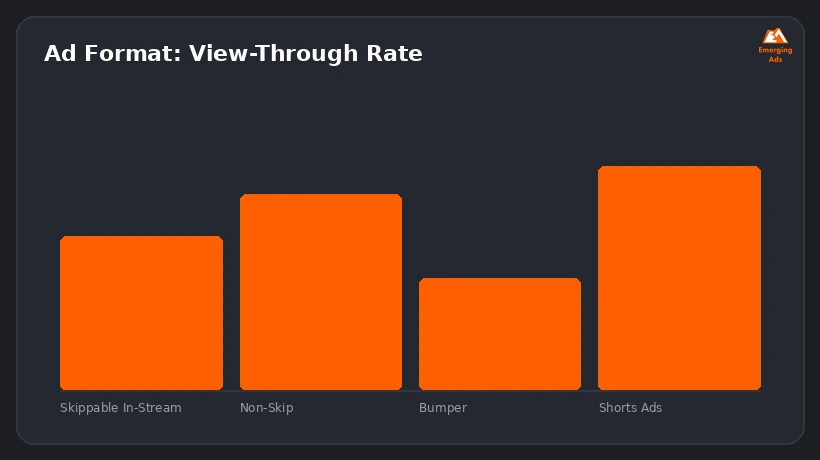
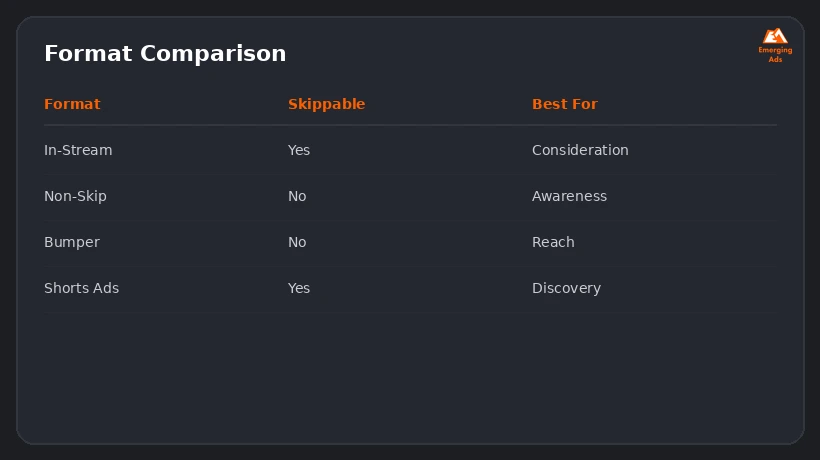
- Skippable in-stream: plays before, during, or after another video, skippable after 5 seconds, you pay only if someone watches 30 seconds or interacts. Best for consideration and remarketing.
- Non-skippable in-stream: 15-20 seconds, can’t be skipped, priced on impressions. Best for pure reach and awareness.
- Bumper ads: 6 seconds, non-skippable, cheap per impression. Best for reinforcing a message someone already saw elsewhere.
- In-feed video ads: show up in search results and the homepage feed as a thumbnail, click to watch. Best for capturing intent-driven browsing.
- Shorts ads: appear between Shorts, vertical, fast, and in 2026 carrying some of the lowest cost-per-view inventory on the platform.
Why It Matters More in 2026 Than It Did a Few Years Ago
Two things changed. First, watch behavior kept shifting toward short-form and mobile, and Shorts inventory has scaled to the point where it’s a legitimate reach channel, not a side experiment. Second, connected TV viewing on YouTube through smart TVs now sits alongside a huge share of mobile viewing, which means YouTube Ads can realistically reach both a scrolling audience and a living-room audience from the same campaign.
It Also Reads AI Overviews Differently
Video content, especially explainer-style content with clear spoken claims, is increasingly what gets pulled into AI-generated search summaries. A YouTube video with a clear, well-structured answer in the first 15 seconds has a real shot at being the source an AI Overview cites, which is a newer reason to invest in video beyond the ad platform itself.
Targeting: Where Most Budget Gets Wasted
The most common mistake we see is running a broad “in-market” audience on a skippable in-stream campaign with no remarketing list behind it. That’s paying full prospecting price for an audience that has no prior signal about your brand.
Start with your warmest audiences: website visitors, customer lists, and engaged YouTube channel viewers if you have any. Layer in-market and custom intent audiences on top once you know your baseline cost per result from a warm audience.
Getting Your First Campaign Off the Ground
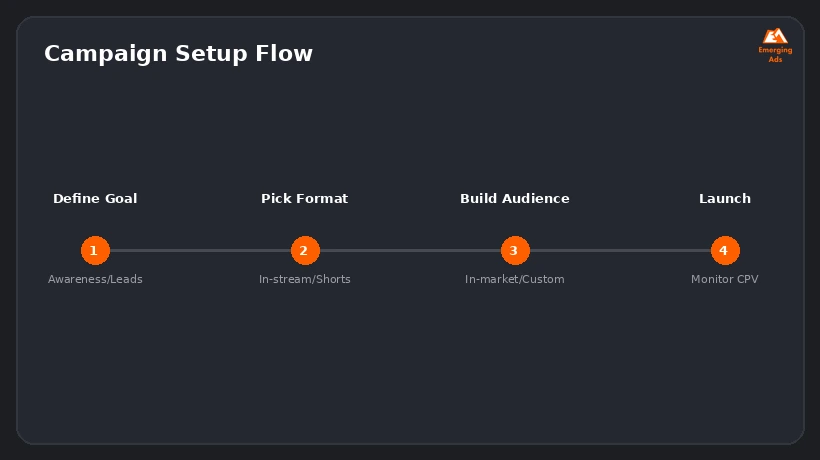
Define the goal before the format. Awareness campaigns should lean on bumper and non-skip for reach efficiency. Consideration and lead-gen campaigns should lean on skippable in-stream and in-feed, paired with remarketing. Shorts ads work for both, cheaply, if your creative is genuinely built for vertical viewing rather than a resized horizontal ad.
Want us to look at your account?
We’ll audit your setup and tell you exactly where the budget is leaking, free.
Get Your Free Ad AuditFrequently Asked Questions
Is YouTube Ads the same as Google Ads?
YouTube Ads is a campaign type inside Google Ads, run through the same account, billing, and much of the same targeting and conversion tracking infrastructure as Search and Display.
What’s the minimum budget to test YouTube Ads?
There’s no official minimum, but you need enough spend to generate a few thousand impressions across a week or two to read format and audience performance reliably.
Do I need professionally produced video to run YouTube Ads?
No, especially for Shorts ads, where native-feeling, lower-production vertical video often outperforms polished horizontal ads that feel out of place in the format.
How is YouTube Ads priced?
It varies by format: skippable in-stream is typically CPV (cost per view/engagement), non-skip and bumper are priced on impressions (CPM), and Shorts ads are increasingly sold on a CPM basis too.
Can YouTube Ads work for lead generation, not just awareness?
Yes, paired with strong remarketing audiences and a clear in-video or end-card call to action, skippable in-stream and in-feed formats can drive meaningful lead volume.
What length should my video ad be?
Skippable in-stream should hook viewers in the first 5 seconds before the skip button appears; bumper ads are fixed at 6 seconds; Shorts ads generally perform best under 15-30 seconds.
Should I run the same creative on Shorts and in-stream?
Not without editing. Shorts needs vertical framing and faster pacing; a horizontal ad resized into a vertical frame usually underperforms a native-format edit.
How does YouTube Ads targeting differ from Meta?
YouTube leans more heavily on search and viewing intent signals (in-market, custom intent, content targeting) alongside standard demographic and remarketing options, rather than primarily social engagement signals.
Can I exclude specific channels or content types?
Yes, content exclusions let you avoid running ads against specific channels, videos, or content categories, useful for brand safety.
How soon will I see results from a YouTube Ads campaign?
Enough data to make real optimization decisions usually takes one to two weeks of consistent spend, longer for lower-volume niche audiences.
Ready to fix what’s costing you conversions?
Book a free, no-pressure audit of your ad account or website.
Get Your Free Ad Audit